How to Produce Tourist Dollars with Your Town's Destination Attractions: What Works, What Doesn't
PLUS
Case Study of the Variously Named Coralville Rain Forest, Earthpark, Iowa Child, The Iowa Child Foundation's Iowa Environmental Project -- and (by critics) "Iowa's Rain Forest in a Cornfield"
PLUS
Report on Other Communities' Attempts with Attractions
A 2021 Introduction: The material in, and linked from, this Web page was my response, primarily between 2004 and 2006, to the proposal of a couple of Iowans (Ted Townsend and David Oman -- and Senator Chuck Grassley) to build an indoor rainforest in Iowa.
Although inspired by "the Eden Project" in England's Cornwall region, pictured above, their effort to duplicate it in Iowa struck me as bonkers for many reasons -- not the least of which was their inability to create the public and charity buy-in Eden received. Those additional reasons are detailed in what follows.
But there is much more here. An analysis of the rain forest in a corn field project led me into the economic literature and news coverage of the hopes of other communities and states that their idea of a destination attraction would surely succeed where others had failed.
From that initial curiosity came what is now titled, "How to Produce Tourist Dollars with Your Town's Destination Attractions: What Works, What Doesn't" -- along with a "table of contents" to ease your passage through what would be at least a 250-page book if printed. May your reading through it contribute to increasing your attraction's contribution to the residents of your community while maintaining its financial viability.
Nicholas Johnson, Iowa City, Iowa, October 6, 2021
Note: In 2021 the underlying computer code in this material was reviewed and tweaked by me, and my computer consultant-son, Gregory Johnson, but noeffort has been made to "update" or "rewrite" the text.)
# # #
Contents
The following links go to the major section headings in the document.
(as of Oct. 2006 an unfunded, $150-200 million indoor rain forest project proposed for Pella, Iowa)
formerly unsuccessfully pitched to Iowa towns: Cedar Rapids, Coralville, Des Moines, Dubuque, Grinnell, Iowa City, Riverside, and Tiffin and prior to May 17, 2006, having been known under a variety of names, such as . . .
So far as is known, this site contains the most complete collection anywhere on the Web of links to the full text of news stories and other reports, data and opinions regarding the proposed Iowa indoor rain forest -- with emphasis on material since January 2004. (Printed, it would more than 100 single-spaced pages -- plus the items to which it links.)
It represents the work of one, unpaid volunteer: Nicholas Johnson. Johnson, and this Web site, are in no way affiliated with either the rain forest or any group opposed to the project. Characterizing himself as "neither booster nor basher," Johnson believes that public officials, journalists, and citizens/taxpayers need access to as much solid information about this project -- pro and con -- as possible. While the price tag has fluctuated over the years between $300 and $155 million, whatever the construction, overruns, start up and operating costs might finally total, the magnitude of the potential risks and rewards are enormous, the unanswered questions seemingly unending.
Given that this is not a commercial Web site, and given the sheer volume of material, Johnson acknowledges that the site has "grown like Topsy" into a resource that is not always optimally user friendly. Moreover, the organization of material changed around December 2005, following which the entries have been made in the form of weekly, Monday morning updates, chronologically arranged. But with time, patience, and use of internal links and a Web browser's "Find" or "Search" feature (usually in the drop-down "Edit" menu) almost anything you may be looking for can be found.
Where are we? Like a dessert that's "all frosting and no cake" the public relations glitz and glamour have been well done, but the underlying problems, and unanswered questions, remain very much as they have been during the ten years since the idea was born.
The problems and questions are dealt with in Johnson's many published and other commentaries about the project, and throughout his commentary on, and material linked from, this Web site. (As but one of many examples, see Nicholas Johnson, "Time to Learn From What Works," for an explanation of what has been successful in Iowa (and elsewhere) and why the rain forest project comes up short by those standards.) The issues are sufficiently numerous and detailed that they can only be illustrated and hinted at in this executive summary, rather than adequately summarized. Here are three:
1. "There's no 'there' there"/Lack of Focus/Absence of Basic Business Plans/Shifting Generalizations and No Details. The project promoters' May 17, 2006, announced changes in name, architectural design, and Web site are only the most current example.
2. Inability to raise capital. Ten years later (at least prior to August 2006, and possibly thereafter) the project has banked no more than the $10 million promised by the project's creator, Ted Townsend. The $50 million federal grant is now contingent upon a $50 million match. Not a dime of local money was ever offered by individuals in the previous possible locations that ultimately rejected the project: Des Moines, Cedar Rapids, Iowa City and Coralville -- more recently joined by Dubuque, Grinnell and Tiffin. (The only two remaining sites as of August 2006 are Pella and Riverside, Iowa.)
3. Revenue streams. Even more serious than the lack of construction funds would be the risks of inadequate operating revenue if the thing ever was built -- with the subsequent need for public bailouts and subsidies. Without focus there can't be details, without details there can't be business plans, and without business plans it's impossible to evaluate projected revenue streams. (a) Many independent economists believe promoters' projections of 1.3 million annual visitors to the project as a tourist attraction (and certainly numbers like that after the first year or two) to be wildly optimistic. (Most Iowa quasi-educational attractions pull in the 30,000-to-100,000 range. Dubuque's National Mississippi River Museum and Aquarium attracts 250,000.) (b) If it is to be, instead, a teacher-training facility, or school -- as promoters have indicated from time to time -- it would need financial support from federal, state or local education budgets, all of which are now stretched thin. And (c) as a research center it would need a stable, continuous flow of grants from federal agencies, corporations or foundations -- also now nowhere in sight.
There is much more to be said about these concerns, and many more issues as well, in the material available through this Web site. In short, for the most part the concerns -- at least those of Johnson -- (a) do not relate to the quality of the architects or contractors. (b) Nor, notwithstanding the national ridicule the project has received, do they spring from a conclusion that there is nothing useful anyone could even imagine doing inside the kinds of structures the project's various architects have designed over the years. (c) The concerns are, rather, the three itemized above plus such things as stonewalling and lack of transparency, process and lack of public participation, and the failure to apply and make public the results from even the most basic kind of independent project evaluation and analysis that would be utilized by venture capitalists or taught as "Management 101."
-- N.J., May 18, 2006; revised August 14, 2006
[What follows was added during the fall of 2005]
The dramatic announcement October 9, 2005, that the $50 million of federal taxpayers' money would someday come to an end has created such a flood of news and commentary that a new sub-section has been created below for it: "From "$50 million will not disappear" to "It's Gone!" -- in less than two weeks." So (as of November 28) the project that refuses to die -- notwithstanding turndowns over the years from Des Moines, Cedar Rapids, Iowa City, and soon to be Coralville -- is returning to its old strategy of playing off one city against another. It's borrowing a line from Willie Nelson; it's "on the road again."
Since then this site has been continuing the sub-section, reporting the news week by week through the first quarter of 2006, by which time the project's promoters promise to have made their ultimate site selection:
Ted Townsend, generous Iowa benefactor of, among other things, the Iowa Primate Learning Sanctuary has been promoting the idea of an Iowa rain forest project since 1996 through something called the Iowa Child Institute of the Iowa Child Foundation.
The background of the rain forest's project's Executive Director, David Oman, was very positively described by the Iowa City Press-Citizen in announcing his appointment. Brian Sharp, "Iowa Child Ushers in New Leader: Oman to be Named Group's CEO Today, Press-Citizen, April 10, 2001 (apparently no longer available online as of July 2005). The Iowa Child Web site describes him as "Former telecommunications executive and Iowa gubernatorial candidate, Oman is the only Iowan to have served as Chief of Staff for two governors. Committed to improving the environment, Oman served as chairman of the Iowa Natural Heritage Foundation."
Sharp has also written a piece about the project's Iowa City representative, and IEEP Vice President, Nancy Quellhorst. Brian Sharp, "Rain Forest Starts Staffing Local Office,"Iowa City Press Citizen, April 6, 2004. (In the May 2005 revision of the Iowa Child Web site Ms. Quellhorst is identified as the project's "Chief Operating Officer.")
Over the years since 1996 the rainforest was offered to, but not accepted by, Des Moines, Cedar Rapids and Iowa City. However, by early 2004 the project had received a $50 million grant from the federal government (thanks to Iowa's U.S. Senator and Finance Committee Chair, Chuck Grassley) and the support of the Coralville, Iowa, City Council. Ground breaking was scheduled for the fall of 2004, and repeatedly postponed, since only $90 million (of the currently projected $180 million construction cost) was known to be on hand in the spring of 2004 [or by January 2005, at which time the groundbreaking was scheduled for some time in 2005. By January 2006 any groundbreaking, ever, in Coralville seemed highly unlikely.]
The Web site you are now looking at was created, and is maintained, by Nicholas Johnson and has no connection with the Iowa Child Foundation.
During the period from February 2004 to July 2005 (and beyond) this site has expanded somewhat beyond its original narrow focus on the Coralville project. A full and fair evaluation of a proposed indoor rain forest in Iowa requires that it be seen in perspective. What are the qualities of comparable attractions that cause them to close -- or to prosper? "What works?" And so you will now find descriptions and discussions on this page, and in linked material, of Colonial Williamsburg, Omaha's Henry Doorly Zoo, and Dubuque's Mississippi River Museum -- among a great many other references. Central to this analysis is the look at the accuracy of early forecasts of attendance at such facilities. (It turns out that the enthusiastic promoters, and their hired professional forecasters, are often grossly overly optimistic.)
This Web site is also both an archive, and an evolving, real-time case study of the efforts of a small group of promoters to sell both their community and their potential backers a vision on the grand scale. As such, whatever may happen to this particular project, hopefully the story told by this site will continue to be a useful body of material for communities elsewhere as well as educators who wish to explore how one community, at one time, went through this evaluative process.
But the central purpose and theme running throughout the site, and the linked material, is the effort to fairly evaluate the Coralville rain forest proposal. Neither booster nor basher, this site is offered in the belief the public, their elected officials, and media have an enormous stake in, and responsibility for, the project however it may come out. It is essential for all to have access to as much factual information as possible, along with the range of opinion the project has generated.
As a result, this site is not so much a narrative text as it is an annotated bibliography. While its nearly 100 pages (if printed) can be "read" as it is, most of the data and opinion of relevance to any citizen's evaluation of this project is to be found in the material to which this site links, rather than in the text on this site as such. Moreover, users should be aware that the linked material is copyright. It is made available here as a non-commercial "fair use" for educational purposes only. Other uses may require the permission of the copyright owner.
-- N.J., February 16, 2004, July 11, 2005, January 2, 2006; and see below for . . .
"KUD-Rain Forest 'Understanding' Retains, Creates Questions," July 8, 2005 (on July 7the Gazette and Iowa City Press-Citizen reported that a $5.5 million memorandum of understanding had been signed by the rain forest promoters and KUD. Nicholas Johnson reviews the terms of the understanding, and notes that most-to-all of the previously unanswered questions regarding the project remain).
"What Works: Colonial Williamsburg and Coralville's Rain Forest," June 29, 2005 (like "Coralville Project Can't Match Up to Omaha's Zoo," above, this piece describes, compares and evaluates the strengths, actual and promised attendance of Colonial Williamsburg and the Coralville rain forest project).
"Rain Forest Hires Rain Man; A Commentary on Rain Forest Project's Negotiation with KUD," June 23, 2005 (the Gazette and the Iowa City Press-Citizen reported on June 23 that the rain forest project was negotiating with John Best of KUD to take over consulting responsibilities for fund raising, design and construction of the project. This is Nicholas Johnson's commentary regarding that development with the provision of links to the articles, Iowa Pork Forest blog site entry, and the consulting firms' Web sites).
"Public Finance and the Coralville Rain Forest," June 22, 2005 (Nicholas Johnson was the guest of host Gayane Torosyan on WSUI-AM, Iowa City, Talk of Iowa, June 22, 2005. This is a transcript of Part 1 of 2 from that guest appearance. The subject was the process and propriety of public financing of for-profit and non-profit projects. Part 1 used the proposed Coralville rain forest as a case study. (Part 2 dealt with the public funding of public broadcasting.) Recorded June 22, transcribed June 23, and uploaded June 24, 2005.
One of Nicholas Johnson's most detailed early reviews of the rain forest project's remaining range of issues, with supporting endnotes, is "The Coralville Rain Forest: A Brief Overview of Remaining Issues," added to this site April 9, 2004 (and most recently revised April 24, 2004).
His personal notes to himself prior to the Iowa City Press-Citizen's public forum March 22, 2004, are titled "Rain Forest Issues and Concerns."
"Iowa Child: Question About Questions," WSUI-AM "Talk of Iowa," January 26, 2004 (an exchange with the project's chief administrator, David Oman).
"More Needed on Iowa Child," Iowa City Press-Citizen, February 13, 2001.
"Whose Child is This?" January 22, 2001 (remarks at an Iowa City forum about the project).
One of his first efforts at exploring the range of issues (some of which have since been modified by the promoters' revision of plans) is "Iowa Child' Concerns," January 22, 2001.
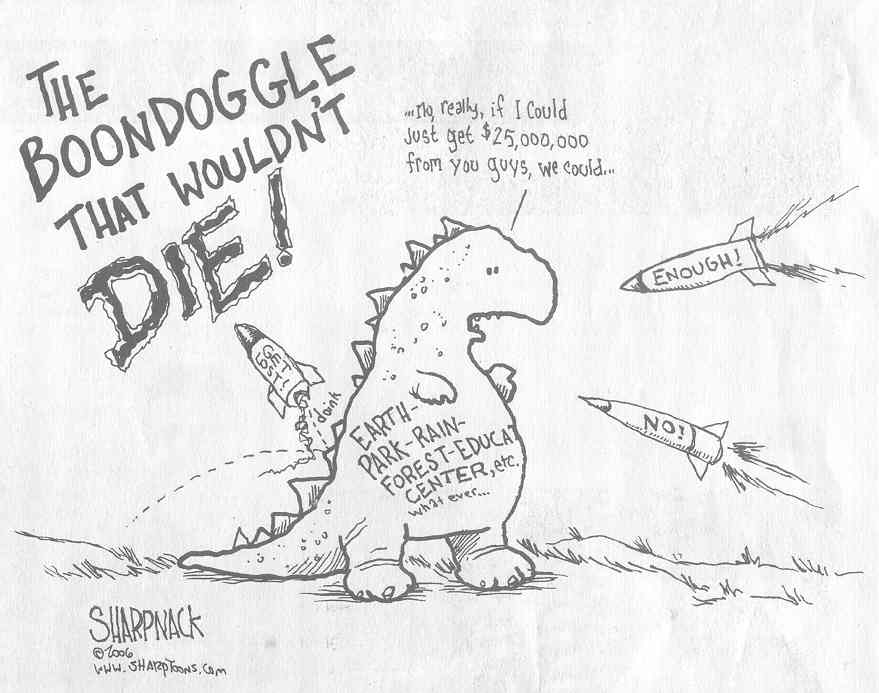
Nine years after this project began, its backers had yet to settle upon a name. Originally "The Iowa Child Project" (still the name of its official foundation and the project's Web site), then the "Iowa Environmental/Education Project," they are currently (August 2004) referring to it as the "Iowa Environmental Project" (and occasionally just "The Environmental Project") -- although vice president Nancy Quellhorst says even this name is simply a "placeholder" [see Zack Kucharski's "Coralville Rainforest Project Running in Red,"The Gazette, August 7, 2004] until they can settle on a final designation. On May 22, 2006, what was represented to be that "final designation" was announced: "Earthpark."
The deletion of "education" from the name is somewhat bewildering, given the near-simultaneous hiring of Ted Stilwill, the former director of the Iowa Department of Education. His, and others', statements at the time were that "education" remains a central focus of the project: "It is that focus on learning and education that makes Stilwill's advent essential to the success of what many think will become one of the greatest research and instruction facilities in the world, according to project officials."
Whatever the project may be called, however, the place to start in reading about it is whatever is the current content of the Web page maintained by the Iowa Child Institute of the Iowa Child Foundation. After near-year-long promises that the Web site would "soon" be updated, a newly formatted Web site appeared sometime around May 2005. [Sometime thereafter, and certainly by 2021, the “iowachild.org” Web site no longer existed on the Internet.] While it is of a very professional design, the content is still devoid of focus, operating details, budgets, business plan, sources of revenue, and so forth.
A major source of commentary is the "Iowa Pork Forest" blog, See also the descriptive site created and maintained by Kevin Kelly, iowarainforest.org (Site no longer available as of 2 Oct 2021.) Even his ads are instructive; for example, one from the Rain Seed Company offers readers the opportunity to "grow your own rain forest at home" with a $3.00 pack of seeds -- an option that would seem to offer a substantial savings over the $180 million plan for Coralville.
One of the most thorough and balanced journalistic jobs (and one of the most recent, as of September 2004) is Perry Beeman and Erin Jordan, "Amazon Meets Iowa" (and related stories), Des Moines Register, September 19, 2004, p. 1A. As the authors note, "Consultants say the project can attract up to 1.5 million visitors annually. But other experts are skeptical of those projections." One of the central questions has always been potential future public liability. The authors note that "[Project chief administrator David Oman] avoided answering questions about what would be done with the facility -- and whether taxpayers would pay the deficits -- should the rain forest fail to draw the 1.1 million annual visitors needed to break even." Thus, the article is not mere hype for all the project's potential benefits. It presents both the promoters' hopes and dreams, and the skeptics concerns -- without engaging in ridicule.
Both the Iowa City Press-Citizen and the [Eastern Iowa] Gazette have also provided extensive coverage of developments in the story of this project since its 1996 beginnings. Some of these stories are linked from here (primarily those since the February 16, 2004, launching of this Web site). But both papers have search features for their archives. (Note that, when entering terms in search engines, there are two spellings of "rainforest"; "rain forest" (two words) and "rainforest" (one word). The more common (which therefore produces the most hits) is "rain forest." However the "Iowa Child" page, and some others, use "rainforest." Both are used on this page.)
To search the Gazette for other "rain forest" stories, or video clips from the KCRG-TV Eden series click here and search for "rain forest" or "rainforest" or "Eden" or other relevant words or phrases to obtain those links.
The Press-Citizen "archives" page offers immediate access to stories in the the last seven days' issues, but also a "Press-Citizen Article Search" box that searches much further back. For example, put "rain forest" into the box as search terms and it returns 72 articles (as of March 31, 2004). It also offers an annotated list of Press-Citizen rain forest stories as of July 24, 2002.
Although dated, one of the best overall descriptions and analyses of the project is the Final Report of the Iowa Child Panel to the Cedar Rapids [Iowa] City Council, February 9, 2000 (a report previously available from the Cedar Rapids Chamber of Commerce and also the Press Citizen) now viewable here. It is, apparently, the most up-to-date report/analysis of its kind. Readers should be aware that (a) since the report comes from promoters of the project it is as much advocacy as independent evaluation and (b) In fairness to the Iowa Child Foundation, many of the specifics of the proposal at that time have since been revised and thus the document does not represent anything currently being used or offered by the project.
The project made some revised, summary budget projections available to the Iowa City Press-Citizen, which provided them as a downloadable MSWord "doc" file on March 23, 2004.
No sooner was news of the $50 million in federal taxpayers' money announced than the Iowa City Press-Citizen was on board editorially, Editorial, "Let's Move Forward on Rain Forest,"Iowa City Press-Citizen, January 31, 2004. It subsequently devoted a number of articles over three issues of the paper to the Iowa Child/Iowa Environmental/Education Project on March 20, March 21, and March 22, 2004. On March 23 it published its coverage of the public forum it sponsored the evening of March 22.
The Des Moines Register printed a favorable editorial March 13, 2004. It is instructive, however, to contrast its essentially unquestioning support for the rainforest with its probing and insightful analysis, questioning and proposals for evaluation of a new arena for Des Moines, "Back to Arena Basics: Get a Strategy," March 22, 2004.
The Register's March 13, 2004, editorial was followed by a couple of articles on April 11 ("Coralville Rain Forest Project Builds Up Steam" and "Industry, Homes Make Way for Project") that, while noting the shortage of funds also report proponents' enthusiasm. An earlier editorial, "For A Secret to Growth, Look Outdoors," April 4, while urging public funding of projects emphasized the desirability of putting money into genuine outdoor, native facilities (while not mentioning the rainforest project). All three may be found at www.nicholasjohnson.org/politics/IaChild/dmr40411.html.
The Gazette (of Eastern Iowa) published a three-part series about the project February 15, 16 and 17, 2004. The parent company, Gazette Communications, also owns KCRG-TV9 in Cedar Rapids, which ran features on Eden, and the Coralville project, the same days as the newspaper. (The president of the Gazette Company is listed as a board member of the Iowa Child Foundation, although so far as is known this fact was not revealed in either the newspaper's or television station's coverage.)
"Not All is Paradise for Eden," KCRG-TV, February 15, 2004
"The WOW factor: Coralville rain forest can look to England for inspiration," February 15, 2004
"Heligan Project Set Stage for Eden Founder," KCRG-TV, February 15, 2004
To search the Gazette for other "rain forest" stories, or video clips from the KCRG-TV Eden series click here and search for "rain forest" or "rainforest" or "Eden" or other relevant words or phrases to obtain those links.
Most letters to the editor about the rainforest have been negative, but not all. Quentin Adams, "Facility Offers Economic Benefits,"Iowa City Press-Citizen, April 1, 2004, argues that the project "will put us on the map of tourist attractions" and create a "couple of thousand of jobs" in Coralville (though it provides no reference to sources or supporting data for these assertions).
Project Vice President Nancy Quellhorst has announced a 26-member "advisory committee" to address "education, research, arts, communications, and tourism and business." Zack Kucharski, "Indoor Rain Forest Committee Formed,"The Gazette, May 21, 2004, p. 3B. And see, Gigi Wood, "Planners Name Advisory Panel,"Iowa City Press-Citizen, May 21, 2004 (which includes a list of the 26 members).
A comparison of the names on that "advisory committee" with the names of those writing favorable letters to the editor reveals a substantial overlap. Many of the positive letters and op eds (linked below) have come from those in some way directly involved, or who stand to benefit personally, from the project. It is not only acceptable, it is commendable, that the project's promoters have brought as many people as they have into the project's many advisory bodies. And it is to be expected that those individuals would both (a) write about the project, and (b) do so in laudatory ways. Not all writers, however, have identified their relation to the project. And many-to-most speak only to the benefits (which others might question) of the project without dealing with its inherent costs and risks. Moreover, they use a language of certainty ("the rain forest will have this feature" or "will give children this benefit") rather than acknowledging the ongoing lack of focus to the project's many possible missions and the distinctions that must be drawn between dreams and realities.
At least one acknowledged her relationship to Ted Townsend ("As someone who has worked with Ted Townsend on the Great Ape Trust project"), but charged "skeptics therefore conclude that the 'real agenda' of the project must be something that is not evident. This is sad for Iowa, as such skeptics might needlessly serve to prevent Iowans being able to benefit greatly from an educational experience not available elsewhere in the world." Sue Savage-Rumbaugh, "Tell Importance of Rain Forest,"Iowa City Press-Citizen, July 14, 2005. Response: (1) I am unfamiliar with either skepticism or criticism of the "Great Ape Trust project." The questions (for the most part unanswered by the Coralville rain forest promoters) have involved the rain forest project. Thus, her experience with Townsend may not be applicable. (2) I am equally unaware of any charges of a "hidden agenda" of rain forest promoters. I haven't memorized everything on, and linked from, this page, so such a charge may be here, but I don't think so. (3) As for the rain forest being "an experience not available elsewhere in the world," in addition to the Eden Project, often referred to by the Coralville rain forest promoters, there are varieties of rain forests available to Iowans in (at least) Omaha, Milwaukee, Chicago and St. Louis. (4) That those asking the fundamental questions necessary to make the rain forest a success ("skeptics") are serving "to prevent Iowans being able to benefit greatly from an educational experience," while preposterous, does demonstrate the promoters' continued refusal to address reality and presages their probable attack/explanation if the project is ever abandoned.
Even The Gazette has fallen into this trap, as illustrated with its December 23, 2004, editorial, "Reversing Iowa Stagnation." The editorial says "the research facility would have potential to attract national and international acclaim," and "having a world-class education facility would do much to promote the state," and concludes "For our money, we like the risk and potential reward of The Environmental Project." Given the fact that the Gazette has no money in the project, it's easy for the editorial writers to find the risk-reward ratio acceptable "for our money." Once again, the issue is not whether "world-class" education and research facilities would be beneficial to an area (for a variety of reasons), the issue is whether, nine years into this project, (a) the promoters are ever going to be able to cover their $90 million shortfall in this $180 million project, (b) produce an attraction that will pay for itself over time, and (c) come up with sufficient focus, followed by (d) detailed plans for construction, and the operation of whatever they end up focusing upon as their mission.
Once again, the paper fails to mention that its publisher, Joe Hladky, is a member of the Iowa Child board of directors. Not only is there no problem with his serving on the board, he is to be commended for his many associations with efforts to improve the local community, both by way of the paper and local boards and organizations, including this one. But given this potential conflict of interest, it might be better practice to reveal the association.
The project's promoters emphasize many potential purposes or uses for the rainforest: tourist attraction, teacher training center and school, and demonstration of energy conservation projects among them. (This has led some to suggest the project "lacks focus.") To these purposes has been added the ability of the project to attract world class scientists, and federally-funded research dollars, to the rain forest as a national research center. The most detailed presentation of this vision is contained in Scott J. Carpenter, "Advancing Science,"Iowa City Press-Citizen, April 18, 2004.
Gerald Holton, "Scientists need it; so do laypersons,"Des Moines Register, April 29, 2004, takes a comparable view to that of Scott Carpenter, "Advancing Science," above. The Holton column was run by the Register in parallel with Nicholas Johnson's column, above, "Will Rain Forest be a Boon or Boondoggle," April 29.
Chris Rohret, an outstanding teacher in the ICCSD (who happens to be a member of the project's Community Advisory Board, though not identified as such in her letter to the editor), has published a letter headlined, "IEEP Will Help Child Learning,"Iowa City Press-Citizen, September 15, 2004. [Comment: Her analysis of science education is sound. But it is illustrative of the promoters' use of the "will" language ("IEEP will continue the mission of public education to make science available to all citizens . . .." emphasis supplied) without acknowledging or discussing the $90 million shortfall (as of the time of her letter), the continuing lack of (and periodically shifting) focus of any kind for the project, the recent removal of "education" from the IEEP (Iowa Education/Environmental Project is now the Iowa Environmental Project), and the near total lack of detail as to what will, in fact, be done educationally to enable her to carry out these sound proposals. It is, in this respect, similar to many of the statements from the project's supporters -- emphasizing the dreams and possible benefits under one scenario or another, while ignoring the costs and risks, always a necessary component of any "benefit-cost" or risk analysis.]
Another of the Iowa City schools' distinguished K-12 teachers, Beth Jorgensen, has written an eloquent op ed regarding the "opportunity" represented by the project, "Opportunity Knocks for Iowa with IEEP,"Iowa City Press-Citizen, August 13, 2004.
Of course, board members can also be expected to support the project when they write about it. One, who at least exercised the responsibility to let his readers know of his relationship with the project, is Daryl Smith, "Rain Forest a Unique Learning Opportunity,"Des Moines Register, August 25, 2005 ("Visitors initially attracted by the tropical rain forest will learn about other unique ecosystems like tallgrass prairie, oak savanna and fossil tropical rain forests of Iowa's geological past.").
Although there has been an effort to link to all the positive letters to the editor extolling the project's virtues, an occasional one may have been missed. In any event, here are some more: Chris Koeppel, "Rain forest right for Iowa," Letters, The Daily Iowan, September 24, 2004.
On July 10, 2004, the Des Moines Register editorialized, under the headline "It's Nice to be Noticed" regarding the movement from East and West coasts to the Midwest, especially Iowa. The editorial includes the line,
"When the rain forest project in Coralville is built, imagine the publicity it will bring."
(Commentary: Publicity? Yes. But of what kind? If it's a going venture, and financially successful, it will be positive. If it ends up as an empty, failed, rotting rain forest and empty aquarium, the publicity will not be so positive. Thus, the question still remains: Does this project make financial sense? For some of the "publicity" addressing that issue see "Opposition to the Project and Humor," below.)
Most rain forest supporters speak only of how wonderful it will be -- without even acknowledging, let alone addressing, the numerous cash flow uncertainties, risks, lack of focus, and other issues raised by numerous commentators linked from this page. Freedom Security Bank CEO, Thomas A. Jepson, is one of the few rain forest supporters who at least addresses those issues. While he does not indicate if he would put his own money, or that of his bank, into such a risky project, he does say he thinks the risks are worth it. This is, of course, a judgment call, but one that carries some weight coming from a bank CEO. He writes,
"Are there risks involved? Most certainly, but there are also risks involved if we continue to stay the same course . . .. [O]ur state must continue to grow or we will wither away.
Those who envisioned this project brought in the highest quality consultants, with experience in similar projects. Endless hours of researching have been spent to ensure a viable project.
Does that mean that the risks have been eliminated? No."
Mehmet Serdaroglu, "Indoor Rain Forest Will be Boon for Region,"Daily Iowan, September 13, 2004, p. 10A, with a comparable letter in the Gazette, "Rain Forest Project Will Make Remarkable Contributions," [Eastern Iowa] Gazette, September 16, 2004, p. 4A, in addition to identifying the author as a member of the project's Community Advisory Board, believes the project "will have the same huge effect on the region [as the Eden project], making remarkable contributions to science and education."
The project has been impressively successful in signing on distinguished names. (News stories describing the qualifications of principals David Oman and Nancy Quellhorst are linked from the top of this page.) The chair of the board is former Iowa governor Bob Ray. (As the Des Moines Register's Ian Binnie has written, "Former Gov. Bob Ray's status comes as close to sainthood as one can get in secular society. As a result he is much in demand as a front man for various projects that need all the help they can get. Recently, he has concentrated on the long-awaited rain forest. Now that this looks less of a long shot with the infusion of 50 million taxpayer dollars (taxpayer debt, actually) courtesy of former fiscal conservative Chuck Grassley, Ray has agreed to take the time to front the Des Moines-Polk County merger proposal." "Merger is Decision of the Decade," September 18, 2004.)
By August of 2005 the Des Moines Register headlined, "Rainforest Project in Coralville Adds Cousteau to Board." Putting aside those who may have believed the rainforest was now being supported by Jacques-Yves Cousteau (who died in 1997), was this anything more than another example of the project's typical response to bad news: add another big name to the board? (The previous day the papers were full of the Coralville City Council's impatience and insistence that the project agree to at least some conditions in exchange for its receipt from the City of $22 million worth of land for $1.00.)
The Cousteau in question -- who may very well be a bright, well-intentioned individual -- is Phillippe Cousteau, the 25-year-old grandson of the famous Cousteau. Indeed Phillipe's "Earth Echo International," which launched its Web site March 2, 2004, is required to carry a disclaimer that "The work and product of EarthEcho is not affiliated with or related to The Cousteau Society or its founder Jacques-Yves Cousteau or of his work." Nonetheless, it was enough to put the rainforest back in the news in a positive light. Perry Beeman, "Rainforest Project in Coralville Adds Cousteau to Board,"Des Moines Register, August 11, 2005. The Gazette heralded the news in its "Homers -- What's Going Right" column: "The Environmental Project . . . has always had a host of big-name Iowans . . . serving on its board. Now it's added a substantial national name -- albeit two generations removed from the reason for its fame." Editorial, "Homers: Namesake," Gazette, August 15, 2005.
Comment: Putting famous people on boards, whether Nobel Prize winning scientists or Hollywood celebrities, often fails to add anything substantive to a project (and may actually increase the board's conflict of egos). But celebrating as a substantive "Homer" putting on someone whose last name is "two generations removed from the reason for its fame" demonstrates either an ignorant, almost primative tribe's worship of the name over the thing, or a knowing, deliberate, cynical effort to present oneself as something other than what one is. Speaking of which, this is yet one more instance in which the Gazette has chosen to fail to acknowledge that its owner is one of those "big-name Iowans" serving on the rainforest board.
It has never been explained -- whether in rainforest project public relations releases or investigative media reports -- what any of the project's board members have contributed, specifically and substantively, to the project. It remains to be seen what Phillipe Cousteau's contribution will be.
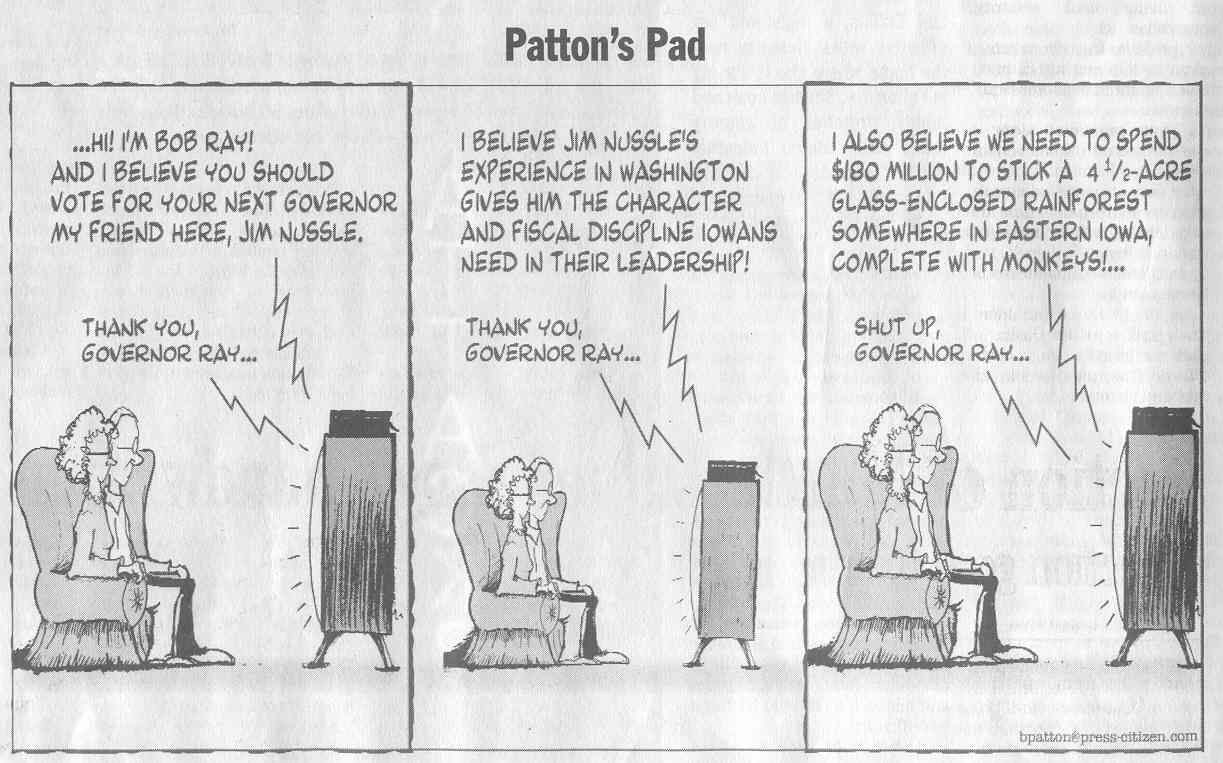
In June of 2005, the rain forest promoters realized they needed a professional project manager. The Press-Citizen's Bob Patton, creator of the "Patton's Pad" editorial cartoons, chose to picture the hiring process under the title, "We understand the Iowa Rainforest folks had a little trouble finding a project manager . . .."
If your browser doesn't reproduce the frames adequately, they depict 8 applicants for the position, each standing behind a podium labeled "IEP" (for Iowa Environmental Project"). The interview process involves their having to read a script about the project that causes the interviewees to respond with something other than serious enthusiasm for it. They respond (1) "'which is why you should sup-p-p-port' . . . HE HE HEE . . . 'Suppor' -HE HE -'Support this Projec . . .' HE HE HO HA HA HO HA HA" From off-screen the voice of what is presumably the interviewer shouts, "NEXT." (2) "'. . . should support this far-viewing proj . . .' of all the ridiculous load of pig doots." "NEXT" (3) ". . . You guys wanna build WHAT in Iowa?" "NEXT" (4) "'. . . should support this project for the future of IO . . .' WA HA HA HA HA HA HA" "NEXT" (5) ". . . You guys on crack or something?" "NEXT!" (6) " . . . I got 2 kids in college and a mother in a home, and you clowns think THIS is $50 million well spent?!!" "NEXT!" (7) "HA HA HE HO HO HA . . . No, wait, wait -- I got it this time -- 'should support this proj . . .' AH HA HA HA HAW" (as he collapses in uncontrollable laughter on the podium) "NEXT" (8) " . . . and that's why we need your support for the Iowa Environmental Project" -- which provokes from the interviewer, "Beautiful! You're hired!!!"
This editorial cartoon appeared on the Opinion page, Iowa City Press-Citizen, July 2, 2005, p. 13A. It is copyright by Bob Patton and the Press-Citizen and reproduced here as a non-commercial "fair use" for educational purposes only. Any other reproduction may require the advance permission of the copyright holders.
Although too early (as of July 5, 2005) to know whether a contract will ultimately be drafted and signed, on June 23, 2005, local papers reported negotiations between the project and the consulting firm of KUD. See Nicholas Johnson, "Rain Forest Hires Rain Man; A Commentary on Rain Forest Project's Negotiation with KUD," June 23, 2005. (This piece, in turn, contains links to Zack Kucharski, "Rain Forest Enlists Experts; Firm Experienced with Attractions Using Habitats Expected to Boost Fundraising for Coralville Project," The Gazette, June 23, 2005; Adam Pracht, "Rain Forest Project Set to Hire Overseer; Officials: KUD Could Help Bring in Funding," Iowa City Press-Citizen, June 23, 2005; and "Amateur Hour," Iowa Pork Forest, June 23, 2005; as well as the Web sites of KUD International and Kajima USA.)
The Iowa Pork Forest blog reprinted the Press-Citizen's July 7 story and commented, "This is a good sign, but I still think it's unlikely that the project will come up with at least $90 million in private financing in 16 months. Iowa taxpayers should consider getting a free sample of this. Even if KUD can come up with the money, it'll be amazing to see how the project will be able to cover the daily operating expenses with an average of over 4000 people needed per day in order to just break even." To see what "free sample" is recommended go to http://iaporkforest.blogspot.com/, July 7, 2005, for the link.
These developments prompted Iowa City resident Candida Maurer to submit a letter to the editor of the Press-Citizen. Its reproduction here is neither a representation that its facts are right nor that its sentiments represent the views of this site's webmaster.
But one of the realities of the rain forest project, which it simply must confront, is that the overwhelming majority of the local population has -- for whatever reasons ((a) short-sighted lack of creative thinking, (b) conservatism, (c) uncontrollable cynicism, or perhaps (d) the intellectual and analytical brilliance to see through a phony idea) -- simply not bought into the rain forest proposal. One of the consequences of that reality is that there are no known local financial contributors to the project. (Compare, in this connection, Omaha residents' financial support of the Henry Doorly Zoo, Nicholas Johnson, "Coralville Project Can't Match Up to Omaha's Zoo"Des Moines Register, July 17, 2004.)
Thus, Ms. Maurer's letter is reproduced here simply because of the clever way it reflects the tone one picks up in conversations with many local residents regarding their reactions to the project in general and the recent publicity in particular. Under a headline, "Rain Forest Still a Foolish Idea," it reads in its entirety:
From the July 2 Patton's Pad [see above], it's obvious that many Iowans see the foolishness of constructing a rain forest in Iowa, costing taxpayers more than $70 million dollars.
As Iowa Child (its first name) didn't really have much to do with children, the new name isn't much better. IEP -- for Iowa Environmental Project -- could more believably stand for Iowa Extracts Pork from more deserving causes. How many realize that the $50 million given to us by our pork king, Sen. Charles Grassley, is already being spent by the high-priced administrators hired to make this pork more palatable? This, in spite of the fact that there are better than even odds this boondoggle never will scar the Iowa landscape.
IEP -- It's Endless Propaganda.
Candida Maurer, "Rain Forest Still a Foolish Idea," Iowa City Press-Citizen, July 11, 2005.
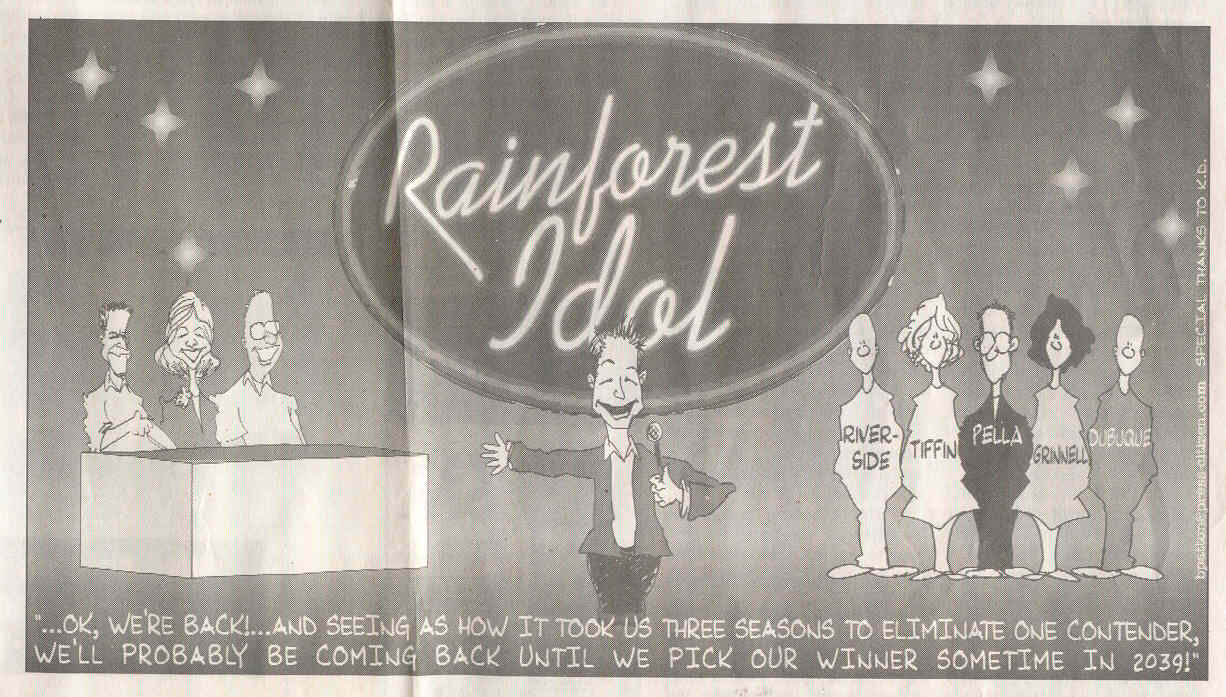
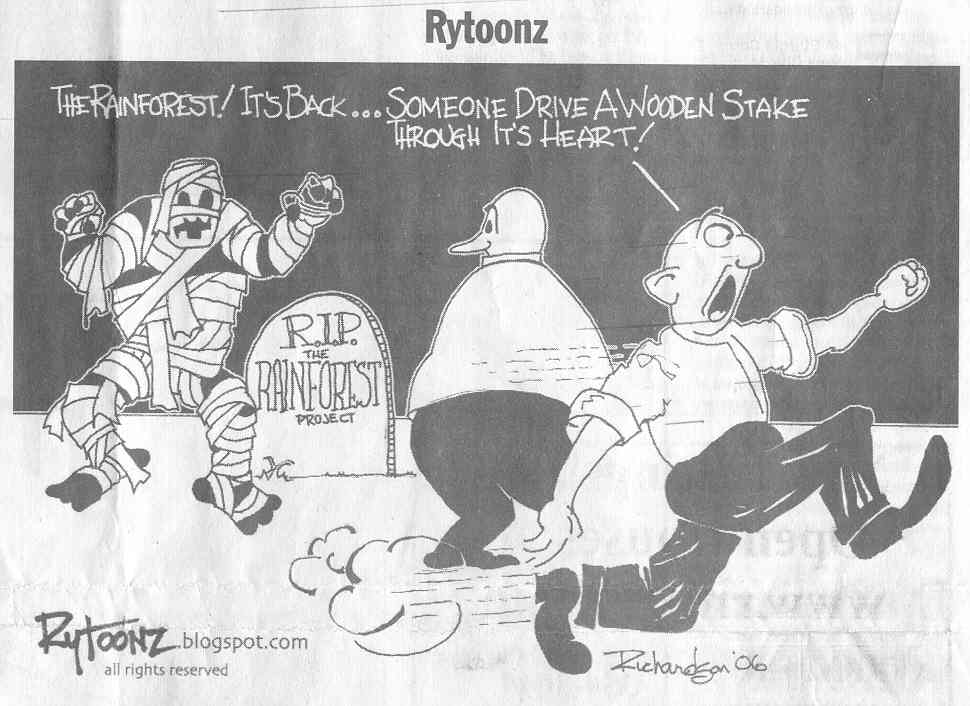
Most available indications are that KUD's and Kajima's consultant-contractor-managers (including their John Best who's working with the rain forest) are a no-nonsense, can-do crew capable of designing and bringing in major construction projects on time and under budget. Nonetheless, (a) the inability to find a contractor capable of building the structure has never been an articulated concern of project skeptics (thus, however good KUD may be its association with the project resolves none of the numerous pre-existing problems), and (b) KUD does not advertise itself as a "fundraiser" in the usual sense. Therefore, to aid their efforts a possible fundraising project (utilizing one of the rain forest's potential future residents) was proposed by the Press-Citizen's guest editorial cartoonist, Robert Richardson, http://rytoonz.blogspot.com/:
This editorial cartoon appeared on the Opinion page, Iowa City Press-Citizen, June 29, 2005, p. 11A. It is copyright by Robert Richardson and the Press-Citizen and reproduced here as a non-commercial "fair use" for educational purposes only. Any other reproduction may require the advance permission of the copyright holders.
It turns out that the project's promoters are not only able to gain strategic advantage, divert attention from bad news, and gain favorable publicity from adding new names to its lists of board members and associates, they are apparently equally adept at doing so by disassociating themselves from associates. Confronted with the Coralville City Council's demand that the project agree to something in exchange for $20 million worth of free land, including a contractual provision that the money be raised within six months of the contract's signing, presumably additional delay became a prime strategic goal for the project. Delay was gained with David Oman's announcement that, nine years into the project, he thought it might be a good idea to switch architects.
"Oman said the board was reviewing proposals from three architectural firms and would decide which one to work with 'fairly soon.'
"He declined to provide a more specific timeline, but he said because the project was in its early stages, the architect switch won't put it off schedule or off budget."
It's not clear whether the Coralville City Council understands the significance of Oman's statement and action. One of the more concerned of the council members, Tom Gill, is quoted in the paper as saying, "a contract the council discussed at a work session last week will be enforced. The contract stipulates that the Iowa Environmental Project board has six months to fund the project and have construction contracts in place after the contract with the city is signed." True enough, but apparently the six months does not begin to run until "the contract with the city is signed."
Comments: (1) Nine years into this the project is still "in its early stages"? (2) Fire the architect? There have been a good many concerns raised about this project, many of which are reported somewhere on this Web site. Virtually all have dealt with the proposals for what would go inside the structure. Virtually none have criticized the architect, the creative design that has graced the rain forest's Web site and literature for years, or questioned the technical feasibility of actually building the structure. One might even say that the architectural firm, and its product, is the only thing that has not produced controversy. If the project is exploring "down-sizing" that seems a rather bizarre place to start. (3) The story reports that the current architect says it "hadn't been paid for the work it already did" and that it was "seeking the assistance of attorneys." The only conceivable advantage to the project of long, drawn out litigation at this point would seem to be the delay it would make possible in its signing the contract with Coralville. As Oman is quoted as saying, "We want to get this [architect] issue resolved first, and then you'll see us move to that [the Coralville City Council's "contract" (actually, until signed, more accurately an "offer")]. (4) There also seems to be a major component of inter-firm conflict going on here. Peter Sollogub -- the individual who has done, or supervised, most of the architectural work -- worked for "Cambridge Seven Associates," at which time he says he began working on the rain forest project. He subsequently went to work for Chermayeff, Sollogub and Poole. In June 2005 Sollogub left that firm and returned to Cambridge Seven, at which time Oman says he terminated the contract with Chermayeff, Sollogub and Poole. Thus, it's possible this is not just a delaying action. It may be simply the Oman-Sollogub effort to keep the latter as architect while firing the firm he's left (notwithstanding Oman's insistence that he's "reviewing proposals from three architectural firms"). In this connection, see Jim O'Neal, "Rain Forest Drops Design Firm,"The Gazette, August 21, 2005.
"Kris" also had some fun with Anne Scheetz' plea that we not "lose faith in rain forest" Anne Scheetz, "Don't Lose Faith in Rain Forest,"Iowa City Press-Citizen, August 25, 2005. Kris, "And So the Fun Begins,"Iowa Pork Forest, August 25, 2005 (Example: "So, the fact that most people don't like it and it doesn't seem to be going anywhere is a reason to keep going? Huh. Are you also the type of person who gets 'just one more' roll of quarters for a losing slot machine because it's "due"?), available as an addendum to the Scheetz' piece and on the Iowa Pork Forest blog for August 25.
See also on the Iowa Pork Forest site for August 2005: "Strings Attached," August 10, 2005; "Welcome Ned Zissou," August 11, 2005; "Design Firm Switcheroo," August 20, 2005; "Coralville Ready to Throw in the Towel?" August 23, 2005; "You've Got Four Weeks, Oman" and "Coralville Starting to Play Hardball," August 24, 2005; "September 20th Deadline," August 25, 2005; and "Good" [a reference to Editorial, "Rain Forest Deadlines Needed,"Iowa City Press-Citizen, August 27, 2005], August 27, 2005.
Meanwhile, like the Iowa Pork Forest's "Kris," the Press-Citizen's Bob Patton, creator of the editorial cartoons, "Patton's Pad," has offered his own editorial comparison between the Arch and the rain forest. If the image doesn't show up for you, the headline reads, "News Item: Coralville City Councilor Likens Rainforest Project to St. Louis Arch." The left panel shows the St. Louis Arch with the sign "Gateway to the West." The right panel shows people looking down holes in the ground (the inverse of the St. Louis Arch) with a sign, arrow pointing down, that reads, "$90 MIL." The cartoon is copyright by Bob Patton and the Iowa City Press-Citizen and is reproduced here for non-commercial, educational "fair use" purposes only. Other uses will require the permission of the copyright holders. It appeared in the August 27, 2005, Iowa City Press-Citizen, p. 7A.
Another noisy week, and things don't look any better for the rain forest. Oman continues his by-now-predictable strategy: Bad news? Tough times? Meet with every editorial board that will still talk with you and announce that yet another prestigious individual or organization is now a part of your team. Whatever happened to Ted Stillwell and his forthcoming proposals for educational programs? Whatever was produced by the Chicago fundraising firm of Gonser, Gerber, Tinker & Stuhr? Do we have plans yet from the world's fourth largest contractor, KUD? Has Cousteau demonstrated any fundraising results? Not that the press has reported. So, what to do? Get another architect -- notwithstanding that the former one will continue to work on other aspects of the Coralville site for the City, and that its dismissal by Oman has now raised to three (out of five) the number of Coralville City Council members who have had it with the rain forest project. Here are some of the results of Oman's public relations efforts regarding the hiring of the Cornwall, England, Eden Project's Andrew Whalley, a partner in the London-based firm Grimshaw Architects:
Thus, once again, aside from the new name in the pot, we are still left with a $180 million project that has remained $90 million short for the past year and a half, that still has no precise focus, and therefore no precise plans or promise of generating whatever ongoing operating funds will be necessary. Moreover, a major bit of news to come out of these stories is that Oman is now considering debt as a way to fund the construction. Not all attractions that are funded with debt fail, but a disproportionate number of those that fail have used debt. Most economic analysts strongly advise against it.
Cityview quotes its inside, unnamed source as saying, "No one want to be the person who kills it. So they're just letting it starve to death." Civic Skinny, "Coralville Project Headed for Scrap Heap,"Cityview, September 1, 2005.
A more graphic view of just how the project will get to the scrap heap was captured in an editorial cartoon by Rytoonz, "Lazin' on a sunny afternoon," Iowa City Press-Citizen, September 8, 2005 (copyright by Robert Richardson, http://rytoonz.blogspot.com/, and the Press-Citizen and reproduced here for non-commercial, educational "fair use" only). It depicts someone floating down the river on a rubber raft, totally oblivious to the fact that they are headed toward a substantial water fall. The raft is named "S.S. Rainforest."
Needless to say, these events, media news and commentary, brought forth a hefty response from the Iowa Pork Forest bloggers. "New Architect, Debt and Timelines,"Iowa Pork Forest, August 31-September 2, 2005.
Note: To remove any possible ambiguity, given the quantity and force of the opposition to the rain forest represented by some of the commentary linked below, it bears repeating that while Johnson has personally raised a great number of questions about the project he believes their answers as essential to the project's success as to the public's stake in this venture. As noted in the introduction, above, he is "neither booster nor basher." He has no stake in either the success, or the defeat, of this proposal -- financially, professionally, politically, socially or otherwise personally -- nor is he in any way affiliated with any individual or organization that has such a stake.
"Grassroots" support for public projects can be manufactured; when that is done it is sometimes called "astroturf lobbying." Given the number of those associated with the project who have written letters to the editor praising its potential benefits, that may, in fact, be going on.
But to the best of his knowledge there has been during 2004 (since this Web site was begun) no organization or otherwise organized opposition to the rain forest. (And he assumes, given this Web site, he would be aware of it if it did exist.) He has attended no group meetings of individuals in opposition. To the best of his memory (not perfect, but serviceable!) he knows virtually none of those who have written in opposition, and has met, or otherwise communicated, with none of them prior to their writing.
A letter to the editor that succinctly notes a number of objections raised by Johnson and others (including the promoters' stonewalling and secrecy) is Richard A. Patterson, "Rain Forest Board Does Too Much in Secrecy,"The Gazette, January 1, 2005 ("It concerns me that the board of directors of the rain forest project [1] meets in secrecy and [2] is considering construction before all the funding is in hand. [And [3]] The greatest financial challenge in operating an attraction of this sort isn't locating up-front money. It's finding income to run the organization five to 10 years after the dedication ceremony.") (bracketed numbering added)
The project board's secrecy was a continuing concern with regard to its February 2005 meeting: "'The Environmental Project's (Coralville rain forest) board of directors will hold a closed meeting . . . to update members on fund-raising as well as educational and research ideas for the center' (Feb. 19). With $50 million coming from the taxpayers, an open meeting would seem more appropriate." Ian Binnie [Des Moines], "Open Dome," Des Moines Register, February 27, 2005.
Finally, by April 24, 2005, even The Gazette -- that had run many major positive pieces about the project in its paper and on its TV station, that in December 24, 2004, concluded its positive editorial, "For our money, we like the risk and potential reward of The Environmental Project," "Reversing Iowa Stagnation," December 23, 2004, and whose president and publisher, Joe Hladky, sits on the Iowa Child Board of Directors -- decided it had had enough of the project's stonewalling. Editorial, "Clearing Air on Environmental Project,"The Gazette, April 24, 2005 ("Coralville leaders . . . must protect the public's interest. . . . [T]heir demands for information and transparency in project decisions are more than reasonable. . . . [T]hey have been denied too much information . . . [and should] not have to settle simply for words of reassurance from project planners. Their worries are understandable. The application for state funding as yet does not contain essential information such as a five-year financial projection, fundraising or marketing plans or a budget.") This theme is one that has run throughout much of Johnson's questioning of project planners since January 2001.
Political "Pork" for Campaign Contributions. Some of the opposition, while noting the improbability of financial success, primarily focuses on what the opponents argue is a wasteful, inappropriate use of taxpayers' money -- and its ties to campaign contributions.
The "Iowa Pork Forest" blog is a site entirely devoted to a very readable discussion regarding Iowa Child, virtually all of it extremely critical. It's available at http://iaporkforest.blogspot.com.
David Hogberg, of the Public Interest Institute in Mt. Pleasant, Iowa, picked up the "pork forest" characterization in a three-part series he did as Institute Briefs (some of which were edited and published as newspaper columns) during July 2004, "Iowa Pork Forest, Parts I, II and III." And see David Hogberg, "Political Hay: Leave No Iowa Pork Child Behind," The American Spectator, February 12, 2004, and Andrew Grossman, "Profiles in Pork: A Rainforest on the Prairie," townhall.com, December 23, 2003.
Similar in spirit are these comments by a blogger named "Steve":
"But if you thought that bribing companies to stay or relocate in the state of Iowa and calling it economic development was ridiculous, you ain't seen nothin' yet. Try to see if you can comprehend the following $200 million example of wretched excess funded by the taxpayers of Iowa in part via the Grow Iowa Values Fund. And while you try to get your mind around this one, consider that you have a part in it as well because our Republican senator, Chuck Grassley, slid $50 million in funding for it into last year's federal budget. So thanks, all you U.S. taxpayers, for helping Iowa fund a gigantic domed rainforest in the middle of a temperate zone. One Eastern Iowa resident has likened it to building a raging blizzard in a dome for the children of Brazil. What's the point?
"A liberal rich guy who is rich enough to not to have to worry about how much his little boondoggle is going to cost everyone else dreamed up this $200+ million white elephant. And the original name of this project is enough to make any rational thinking person gag -- the Iowa CHILD project. What is CHILD an acronym for, you might ask? Try Center for Health in a Loving Democracy if you can even believe (or stomach) that. Finally, someone decided that this name was just TOO much of an embarrassment and the name was changed to the Iowa Environmental Project. And don't think that your financial obligation to this tropical example of wretched excess in a temperate zone ends with taxpayer rape at the hands of our Republican senator. If you actually want to GO to it after it's built, it's estimated that admission is going to be between $14 and $20. At any rate, if Ted Townsend, the aforementioned liberal rich guy who can afford to request the rape of taxpayers to fund his eccentricities, wants to build his rainforest great, but bankrupt state and federal governments shouldn't be helping to fund it. This topic is such a joke in this state that someone has put up a very enlightening blog dedicated to opposing it. It's called the Iowa Pork Forest blog."
Steve, "The State of the American Taxpayer," Pardon My English, February 2, 2005, www.pardonmyenglish.com.
Rob Bignell, "Your Congressman's Price Tag,"Iowa City Press-Citizen, December 10, 2003, is an early, and effective, analysis of the relationship between the quantities of money given to Senator Grassley and others by the Townsend family and David Oman and the rain forest project's ultimate receipt of $50 million in federal tax dollars. Although Iowa's Senator Grassley has taken the most criticism (and received the most credit) for this federal largesse, local Republican Congressman Jim Leach (whose district includes the proposed location for the rain forest) also received contributions from the promoters, and has both supported and opposed the project. See Gary Grommon (letter), "Deliberate Deception Hurts Leach's Claims of Integrity," The Gazette, December 3, 2004.
The following exchange is illustrative of Congressman Leach's position:
Borg: IT'S INTERESTING YOUR COMMENT "YOU'VE GOT TO HAVE SOME DISCIPLINE" IN BUDGETARY MATTERS. THE REPORT TODAY IN THE "CEDAR RAPIDS GAZETTE" QUOTED YOU AND HOUSE SPEAKER HASTERT ON THE IOWA CHILD APPROPRIATION FOR THE RAIN FOREST IN THE IOWA CITY-CORALVILLE AREA, AND HE CALLED IT PURE PORK AND AS HOLDING IT UP IN THE OMNIBUS ENERGY BILL. HOW DO YOU DEFEND THAT WHEN OTHER SECTIONS OF THE NATION ARE BEING ASKED TO -- PEOPLE ARE BEING -- AMERICANS THINK THEY'RE SACRIFICING. HOW DO YOU DEFEND THAT WHEN YOU TALK ABOUT DISCIPLINE?
Leach: THAT'S A PARTICULAR PROJECT. IT'S A NONPROFIT, VERY IMAGINATIVE ENVIRONMENTAL PROJECT THAT SENATOR GRASSLEY HAS PUT IN THE SENATE SIDE. FRANKLY, IT'S CONTRASTED WITH -- A GROUP OF HOUSE MEMBERS WANTED FOUR SPECIFIC PROJECTS THAT ARE SO-CALLED GREEN BONDS, AND CHUCK SAID, "WELL, IF YOU'RE GOING TO HAVE THOSE PROJECTS, WE'D LIKE TO HAVE THIS PARTICULAR NONPROFIT." THE OTHERS ARE CORPORATE KINDS OF PROJECTS. THIS IS AN ENVIRONMENTAL, NONPROFIT, ENERGY EDUCATION ORIENTED CIRCUMSTANCE THAT WOULD BE THE BIGGEST, POSSIBLY, PUBLIC WORKS PROJECT IN THE LAST DECADE IN IOWA. IT WOULD BE A VERY EXCITING PROJECT. AS YOU KNOW, BOB RAY IS THE CHAIRMAN OF THE BOARD OF IT. THIS IS SOMETHING THAT IS AN IDEA THAT'S BEEN DEVELOPING FOR FOUR OR FIVE YEARS. CHUCK IS ADVANCING THE APPROACH THAT I THINK IS DEFENSIBLE. I CANNOT TELL YOU THAT IT IS THE HIGHEST PRIORITY OF THE FEDERAL GOVERNMENT. I'VE NEVER MADE THAT ARGUMENT. IF YOU TALK ABOUT BALANCE IN FEDERAL SPENDING, IT'S ONE OF THOSE THINGS THAT IF SOME STATES GET SOMETHING, IT'S FAIR THAT IOWA GETS SOMETHING. SO IT'S ONE OF THESE KIND OF BALANCING CIRCUMSTANCES.
Congressman Jim Leach, Transcript, "Iowa Press," Iowa Public Television, Program Number 3110, November 7, 2003.
"Infamous" is the word nationally syndicated columnist and television personality Robert Novak uses to describe the $50 million federal grant for the forest. "Reform the Budget?," May 6, 2004. ("Ryan's bill . . . would allow money saved by pork-elimination to come out of the federal budget altogether -- a change from the current practice under which killing $50 million for the infamous indoor rain forest in Coralville, Iowa, for example, would merely transfer that money to other accounts for appropriators to spend.") The full text of the column is available at http://www.townhall.com/columnists/robertnovak/rn20040506.shtml (last visited May 13, 2004). And see, Robert Novak, "The General and the Flag," November 15, 2003 ("GRASSLEY'S PORK. The 'pork' sponsored by Republican Sen. Chuck Grassley of Iowa that House Speaker Dennis Hastert claimed has been holding up passage of an energy bill is a proposed indoor rainforest near Coralville, Iowa. . . . The Iowa rainforest, called the Iowa Child Project, was proposed by Ted Townsend, a Des Moines businessman who has contributed mostly to Republicans (including Grassley).")
And here's an account of what conservative Congressman John Culbertson is reported as having said, "This weekend, I attended a townhall meeting with my Congressional representative, John Culberson. Culberson is a conservative Republican and a DeLay protégé. . . . Culberson said that cutting off notorious pork barrel projects, such as the rainforest in Iowa, was a good idea on its own merits . . .." Ted, "Letter From a Town Hall," www.crookedtimber.org blog (posted 4/11/2005 11:53 AM in US Politics).
Published responses to the Iowa City Press-Citizen-sponsored Rain Forest Forum, March 22, tended to be critical of the then-current status and presentation of the rainforest project. They included an op eds by Nicholas Johnson and Norman Luxenburg, three letters to the editor in the Press-Citizen, and an editorial in that paper:
Editorial, "IEEP Openness Generating Public Support,"Iowa City Press-Citizen, March 27, 2004 (This editorial response to the paper's March 22 Forum is listed here, notwithstanding its headline, because the body of the piece (as distinguished from that headline), rather than dealing with "openness" or "public support," primarily reinforces and endorses serious questions about the project's viability similar to those raised in "The Elephant in the Rain Forest," above.)
Norman Luxenburg's Press-Citizen op ed of March 31, "Rain Forest Organizers Mist Over Issues at Town Meeting," is one of the first to discuss, and seriously question, proponents' suggestion at the Forum that the rainforest will attract top scientists, and $5 million or more in annual grants for their research.
On January 7, 2004, Iowa City Press-Citizen Writers Group member Derick Cranston reflected, "2003 brought several notable events: . . . An indoor rain forest no one seems to want built, except lawmakers who control where our tax dollars go. Are our lawmakers showing the kind of vision and foresight that allows them to be good leaders or have they been seduced by a pied piper who will lead them off the edge of a cliff?" Derick Cranston, "Looking Backward and Ahead."
Norman Luxenburg, "Answers Needed on Rain Forest,"Iowa City Press-Citizen, March 10, 2004, adds a good number of examples and well-written exposition to Nicholas Johnson's earlier "Rain Forest Questions Remain," above. Luxenburg's analysis is applauded by Edith Brysch, in her March 30 letter to the Press-Citizen, "Column Properly Judged Rain Forest."
Jonathan Roos, "Most Iowans Boo Rain Forest Plan," Des Moines Register, February 23, 2004 (a story and chart reporting on a Register poll revealing, among other things, that of those Iowans over 65 years old 66% think the rainforest "a waste of money"). Even Iowa's Republican Congressman Jim Nussle "concedes he cannot stop it now, but he says lots of folks in Iowa complained about the $50 million earmark already approved for the rain forest project in Coralville." Ed Tibbetts, "Nussle Budget," Quad City Times, March 5, 2004.
Sonia Ettinger, Consider Zoo Costs, Revenues, Letters, Iowa City Press-Citizen, April 1, 2004, characterizes the project as "a boondoggle of gigantic proportions," using the Brookfield Zoo's costs and revenues for comparison, while posing more questions.
There have been a number of commentaries dealing with the cost, and this use of federal money.
On April 7 Citizens Against Government Waste made national news with its Pig Book for 2004, a report of pork projects that highlighted the $50 million Coralville rainforest project and gave Senator Chuck Grassley its "Soaking the Taxpayer Award" for his role in obtaining the federal grant. An example is this ABC News report: Greg Hunter, "Politics and Pork: Are Your Taxes Headed to the Pork Barrel?" abcnews.com, April 7, 2004.
There was also local coverage. Here are a couple of examples: the Press-Citizen's story: Mike Madden, "Group Singles Out Rain Forest: Coralville Project Tops 'Pig Book,'"Iowa City Press-Citizen, April 8, 2004, and the KCRG-TV9 news item, Mike Wagner, "Rainforest Funding Criticized," filed April 7, 2004. (This is the piece that quotes Iowa City's Jean Lloyd-Jones as saying, "The idea of putting a rainforest here is so exotic and so alien really to our eco-systems here that I just think it's laughable. . . . I think it would be easier in a lot of other places where it would seem a little more logical for a rainforest. I think the idea of putting a rainforest in the middle of cornfields strikes most people as absurd.")
Eileen Robb, "Too Pricey," Letter, Des Moines Register, August 22, 2004, notes the relationship of the project's $69,500 lobbying expenditures "to leverage the $50 million in a federal grant. . . . I don't know how I'm going to be able to afford to keep Senator Grassley in my employ. His vote is just too expensive." Even Republican senatorial candidate from Colorado, Pete Coors -- who, once elected, would like to sit on Chairman Chuck Grassley's Finance Committee -- has attacked Grassley's $50 million rain forest appropriation. See also Eugene Spaziani's letter to the editor, Des Moines Register, "Grassley Works, But Not Always in Iowans' Best Interests," October 24, 2004, making similar points about Senator Grassley and the rain forest appropriation.
Some of this criticism goes to the public funding of corporate for-profit projects as well: the possibilities for corruption, and what is often the modest, to negative, public benefit from this "corporate welfare." See Joe Van Ginkel, "Corporate Welfare Rarely Produces Jobs,"Des Moines Register, March 1, 2005.
Although there has been repeated reference to the "$50 million" there has been very little reporting or analysis of the details. Where does this money come from? Does it even exist; that is, is this merely a promise to pay, or is there actually money in a bank somewhere? Are there conditions to its expenditure; that is, does it only become available once the project is actually going ahead, or can it be spent on salaries and promotional efforts immediately? Who is in charge of this fund? Who is monitoring the legality and ethics of any withdrawals? Adam Pracht's article, "Government Monitors Use of $50 Million Grant,"Press-Citizen, March 12, 2005, begins the process of looking into some of these issues.
When evaluating proposals for an indoor, 4.5-acre rain forest in Coralville, Iowa, it's useful to examine the features that bring success to other educational attractions around the country.
The Coralville project is criticized for its lack of funding, focus, operational plans, budgets, business plan and realistic projections of cash flow. The constructive questions posed by skeptics, and unaddressed by promoters, deserve answers.
It's a little reminiscent of the 1837 Hans Christian Andersen tale, "The Emperor's New Clothes." [https://sites.pitt.edu/~dash/type1620.html] The material from which the emperor's clothes were made, promoted as so fine as to be invisible to the stupid, was in fact non-existent, leaving the emperor to parade through the streets naked until identified as such by a young boy with the courage to speak out.
But the mere fact that the rain forest currently stands as naked as a hardwood tree in an Iowa winter does not mean that visible covering could not be found.
First, looking to projects that do work financially is a little more upbeat than always focusing on the rain forest's failings. Second, even if we never have a rain forest the lessons may be applicable to other community promotional efforts. Finally, it may offer enough suggestions we could copy to make a rain forest workable -- or, make it abundantly obvious there's no way to get there from here.
There are three comparative studies offered here, two via links and one within this text.
The Omaha Zoo.The first was published as an op ed column in the Des Moines Register, "Coralville Project Can't Match Up to Omaha's Zoo,"Des Moines Register, July 17, 2004. It represents an effort to tease out, organize and present what seem to be the qualities of the Henry Doorly Zoo that make it work. Unfortunately, many of its features are not contained in the rain forest proposal.
Colonial Williamsburg.Another is the result of a return visit to Colonial Williamsburg and an examination of its Web site (that may be the basis for a forthcoming column, but has not yet been published), "What Works: Colonial Williamsburg and Coralville's Rain Forest," June 29, 2005. Notwithstanding all the positive features of Williamsburg, the rain forest's promoters are promising attendance in Coralville will immediately be double what this internationally renowned facility attracts.
The National Mississippi River Museum and Aquarium in Dubuque, Iowa. A third is described on this page, immediately below: Dubuque, Iowa's, river development.
One of the most dramatically successful efforts along this line in Iowa, one with many lessons for Coralville, would have to be the National Mississippi River Museum & Aquarium in Dubuque (finally visited by the author February 26, 2005).
Here is some brief historical background taken from its Web site:
The Dubuque County Historical Society has its roots in the Richard Herrmann Museum of Natural History, established in the 1870s. The Society was organized in 1950 as a private, non-profit organization with a focus on oral and archival history, and opened its first museum, the Mathias Ham House, in 1964. Over the past 25 years, the museum has successfully raised $54 million to establish and expand its Mississippi River Museum into the National Mississippi River Museum & Aquarium. The Museum & Aquarium is accredited by the American Association of Museums - a distinction held by only nine percent of American Museums - and was named an affiliate of the Smithsonian Institution in August 2002.
The new river campus houses the William Woodward Discovery Center, the National Rivers Hall of Fame, the Fred W. Woodward Riverboat Museum, a boatyard, a wetland, and a refurbished train depot.
For more information, see generally https://www.rivermuseum.comand an early positive review, David Pitt, "New Iowa Aquarium Honors the Mississippi," Associated Press/The Atlanta Journal-Constitution, August 17, 2003.
And here are some of the lessons one might draw, or at least explore as possibilities, from the Omaha, Williamsburg and Dubuque experience.
1. Both Colonial Williamsburg and the Dubuque attraction/s draw upon their natural setting. Colonial Williamsburg is its natural setting; the whole point of it is the experience of being amidst the re-creation of what was there before. In Dubuque, the Mississippi River, the subject of the facility, is no more than a few feet walk from the Museum. See Emily Kittle, "Rainforest 'Has No Context;' Dubuque Museum Officials Show Some Interest in the Educational Aspects of the Project,"Dubuque Telegraph Herald, January 8, 2006. Every visitor will have recently crossed, or at least seen, the River. An artificial, indoor rain forest, by contrast, has little to do with Coralville, Iowa City, or the surrounding rural countryside. Ironically, the excitement of the natural setting for the proposed rain forest is found in a thousands-of-years-old settlement that is the subject of an archeological dig -- a site that will, of course, be destroyed if the rain forest project goes ahead. For numerous comments by Iowans encouraging this approach see "Focus on Iowa," below.
2. How might Coralville-Iowa City make more of its own river? The Iowa River is the source of the regional Lake Macbride and the Coralville Reservoir. It can be seen from the Iowa River Power Company (restaurant and bar) windows, and borders the Iowa City Public Park. Aside from that (and possibly other exceptions) the River is mostly lined with the backs of University buildings, parking lots, and industrial facilities of one kind or another. The contrast between what the two cities (Dubuque and Coralville-Iowa City) have done with their rivers is stark.
3. Local support. The author does not yet know where the Dubuque Museum's $54 million (over the past 25 years) has come from. Undoubtedly some of this represents public money. But it is interesting that both the Museum, and the Omaha Henry Doorly Zoo, discussed above, can trace their origins, and local support, back to the 19th Century. Colonial Williamsburg is on track to meet its 2005 goal of an additional $500 million in contributions along with its $600 million endowment. Neither Williamsburg or Omaha take state or federal money. So far as is known (as of February 2005) there is not a single dollar contributed by local citizens in the Coralville rain forest treasury. Of course, local support is not limited to money. It also takes the form of energy, volunteers, ideas, and the support of related enterprises. More explanation for Dubuque's community support may well be found in the process described in Rob Kundert, "Visioning Has History in Dubuque; Envision 2010 Not the First Time Community Input is Taken to Shape Action by the City,"Dubuque Telegraph Herald, December 29, 2005. And see the follow up to this story in Rob Kundert, "Building a Better Dubuque; Committee Announces Top 10 Ideas," and "Envisioners See Ideas Crystalize; The Process Generated Plenty of Interest Throughout the City,"Dubuque Telegraph Herald, January 6, 2006.
4. Mutually reinforcing attractions. Like the amusement attractions in the center of the Mall of America, the Dubuque Museum both benefits from, and adds to, the attractions of which it is a part. The short walk to the Mississippi River has already been mentioned. Fishing and boating on the River (a part of the subject matter in the Museum) are major attractions to the area. An only slightly longer walk, across a free parking lot (not incidentally reducing parking lot expenses for all the facilities that share it), is one of the region's major gambling casinos, the "Diamond Jo Casino," designed to look like a river boat on the Mississippi. The adjacent Grand Harbor Resort and Waterpark combines hotel, conference center and indoor waterpark. And, of course, there is the city of Dubuque itself, with its rich history, cable cars, refurbished old hotels and other features one can learn about in the Museum and then drive or walk a few blocks down the road to visit. (There's far too much to mention here, but "Travel Dubuque" maintains a very informative and relatively thorough Web site of attractions, facilities, tours, and other information of interest to tourists.)
Omaha's zoo combines nine major attractions with restaurants and is adjacent to a major athletic stadium. Colonial Williamsburg is a family vacation site, resort, conference center, and educational experience, which also operates the related hotels and restaurants.
None of this is to say that Coralville would offer nothing but a rain forest. The City plans its own hotel and conference center. [See Adam Pracht, "Booking Gigs Not a Problem,"Iowa City Press-Citizen, October 28, 2005.] And the rain forest promises an aquarium and outdoor prairie, among other things. There is the Coral Ridge Mall a few miles down Interstate-80. There are numerous activities associated with a major Big 10 university -- not the least of which are the athletic events of major college teams, and the shows brought to the area by the Hancher Auditorium.
It is to say that Colonial Williamsburg and the Dubuque Museum benefit substantially from the amount of symbiotic synergy they create that Coralville will lack. It is to say that there is an enormous difference between having an amusement park in a mall (Mall of America), and having a rain forest four or five miles down the road from one (Coral Ridge Mall).
5. Realistic goals, costs, and attendance -- the "good news" (for Dubuque). The author does not now know what the Dubuque Museum cost to build. Even if it took every dime from the last 25 years it would only be $54 million, and from the looks of it the cost was a small fraction of that. Whatever it cost, it was substantially less than the rain forest's $180 million. And its operating costs will be a fraction of those of the rain forest as well. As a result, it can (apparently) sustain itself with all admission costs that range from $3.75 to $9.25 -- as compared with the rain forest's projections of $15 for adults. And its attendance of 200-300,000 a year can both be easily handled and can pay enough to keep it going. The rain forest promoters project they will need 1.3 to 1.5 million visitors a year to make it.
Museum draws 264K visitors
The National Mississippi River Museum and Aquarium in Dubuque has announced that its attendance for 2004, its first full year of operation, was 264,529 visitors. Economic forecasts for the museum projected a range of attendance between 230,000 to 309,000.
The museum opened in June 2003. Since its opening, attendance has surpassed 400,000 visitors. Jerry Enzler, the museum's executive director, estimates that the 500,000th visitor will walk through the doors in early summer.
Attendance numbers last year were boosted by exhibits such as Lewis and Clark's Excellent Adventure and special events including Ice Fest, Log Jam, History Mystery Walk, Trappers and Traders, and Native American Days.
The museum soon will announce a major exhibit, which will open in May 2005.
Sarah Reicks, "On the River/Deck Talk," Quad City Times, undated, presumably January or February 2005 (excerpt).
6. Realistic goals, costs, and attendance -- the "bad news" (for Coralville). It speaks well for Dubuque's Museum that many Iowa museums and galleries are attracting no more than 10-30 percent of Dubuque's attendance. The bad news, for the Coralville rain forest project, is that with all that the Dubuque attraction has going for it, as discussed above, it is only attracting 264,000 visitors -- and that in its high attendance first full year. Such numbers, for an attraction with its features and supporting environment and institutions, raises even more questions as to how a rain forest in Coralville is going to be able to attract five times that number year after year. The theme of financially realistic projects is picked up in Julie Spencer, "Be Realistic on Rain Forest Plans,"Iowa City Press-Citizen, August 30, 2005.
Chattanooga, Tennessee, River Front Development. Chattanooga leaders set out to reverse the city's reputation for America's dirtiest air -- and succeeded, with a three-year $120 million redevelopment project. An aquarium that has brought in one million visitors a year since 1992 added a saltwater wing in 2005. The Hunter Museum of American Art has been expanded, as has the children's Creative Discovery Museum. There's a new 160-foot pier for closer access to the river, a sculpture garden and cable car. There's recognition of the Cherokees' Trail of Tears in 1838. The effort was funded with $56 million from a hotel-motel tax and $51 million from local donors. Bill Poovey, "Chattanooga Surges Back with Revitalized Waterfront," Associated Press, June 26, 2005.
"What works in Chattanooga?" Tennessee has a population of 6 million; apparently enough to sustain the million-visits aquarium. There is more than one venue to visit. The community was behind the effort, including the $51 million in contributions. The city's emphasizing its own resources (the river) and history (the Cherokees). There was an overall, integrated plan.
Presidential Libraries.When it comes to predicting attendance there is no perfect parallel to the proposed rain forest (e.g., contents, location, contiguous population). All one can do is look for related attractions and institutions. This is made more difficult by the promoters' failure to indicate precisely what it is they have in mind. But given the promoters' emphasis on "education" and the subject of a rain forest (as distinguished from a Disneyland or Advertureland-type attraction) comparisons to other quasi-educational facilities may be useful. Consider, for example, presidential libraries. (See AP, "Presidential Libraries Becoming a Tougher Draw,"Des Moines Register, January 30, 2005, and AP, "Presidential Libraries Compete for Visitors in a Theme-Park World," November 16, 2004.)
One would think that for those seeking a family educational-vacation event a presidential library would rank right up there. And yet, as these stories report, all of the attendance for all of the nation's now-12 presidential libraries combined is what the rain forest's promoters are predicting for their attraction alone. Moreover, during the past five years that total attendance has declined by 13 percent, from 1.5 million to 1.3 million. The most popular has been the Lyndon B. Johnson Library, at 200,000 annual average visitation.
Of course, most attractions have their greatest attendance during the year or two following their opening. In its opening months President Bill Clinton's new library was drawing 1500 a day. As an example of multi-attraction synergy, his Hope, Arkansas, boyhood home got a boost in attendance from the Presidential Library as well. David Hammer, "Arkansas: 'Billgrimage' Has Clinton's Hope Birthplace Back in the Black,"Associated Press, May 27, 2005.
The Herbert Hoover Library.Most revealing, given that the rain forest's primary attendance will have to come from within Iowa, is the poor showing Iowans provide for the library of their own pride, the only Iowan ever to occupy the White House, Herbert Hoover. At 66,000 visitors a year it is the most poorly attended of all the presidential libraries. Moreover, given its 100,000 attendance in 1975 these numbers are headed in the wrong direction.
As Director Timothy Walch acknowledges, "Being in West Branch doesn't help." Marketing instructor David Collins agrees: "The problem is getting people here." Walch reports that "on some days in January only a half-dozen visitors come."
Note that the rain forest would also be in a small Iowa town (Coralville) and dealing with the same winter weather as West Branch, which is only about 10 miles due east. It's quite a leap of faith from the reality of a hometown boy's presidential library attendance of 66,000 (where no admission price is charged) to the rain forest promoters' dream of as many as 1.5 million paying visitors at $15 a head.
The Iowa Hall of Pride.Like the President Herbert Hoover birthplace and museum, we can learn something from the February 2005 opening of the Iowa "Hall of Pride" in Des Moines. Columnist Marc Hansen characterized it as a "one-of-a-kind spectacular . . . 26,000-square-foot, $12.5 million orgy of all things Iowa. . . . The Hall of Pride had everything. Everything, on this day, except a tidal wave of visitors. . . . The folks who run the Hall of Pride seemed undaunted. They're still looking forward to 90,000 visitors the first year." It is yet another example of an attraction one would think would appeal to Iowans, and yet -- at least so far -- is not, even with the much more modest projection of attendance (compared with the rain forest's 1.0-1.5 million) of 90,000. Marc Hansen, "Hall of Pride is Enough to Make You Proud,"Des Moines Register, February 24, 2005.
Rock Island's Children's Garden.Of course, it is not necessary for a project to be the size of the rain forest, Omaha Zoo, or Colonial Williamsburg. The same principles apply to smaller undertakings. Communities can undertake worthwhile projects, with educational value, involving real botanical species, aimed at children, of a smaller scale, and costs more easily obtained, that -- at least a first blush -- seem to be solid attractions and financially viable. Rock Island, Illinois, for example, is in the process of raising $5 million locally for a substantial expansion of its "Botanical Center": a "children's garden" planned to be one of the top ten in the United States, See Alma Gaul, "Botanical Center Plans Bold Expansion,"Quad City Times, February 23, 2005.
West Branch, Iowa. Another small scale project for a small town involves developer SouthGate's approach to West Branch, Iowa (population 2200). As the cited story reveals, there is involvement of the entire community in gathering ideas and planning, an effort to integrate parts into a synergistic whole, and to recognize the community's natural assets (e.g., a presidential library) rather than unrelated artificial "attractions." Deidre Bello, "SouthGate Aims to Revive West Branch,"Iowa City Press-Citizen, June 17, 2005. Galena, Illinois, offers yet another example of a relatively small town, coming together, thinking through what might work, at very little cost, to expand its "shopping season" by four months, Emily Klein, "Galena Repackages Tourism Effort; Business Group Seeks to Expand the Retail Cycle by Several Months,"Dubuque Telegraph Herald, December 9, 2005.
Chicago's Garfield Park Conservatory. Another attraction worth mention for a variety of reasons is the Garfield Park Conservatory in Chicago. It is, like the proposal for the Coralville rain forest, 4.5 acres. Unlike the rain forest it is situated in a 184-acre park, in an urban area with much greater population than Coralville, with numerous gardens besides its rain forest (completely restored in 2003 and referred to as "Palm House"), including, like the Henry Doorly Zoo, a desert area, with a history going back to the 19th Century (like Omaha and Dubuque), lots of local citizen support and integration with the community, a children's garden, and a variety of services for the surrounding neighborhood. Here is a link to its history.
The Garfield Park Conservatory is relevant to an evaluation of the Coralville rain forest proposal because (1) it is yet another example of how something like the rain forest proposal can and has been conceived, configured, and executed with seemingly less cost than the rain forest while producing greater benefit, and (2) is one more -- like those in Omaha, St. Louis, and Milwaukee -- attraction within a reasonable drive that presumably would be attractive to any Iowans interested in an indoor rain forest, and thus another competitor for the time and money of potential Coralville rain forest visitors.
The Iowa Children's Museum.There may also be lessons regarding potential rain forest attendance in the popularity of the Iowa Children's Museum -- located inside Coralville's Coral Ridge Mall, the second largest mall in the state of Iowa, with some 10 million visitors (visits, not unique individuals) a year. (That number comes from the Iowa City and Coralville Convention and Visitors Bureau.) In addition to the museum, the Mall also offers a NHL regulation-size ice arena, Healthy Trails Play Area, an antique carousel, a 1,000 seat food court, 10 movie theaters and over 120 stores. (The Mall's Web site is http://www.coralridgemall.com.)
Clearly a children's museum is not the physical equivalent of what is planned for the indoor rain forest (900 feet long and 200 feet high). But this one is a quality experience, something to which schools bring students, and is in some ways a functional equivalent of the rain forest for Mall visitors in the limited sense that it is the kind of place parents might want to take their children, a place seen by parents as having something more than mere entertainment value.
Why is this relevant?
The rain forest is a stand-alone attraction. Most of those who visit it will be near it for no reason other than having gone there deliberately. And yet rain forest promoters are representing its attendance will be 1-1.5 million visitors a year.
The Iowa Children's Museum, by contrast, is in the middle of a Mall that attracts 10 million visits from parents and children every year -- many of whom walk right by its entrance. The Museum's potential attendance benefits from the shopping and range of entertainment that attracts those crowds. And yet, notwithstanding these advantages, Museum attendance -- including school visits -- is less than 100,000 a year. (The museum opened in 1999 with 100,000 visitors a year, dropped to 70,000 in 2001, and was back up to 85,000 in 2003. Jamie Nicpon, "Iowa Children's Museum Sees Boost in Attendance,"The Gazette, October 29, 2004. Attendance figures for the University of Iowa's "Iowa Hall" exhibit -- of National Geographic or Smithsonian Museum quality -- are not made public. They are, however, significantly less than even those of the Iowa Children's Museum.)
Given the Iowa Children's Museum's comparative advantages, it is hard to see how the Iowa Child Rain Forest is going to be able to attract 10-to-20 times as many visits.
The Mall's geographical source of gross revenue also holds lessons for the rain forest. Of the roughly $100 million annual gross, "Most of the sales at the new mall came through capturing sales from existing firms within a 60 mile radius." The six counties immediately adjacent to Johnson County (Coralville) lost $53.7 million in sales to the Mall; the next surrounding tier of 12 counties lost another $37 million, for a total of $90.7 of the $100 million. Kenneth E. Stone and Georgeanne M. Artz, "Analyzing the Economic Impact of a New Super-Regional Shopping Mall in Central United States," https://econpapers.repec.org/paper/isugenres/10509.htm. The authors conclude, "Local officials should carefully consider whether to offer financial incentives to new mall developers, since they will be using taxpayer funds to help the new mall take sales away from existing businesses." (For a contrary report that the Coralville-Iowa City markets are recovering from the Coral Ridge Mall competition, see the four articles by Adam Pracht and Brian Sharp on May 13, 2005.)
Aquariums. Although aquariums have been occasionally referred to throughout this page, they are really entitled to their own section. As the New York Times' Shaila Dewan has noted, aquariums "have become a municipal status symbol . . .. Of the 36 aquariums in the United States accredited by the American Zoo and Aquarium Association, nearly half have opened in the past 15 years . . .." Shaila Dewan, "A Pioneer of the Big Box Builds a Tank for Some Very Big Fish,"New York Times, August 7, 2005. The "big box" reference is to what makes this project a little unique. The promoter, who is funding this 5 million gallon, $200 million aquarium with his own money, is Bernard Marcus, the founder of Home Depot.
By opening, November 23, 2005, the "Georgia Aquarium," boasting it is the "world's largest," was actually at 8 (rather than 5) million gallons, with 100,000 individual fish. Adult admission was set at $22.75 (children $17.00, seniors $19.50). Its Web site is at http://www.georgiaaquarium.org/. [The test will be the currently unpredictable attendance, revenue, and operating costs in the 2008-2010 period. But the positives are significant: the ability to market "the world's largest," the Marcus' substantial ($200 million) upfront kick-off, plus the corporate support of at least six major Atlanta corporations, that results in (presumably) a debt-free beginning, the local population of Atlanta, and the fact that the city is a major airport hub and convention center that offers a number of visitor attractions besides the aquarium -- a number of which are within walking distance of the aquarium.]
At the other extreme is the Tampa aquarium's financial problems. As Sean Gorman reports, "The Tampa aquarium had forecast first-year attendance of 1.7 million and 1.6 million annual attendance a year after that to pay off its $84 million construction debt. But attendance was only 1 million in its first year and it pulled in just 600,000 visitors in 1996. Only an emergency bail-out from the city kept the project from defaulting on its loan." Sean Gorman, "Aquariums: Beyond Fish in a Box," Scripps Howard News Service, October 6, 1997.
Nor are the problems always limited to attendance. Tufts University graduate student Mary Noble's research report regarding some of the problems confronted by the New England Aquarium observed that "The aquarium switched architects midway through the planning. The budget for the second wing grew from $70 million to $125 million. And the aquarium didn't kick off fund-raising until it was already committed to the project. As a result, when the aquarium abandoned the expansion in November 2001, it was left with millions in sunk costs for the uncompleted project." Mary Noble, "New England Aquarium: How Does a Non-profit Come Back After Hitting the Wall?" (May 2004).
Nor is this kind of financial over reaching limited to Boston. Morey & Associates is a firm that provides audience, membership, educator surveys and focus groups for cultural attractions throughout the country. Among its reports is an annual report on aquarium attendance. The firm reveals that for 2004 although total paid aquarium attendance decreased by 2.4% average total capital improvement exenditures increased by 58.9% over 2003. Morey & Associates, "Annual Aquarium Attendance Report: 2004."
Another $100 million aquarium project, located in New Bedford, Massachusetts (and yet hoping to draw visitors from the nearby Boston area, which already offers the New England Aquarium mentioned above) bears so many similarities to some of the problems associated with the Coralville rain forest it is uncany: "Only a fraction of the money needed has been raised, even after nine years. There has been little scrutiny from the local newspaper, whose publisher sits on the aquarium's board. On top of all this looms the question of why a new aquarium is going up in New Bedford at all given that nearby Boston and Mystic, Connecticut, each already have one. . . . One reason money has been slow to trickle in might be skepticism that the aquarium will draw the promised 850,000 people a year." Eric Jaffe, "Fishy Business,"Boston Magazine (2002).
Zoos.
Although there are mixed reports regarding the financial success of zoos, they do seem to be more popular than botanic gardens.
People for the Ethical Treatment of Animals (PETA) and other animal rights organizations have some objections to taking animals out of the wild regardless of how they are housed, and a special objection to their being caged. The organization reports on zoo financial difficulties, layoffs, and declining attendance (including their report of a 30% decline in attendance at the National Zoo, the San Diego Zoo's decline of some 300,000 a year, and the Houston Zoo's decline over a two-year period). People for the Ethical Treatment of Animals, "State of the Zoo Industry: Factsheet" (2004).
Morey & Associates, by contrast, reports a 2.1% increase in zoo attendance from 2003 to 2004. Given that the zoos on which it reports are some of the largest in the country, however, it is noteworthy how low that attendance is. No zoo on which Morey gathers data had attendance of 1 million or more. Morey reports the minimum, median, mean, and maximum attendance of the zoos. The range, for 2004, was from a minimum of 43,549 to a maximum of 905,373. While there was an overall increase from 2003 to 2004, the maximum actually declined (from 927,920 to 905,383), as did the median (from 313,466 to 295, 252). It was the miinimum (from 40,493 to 43,549) and mean (384,522 to 392,730) that produced the 2.1% increase. Morey & Associates, "Annual Zoo Attendance Report: 2004."
Casinos and "Entertainment."
Gambling casinos are such a distant departure from child-oriented venues like aquariums, zoos -- and rainforests -- that their statistics are of little comparative use. The numbers are, however, revealing when it comes to predicting what humans will find attractive (or addictive) when it comes to their time and money. Even though there are only 11 states where America's 445 casinos are located, in 2004 54.1 million Americans (roughly one-fourth of all adults) made 319 million trips to gamble there. In the process they left some $29 billion of their earnings behind. See American Gaming Association, "The State of the States 2005: The AGA Survey of Casino Entertainment." For a more current example, see American Gaming Association, “State of the States 2021,” May 20, 2021
Note that even these numbers do not reach the rain forest promoters' estimates of projected attendance; most of the time they have been talking in terms of one to 1.5 million visitors a year. With 319 million trips, and 445 casinos, at least the average attendance per casino is 717,000 annually -- one-half to three-fourths the rain forest promoters' projections. Note also that, while many casino attendees' visits end up costing them much more than the admission fee to a rain forest, there is normally no casino "admission fee" as such. Even if an admission fee is only, or primarily, a psychological disincentive, it is one with which casinos need not be concerned.
It is not surprising that attractions and events without an informational/educational component sometimes substantially outdraw those with such elements. At least one water park is pulling 3.5 million visitors annually (John Seewer, "Parks Ride Wave of Water Fun," Associated Press, July 30, 2005, referring to Paramount's "Kings Island," Kings Mills, Ohio). Disney's 10 theme parks have, for the most part, maintained annual attendance in the 10-15 million range from 1984-2004.. Las Vegas has been pulling those numbers since the late 1970s, with a steadily increasing visitor traffic now approaching 40 million a year. See the Las Vegas Convention and Visitor Authority's "Historical Las Vegas Visitor Statistics." In Iowa, the Des Moines amusement park, "Adventureland," with attendance of "more than half a million a year" (Editorial, "Our Gift of Fun,"Des Moines Register, January 11, 2006), outdraws even the National Mississippi River Museum & Aquarium, not to mention the Living History Farms, Coral Ridge Mall's Children's Museum, and the Herbert Hoover Presidential Library.
The Register's Editorial Page Editor, Carol Hunter, has provided her take on what makes Portland, Oregon, work in a column headlined, "To Attract Others, Iowa Should Borrow a Page from Portland,"Des Moines Register, September 25, 2005. She says it "has as much to do with attitude as latitude . . . a place for independent thinkers. . . . Portland's commitment to planning . . . also built its image as a different kind of place." In fact, she was so impressed with Portland, "that's why I'm pulling for the implausible Coralville rain forest project. . . . It would send the message that just about anything is possible in Iowa."
Of course, not all the elements of "civic society," attractions, development, and economic growth involve bricks and mortar. The Iowa City Press-Citizen picked as its "Persons of the Year, 2005" a local group of young people operating under the name of the "Jones Gang" who organize local events and opportunities for community service by others as well as themselves. Editors, "'Get Out and Do It'; James Gang Builds Community With Passion, Collaboration,"Iowa City Press-Citizen, January 1, 2006.
What Doesn't Work?
A fundamental flaw in the rain forest project's foundation, for anyone attempting to evaluate its financial viability, is that there is no formal, final, board-approved description of what, in fact, the promoters are promoting. Public relations material is presented as if a substitute for plans. The promoters' addition of more names to their board of directors is heralded as an adequate alternative to data. Almost all that an independent evaluator has to go on is what slips out from time to time in press reports -- some of which are linked from this page. Promoters have emphasized at various times a tourist attraction, a K-5 school, a scientific research facility, a teacher training institute, and so forth.
Obviously, the financial feasibility of supporting scientific research with an adequate, perpetual flow of grants (or institutional support) involves an entirely different analysis from that involved in projections of the attendance, revenue and costs of operating a tourist attraction. And financing a teacher training facility is yet another unique challenge and analysis, as are each of the other occasionally mentioned, and often mutually inconsistent, dreams of the project's "potential."
Moreover, even assuming the rain forest is to be primarily a "tourist attraction" that still leaves questions about its content. For example, there is an enormous difference between the attendance reported by "botanic gardens," on the one hand, and "zoos" on the other. (See, e.g., Nicholas Johnson, "Coralville Project Can't Match Up to Omaha's Zoo,"Des Moines Register, July 17, 2004.)
So far as is known (as of January 10, 2005) the promoters have not yet finally resolved, in any publicly revealed formal document, the outcome of their ongoing discussion regarding whether or not to have animals. However, The Boston Globe has now reported, almost as a casual insertion, that the rain forest will have animals, "such as poison arrow frogs, capuchin monkeys, sloths, walking stick insects, and other exotic . . . fauna." Alan Scher Zagier, "If They Build It, Who Will Come? Iowa Builders Tout $180M Indoor Rain Forest, But Critics Unconvinced,"Boston Globe, January 8, 2005. Does this mean the board and administrators have definitely settled on an inhabited forest, and decided to use The Boston Globe to announce their decision to the Iowa public and media? Was the "such as" the most relevant clause; i.e., have contracts been entered into for the purchase of poison arrow frogs, or a definite decision made to include them, or were they merely an example pulled out of the air by a promoter speaking extemporaneously (and imaginatively) to a reporter? There is no way to answer such questions, given the promoters' absence of formal documents and inclination to stonewalling. And without those answers, and dozens like them, any financial analysis is bound to be "faulty."
Zack Kucharski, "Done the dome? Rain forest alone won't draw visitors, projects learn,"The Gazette, April 11, 2004, is not an opinion piece; it's a solid bit of factual journalism. But the facts it reveals are disquieting. There are already two rainforests within 250 miles of Coralville (Milwaukee and Omaha). Reporter Kucharski's report of their features, funding, and attendance raise further questions about the feasibility of the IEEP rain forest. There is also a rainforest in St. Louis.
Jeff Morrison provides another example on this theme: "A cold splash of reality can be found 425 miles to the west. The Great Platte River Road Archway Monument, in Kearney, Neb., is a $60 million attraction that depicts the importance of transportation in the American experience (and does so very well, I might add). Attendance has fallen far from the original estimate of 900,000 a year; the Omaha World-Herald reported 2002 attendance at 165,000 in a May 23, 2003 article. Factors like lack of advertising and especially lack of direct interstate access may partially explain it, but if people aren't going to stop for a history display, will they visit a rainforest?" Jeff Morrison, "Rainforest Idea Silly, But Not Worth All the Flak," Iowa State Daily, April 1, 2004.
It is admittedly difficult to predict with accuracy anything about the future. Clearly, that includes predicting the attendance and cash flow of new attractions. The fact remains that overly optimistic projections from boosters, promoters -- and their professional consultants -- are all too common. Some examples are provided in Nicholas Johnson, "Boosterism and the Fog of Rain Forests," October 5, 2004 (see the substantial listing under the heading "Barriers to Rational Analysis" and its sub-head "Hype." And see Dave Umhoefer, Steve Schultze and Avrum D. Lank, "Museum Audit Leads to Criminal Inquiry,"Milwaukee Journal Sentinel, December 2, 2005, for a case in which overly-optimistic projections lead to possible criminal charges). It is not uncommon for projections to run as much as 10 times what the actual numbers turn out to be. This has been one of the major concerns: even if the rain forest promoters are able to raise enough money to build their structure and fill it, are their estimates of attendance and cash flow realistic?
Another example of unrealistic projections for a City of Coralville project was the August 2005 revelation that the $1.5 million in projected revenue from the city-owned golf course (with its newly added additional 9 holes and $3 million club house) turned out to come up $500,000 short. Jamie Nicpon, "Recreation/Brown Deer Sees Red; Coralville Golf Course Ends Up Costing City,"The Gazette, August 28, 2005. On the other hand, the same day's papers brought the good news from Iowa City that the $18 million spent on library expansion (one-tenth the rain forest's $180 million), was producing 18-30% increases in library usage. Editorial, "Business Has Been Booming for the Iowa City Public Library,"Iowa City Press-Citizen, August 28, 2005.
On March 12, 2005, Liz Mathis of local (Cedar Rapids, Iowa) television station KCRG-TV9 reported on (what is believed to be) Ted Stilwilll's first statement about the educational planning. Unfortunately, the piece continued to use the "will" language for a project still very much up in the air ("will be built," "Iowa students will," and "links via the Internet will") rather than revealing that these are only proposals, and only half-funded, undocumented proposals at that. Little new was revealed: an endorsement of the value of science education, especially hands on; the focus on visitors, students and science teachers; links to the Internet; academies for teachers; and plans for a "site school" in the "far future." There was no reference to any publicly available document laying out the specifics of these proposals. Liz Mathis, "Coralville Rain Forest Project," KCRG-TV9, March 12, 2005.
Moreover, rain forest proponents' claims of benefits to the Iowa economy should be subjected to an analysis comparable to that of the Coral Ridge Mall, above. That is, to the extent its attendance and income are in any way geographically comparable to those of the Mall, its primary economic impact may also be more one of merely shifting discretionary educational-entertainment spending away from existing regional attractions than the creation of new economic impact.
(1) Unlike
cities such as San Francisco and Washington
areas with the attraction of ocean beaches or mountains
two or three commercial attractions, such as Disneyland, that are destinations in themselves
convention centers, such as Las Vegas
Coralville, Iowa, is not a top, magnetic, national destination in its own right. (Making it part of a "region" won't make it a national destination either. But at least that's a step in the direction of the synergy illustrated by Dubuque's effort, above. An Iowa City Press-Citizen editorial, "Tourism Plan Makes Sense,"Iowa City Press-Citizen, May 3, 2005, spells out some of the details as to what a regional tourism effort might entail.)
Like most attractions throughout America, and like the Coral Ridge Mall, the Coralville Rain Forest will in all probability draw most of its attendance from the population living within a fairly short radius of Coralville.
(2) Unlike the Mall, however, visiting an indoor rain forest is not something one does with the regularity of "shopping" -- or even, for movie-goers, watching the changing offerings of a 10-theater multiplex. Getting rain forest attendance the first year it opens -- like the experience of the Iowa Child Museum -- may well be possible. Getting those attendees to return, year after year -- let alone more often -- is much more difficult than getting them to return to one of 120 stores.
If the project turns out to be, in fact, a tourist attraction with interactive educational exhibits, a cost that no one (including the author of this Web site) has discussed is the upkeep and maintenance. As the Des Moines Register editorialized with regard to the Des Moines Science Center, "when something breaks, it needs to be fixed quickly. Visitors are coming for the first time and forming their initial impressions. Those impressions will determine whether they return. And whether they return will determine the center's success." Editorial, "Center's Science Needs to Work,"Des Moines Register, June 4, 2005.
The editorial provoked a couple of letters to the editor. Ben Meiry argued "broken exhibits waste a chance to get children excited about science and may, in fact, contribute to a sense of frustration . . .. If the center doesn't have enough volunteers or staff to frequently check the status of exhibits, it should rethink its procedures, budget or mission." Ben Meiry, Letters, "Failed Science Exhibits Could Discourage Kids,"Des Moines Register, June 22, 2005. Kristi Knous, by contrast, was willing to tolerate a little failure. Kristi Knous, Letters, "Science Center a Community Gem,"Des Moines Register, June 22, 2005 ("I'll happily walk on to another of the more than 200 interactive exhibits and watch my children grow in their love for science").
Kay Thistlethwaite, "Whither the Coralville Rain Forest?"Iowa City Press-Citizen, May 1, 2004, lays out reactions to the rain forest that range from laughter to troubling questions to serious concerns. (And see praise of column in David C. Vigen's Letter to the Editor of May 13, 2004, below.)
Norman Luxenburg, "IEEP Wastes Federal Dollars,"Iowa City Press-Citizen, May 3, 2004, questions the project's revenues and continues the debate with Scott Carpenter ("Advancing Science," above, in the "Descriptive and Supporting Links" section) over the implications of the problems encountered by Biosphere II for the Coralville rain forest (as a national research center magnet to attract world class scientists). (And see Luxenburg's earlier, March 10, "Answers Needed on Rain Forest," above.)
As Nicholas Johnson wrote in "The Coralville Rain Forest: A Brief Overview of Remaining Issues," April 9, 2004, revised April 24, 2004, "Carpenter's effort to explain away Biosphere II's demise is too facile. Unlike his multi-purpose rain forest (school, tourists, energy projects), Biosphere II was focused. Scientists were testing an exciting, specific hypothesis: Could we design (on the Moon or Mars) a sealed dome with earth-like interdependent eco-systems capable of sustaining human life? With private funding from wealthy Texans, the inspiration attracted scientists and media. Yet it failed."
Insofar as the rain forest's "national research center magnet to attract world class scientists" module is concerned, the promoters really do need to reflect seriously upon the fact that the Associated Press reports Biosphere II has been put on the auction block, "Texas Company Wants to Sell Biosphere 2," January 9, 2005.
It's not clear whether the letter writer of the following letter to the editor was engaged in humor or was making a serious proposal, but in either case it involves (for Cedar Rapids) the Dubuque concept of developing an area as distinguished from a single, major attraction. Robert Bates, "Cedar Rapids Zoo Project Deserves Public's Support,"The Gazette, April 8, 2005. In fairness to the Coralville projects' planners, they are also thinking in terms of synergistic projects, Zack Kucharski, "Coralville Leaders Entertain Options,"The Gazette, April 9, 2005.
Better Uses for Money. Some criticism focuses on a kind of comparative analysis of the expenditure. How better might the money be used?
Rain forest backers argue that is not an option. The $50 million in federal funds was not given to the Coralville City Council to spend as it chooses. It was money earmarked for the rain forest project. No rain forest project, no money.
That may be a little too facile. While technically correct, given politicians' (in this case, Iowa Senator Chuck Grassley) motivation to impress local constituents with pork projects it may well be that, but for the rain forest, Senator Grassley would have produced at least some federal money for something else. See "Political 'Pork' for Campaign Contributions," above. Moreover, the $130 million of the $180 million budget that is not from this $50 million appropriation, if that $130 million is ever acquired, may come from sources that do create an "opportunity cost" (i.e., using money from those sources for the rain forest will mean the $130 million is not available to be used for something else).
Here are some examples of the "there are better uses for the money" argument.
Frank Stewart simply sees the project as wasteful, Frank Stewart, "Rainy Day,"Des Moines Register, November 23, 2005.
The 2004 Democratic Party candidate for Senator Chuck Grassley's U.S. Senate seat, Art Small, questions Senator Grassley's role in obtaining $50 million in federal dollars for the rain forest: "If you made a list of all the things Iowans want, do you think an indoor rain forest would make the list?" Quoted in Borsellino: 'Underdog' thinks big, doesn't fear going against Grassley," Des Moines Register, August 18, 2004. G. F. Castonguay's letter, "The Power of Politics -- and Words,"Des Moines Register, January 21, 2005, takes a similar position.
A reader's letter reads (in its entirety), "How can anyone spend millions of dollars on a rain forest in Iowa with starving people in the world?" Bob Robinson [New Sharon], "Other Needs," Des Moines Register, December 27, 2004. Another reader asks, "Why do our state and local governments pump billions of dollars into reconstructing other countries and establishing a mega-million dollar rain forest in Iowa when women and children here in Iowa and the rest of the United States suffer?" Sandra Altman, "Closed Shelters Limit Options for Rural Iowans," Des Moines Register, April 16, 2005.
Another reader writes, "So the promoters of the rain forest missed their deadline. Cheers! It's time to think of some other use for this land. . . . Coralville should develop a . . . project on the rain forest site that would provide housing for a broad range of incomes along with some employment and retail use." Donald Baxter, "Missed Deadline? Try Housing," Iowa City Press-Citizen, September 25, 2005.
David C. Vigen's Letter to the Editor, "Column Showed Rain Forest's Folly,"Iowa City Press-Citizen, May 13, 2004, praises Kay Thistlethwaite's op ed ("Whither the Coralville Rain Forest?," May 1, above), and concludes, "I suppose the project will proceed with ever increasing gulps of our money as the world God gave us continues its eroded decline."
"River Project Demonstrates Area's Energy," while a relatively balanced editorial of the Iowa City Press-Citizen Editorial Board asking "what will happen if they [Coralville's development projects, including the rain forest] succeed" its reference to "much criticism of each component" including "questions, many of them about basic finances, regarding the Iowa Environmental/Education Project" causes me to put the link in this section. It was published May 24, and prompted this amusing and critical letter to the editor from Marge Stell on June 7 titled "River Landing: That's a Name": "We had Iowa Child, Rain Forest, Iowa Environmental Education Project and now RIVER LANDING. That, at last, is a great name and will make it so much easier to locate and identify the gambling boat that will be docked there, at the RIVER LANDING."
The Daily Iowan responded, "The $50 million rider on the 2003 Energy Policy Act for the indoor rain-forest project in Coralville was an embarrassing way to bring national attention to our Eastern Iowa community. Aside from "what the f-?", the resounding question people asked was what a domed rain forest had to do with energy." It continued with the Editorial Board's own proposal for a $40-50 million project: "Trolley Could Save Rain-Forest Folly,"Daily Iowan, June 17, 2004.
Although not a focus as such for this Web site, there has been a good deal of hand wringing, speculation, and proposals, during the time the rain forest has been under discussion, in newspapers and elsewhere, regarding how to keep young Iowans "down on the farm" (to borrow a line from an old song); more accurately, how to make Iowa an attractive place for our young people to stay once we have provided them (along with imports from Illinois and elsewhere) a K-12 and college education. Occasionally it has been suggested that the rain forest will play a role in keeping Iowans at home. David Lewis rejects the suggestion in "Young Leave Over Lack of Culture,"Iowa City Press-Citizen, March 11, 2005.
If the "end" sought is not attractions (and tourists) for their own sake, but the "economic development" for which attractions are only the "means," perhaps other means should be thrown on the table. The Des Moines Register has editorialized, since manufacturing in Iowa has a six times greater impact on the state's economy than agriculture, perhaps it's worthy of a little more attention. Editorial, "Heed Report's Call to Foster Manufacturing; State Must Invest More, Encourage Collaboration," November 17, 2005.
Although there has been relatively little discussion of the environmental impact of the project, it gets occasional mention. However energy efficient the structure may be, there is something a little ironic about a project with "environmental" in its name, located in Iowa, trying to cool in summer and heat in winter a domed 200-foot-high, 4.5-acre area, given the extremes in temperature during both seasons. As Kevin Woods, "U.S. Presence in Mideast Fueled by Need for Oil,"The Gazette, June 8, 2005, observes, "A society that watches in amazement as cars race in circles and builds rain forests in this latitude is not seriously ready to rethink its energy use."
In his thoughtful and informed analysis of our miserly approach to foreign aid (Americans think it is 24 percent of our federal budget when in fact it's only 1 percent), history professor Colin Gordon notes that the Bush Administration's contribution to recovery efforts following the 50,000 deaths from the Pakistan earthquake, $50 million, is precisely what Senator Grassley pushed to appropriate for the Coralville rain forest project. Colin Gordon, "Distorted Budget Brings Lard Home, Sends Pittance Abroad,"Des Moines Register , October 19, 2005. In October 2005, as the project moved ever closer to self-destruction, the Press-Citizen's headline captured the Senator's reaction, Adam Pracht, "Grassley 'Embarrassed' but Committed; Others Blame Oman for Rain Forest's Woes,"Iowa City Press-Citizen, October 28, 2005. That belief that all save Oman had abandoned hope for the project by late 2005 was rebutted by this letter to the editor, Adam Weeks, "Project Needs Our Support,"Iowa City Press-Citizen, October 29, 2005.
Focus on Iowa
A major sub-set of the "better uses for money" arguments involves the suggestion that efforts to create "attractions" and bring tourists to Iowa might be more effective if they focused on what is already here rather than creating something alien to this location. The success of this formula is described in "What Works? Financial Analysis," above, especially in its two numbered examples of "lessons learned" from "What Works":
1. Both Colonial Williamsburg and the Dubuque attraction/s draw upon their natural setting, and 2. How might Coralville-Iowa City make more of its own river?
It's not that profound a notion, as is demonstrated in the links, below, to comments by many Iowans who share this intuition.
The letter from Russell Tabbert, from Grinnell, "Just imagine," is also short enough to reproduce in full: "Wouldn't it be neat if the fat cats and heavy hitters pushing rain forest and tropical primates on us would instead be leading a drive for something natural to Iowa tall grass prairie and savanna? Imagine what those millions of dollars could do for restoring and managing our equivalent to the rain forest."Des Moines Register, May 5, 2004. Tammy Elam's letter in the November 15, 2004, Press-Citizen, hits a comparable theme, "Better ways to spend $180M," as does Evan McCarthy, "Rain Forest Won't Attract Visitors,"Press-Citizen, December 18, 2004 ("We are using money that could be going toward some sort of deer reservation or something like that.").
One of the more thoughtful set of suggestions is found in Gary Frost's letter, "Rain Forest for Science,"Daily Iowan, September 7, 2005 ("From tropical rain forest to inland ocean and from glacial ice fields to rolling prairies, Iowa is one long ecological adventure"). However thoughtful, and seemingly unconnected to the rain forest's promoters, Frost does not intend to, and does not, address the issues of funding, focus, operating costs, and lack of detailed plans, budgets, and transparency. Sadly, those remain -- now nine years into this project -- the central problems, however creative proposals for what the rain forest might have been may be.
The Press-Citizen's Rob Bignell reports that, "Travelocity . . . collected 30,000-plus nominations to compile a state-by-state list of places and events that '... help people try true local flavors,' . . .. No theme parks and no casinos got mentioned. But good food, friendly service, outdoor activities and historical places did." "Don't Give Up What Everyone Else Wants,"Press-Citizen, April 24, 2005. In short, it may well be that Iowa-focused efforts to "help people try true local flavors" would end up not only being cheaper but more popular than artificial, imported, mega-million-buck "attractions" as well.
As William Wright has put it, "Rather than becoming more urban, Iowa should nurture and capitalize on its rural heritage. The national fame of the Amana Colonies should serve as an example of how small Iowa communities can benefit from marketing what they are rather than trying to become something they are not . . .."William Wright, "Make 'Rural Heritage' Our Mantra,"Iowa City Press-Citizen, June 7, 2005.
On December 20, 2004, the entire Des Moines Register editorial board, in a seeming reversal of its sometimes past support of the rain forest project, joined the chorus for a tourism emphasis on Iowa's indigenous native prairie grass, "Our Vistas Can Lure Tourists,"Des Moines Register, December 20, 2004. (The link goes to the full text, but here is a sample: "One answer . . . is to tap into the largest industry in the United States - travel and tourism. But not just any tourism. It needs to be tourism that relates to the unique features of the land, the history and the people of particular areas. . . . It's the fastest-growing segment of the travel industry, fueled by people who have had their fill of artificial attractions like Disney World and are seeking to experience something real.") A subsequent letter to the editor makes reference to the editorial in pursuing the same theme, Jim Thomas, "Focus on Iowa's Natural Sites,"Des Moines Register, December 31, 2004 ("The Dec. 20 editorial . . . touts the need to develop 'tourism that relates to the unique features of the land, the history and the people of particular areas.' Much of that need could be helped with the millions of dollars being proposed for the absurd idea of a rainforest in Iowa, especially with the likely possibility it will become an expensive albatross that will never pay for itself.).
Post-Hurricanes Alternative to Cutting Social Programs. In the aftermath of the Katrina Hurricane disaster in late August and early September 2005, questions began to be raised regarding how the, say, $200 billion in aid and reconstruction costs would be paid for. Of course, no one was willing to suggest a pay-as-you-go tax increase; all agreed that any increased debt should be passed along to our great-grandchildren. But attention came to be focused on cuts in social programs. No more did that proposal emerge than voices were raised with the suggestion that Iowa ought to contribute by giving back its $50 million of pork for a rain forest that didn't seem to be going anywhere and few wanted anyway.
Editorial, "Rain Forest Funds at Risk,"Iowa City Press-Citizen, September 24, 2005 ("The feds' post-Katrina scramble for funds -- in addition to the fact that the Coralville City Council has grown increasingly frustrated with missed deadlines, unresolved land-use issues, a change in architects and, last but not least, an inability to make substantial progress in raising the remaining $90 million for the project -- does not bode well for the sprouting of a rain forest in our area"); Neill Goltz, "Give Rain Forest Funds to Victims,"Iowa City Press-Citizen, September 26, 2005 ("Shouldn't Iowa . . . voluntarily move its allocation for the unnecessary and bizarre Coralville rain forest to help pay for the reconstruction on a current basis, rather than charging it on the president's credit card?"); Loyde Lull, "Give It Up,"Des Moines Register, September 23, 2005 ("I propose Iowa lead the way . . . and redirect the $50 million . . . for the rain forest . . ."); Cragg Hines, "Inaction Plan, Pork Plea, Plus a German Postscript,"Houston Chronicle, September 20, 2005 ("In terms of a federal deficit that will explode further because of Katrina, the project is not appealing but appalling. . . . The project is managed by a well-connected longtime Republican acquaintance of mine [David Oman]. I wish him all the best -- in another venture"); Gloria Kottick, "Send Rain Forest Funds to Gulf,"Iowa City Press-Citizen, September 2, 2005 ("Wouldn't Iowa rather be remembered for that?"); Neill Goltz, "The Coralville Rainforest -- Shared Sacrifice," Daily Kos [blog], September 19, 2005.
As he so often does, Bob Patton has forcefully made the point with his sketch pen:
(The cartoon shows the outer shell of the proposed rain forest structure with sections identified with the social program from which its construction is drawing funds: "Emergency Food Relief," "Emergency Federal Housing Funds," and so forth.)
This editorial cartoon appeared on the Opinion page, Iowa City Press-Citizen, September 24, 2005, p. 13A. It is copyright by Bob Patton and the Press-Citizen and reproduced here as a non-commercial "fair use" for educational purposes only. Any other reproduction may require the advance permission of the copyright holders.
Failure to Raise Construction Budget. In some way the deal breaker that trumps all other concerns about this project is whether the promoters will be able to acquire what they represent to be the $180 million construction budget. So far as is known (given the lack of transparency for this project) they started off the year 2004 with a $90 million shortfall and by December still had a $90 million shortfall -- a rather substantial amount in a $180 million project. If they can't solve this one all other concerns become moot.
Although Zack Kucharski's "Coralville Rainforest Project Running in Red,"The Gazette, August 7, 2004, can't be considered "opposition" because it is fact-packed solid journalism, not an opinion piece, it is difficult to draw any other conclusion from it than that the project is in trouble weeks before the scheduled "ceremonial groundbreaking." The details in the story are drawn from the project's own federal financial disclosure form 990 -- on the one hand an obvious source for a journalist, but one used seldom, if at all, by others writing about the project. He reports the project promises a new Web site during August 2004, but as of October 1 the old one was still carrying the months' old, "A newly designed site will be updated soon." Still $90 million short, the federal form reports over $250,000 spent on "fund raising," a $70,000 payment to the lobbyist who worked on getting the $50 million via Senator Grassley, $175,000 paid to David Oman, and other details regarding how the project went through more than $600,000 and ended the year $46,000 in the red -- just click on the link, above, if interested in more.
The Iowa Pork Forest blog provides a number of entries about the grant application and "education plan": "Dear Iowa, Can I Have Another $20 Million Dollars? Love, Rainforest," April 20, 2005; "Pitch Your Tent at Rain Forest Motel 42," April 21, 2005; and "OMG, Are They Serious?" April 23, 2005. Random Mentality has her own blog entry, "More Fake Rain Forest Stuff," April 22, 2005 (reproduced in "OMG, Are They Serious?" above.
The State 29 blog provided this colorful bit of writing about the "lack of focus" theme Johnson has emphasized (and mentioned again in "What's New?," above):
"It's a floor wax. It's a dessert topping. It's an aquarium. It's an IMAX. It's a tourist attraction. It's an educational trainer center for science teachers. It's whatever they want it to be - except PAID FOR BY PRIVATE INVESTORS."
Both Johnson and State 29 commented about the proposed $42 camp sites inside the rain forest. Here's State 29's reaction:
"Camping in the Pork Forest for $42 a night... I'm still laughing about that one. Stilwill is going to want to forget that quote. I am going to abuse that bit of mindless verbal stupidity on Stilwill's part FOR-EVAH! You just watch. I'm going to be a roll with that one."
State 29's comments are found in "Pitch Your Tent At Rainforest Motel 42," April 21, 2005, at http://state29.blogspot.com/. And he was right about being on a roll; see the further comments about his campsite in the rain forest at "OMG, Are They Serious?," above.
Bio-Domes and Biodiesel. The Iowa Pork Forest links to a State 29 (blog) entry, which in turn has a link to Iowa Radio and Des Moines Register stories that should produce some serious thought for anyone exploring the issues surrounding public financing of private projects in general and the rain forest in particular.
References to "business," "the marketplace," "free private enterprise," "business plans" and "entrepreneurship" conjure up in many persons' minds risk-takers who invest their own money, and that which they borrow from banks and other sources, in potentially rewarding ventures, designed to generate goods or services at a profit, knowing of their obligations to shareholders and creditors and their risks of bankruptcy.
Of course, all businesses benefit from the taxpayer-financed infrastructure that includes a wide variety of services and physical structures (roads and bridges, police and fire protection, libraries, hospitals, the schools and colleges that train their workforce, and the federal expenditures for everything from national security to social security).
In addition, however, there are now a number of programs that provide billions of dollars for what is sometimes called "corporate welfare." "Tax breaks" and "subsidy programs" are virtually identical in their impact on both the taxpayers who must come up with the money and the businesses that benefit from the largesse. In Iowa, in addition to "tax breaks," "Vision Iowa" funding is provided to companies that either threaten to leave the state or refuse to establish facilities here without the bribe.
(As links from this Web site detail, the rain forest project (ostensibly a "non-profit venture") has already received $50 million in federal funds, and in April 2005 announced it was going after $20 million more in state funds, Jeffrey Patch, "Rain Forest to Ask for State Money,"Des Moines Register, April 30, 2005.)
Sometimes these taxpayer "investments" -- socialist investments in ventures providing private profit -- provide some payback. Often they do not. At a minimum, however, they seriously distort the free market model and process. It is unfair to their competitors, like providing stepladders to one basketball team and not the other. It is rife with opportunities for political favoritism and corruption. But most serious, for the purpose at hand, it distorts the judgment of everyone from investors to bankers to legislators and public officials in the necessary "risk assessment" process integral to a free enterprise start-up.
In short, if a venture is so risky, or its business plan so inadequate, that banks won't loan it their depositors' money, and even risk-taking venture capitalists won't invest in it their personal funds, perhaps it is not sensible to try to get the venture going anyway with a generous grant of taxpayer money (or tax forgiveness). Perhaps the marketplace really is the best process to use in sifting through which businesses will get started and which won't, which will prosper and which will fail.
So what are these stories about? The contrast between the promoters of the rain forest who have apparently raised not a dime of private money during the past year (notwithstanding a substantial payroll and fees for fundraising), are primarily relying on public money and are going after more, and the promoters of the Wall Lake bio-diesel plant.
The bio-diesel plant is a not-insignificant $40 million project, funded roughly half through loans and half with equity, that succeeded in obtaining $22 million from investors (virtually all in-county, or from neighboring counties) in -- get this -- two weeks! That's the market at work -- when a project makes sense to local citizens and investors alike.
Falling Behind Schedule. This project was first proposed in 1996. Nine years later it still does not have the construction funds.
As late as April 2005 local papers were reporting that, "City officials have met several times in recent weeks to pin Environmental Project leaders to a timetable for the ambitious $180 million rain forest project." Lyle Muller and Tom Owen, "Rain Forest Timeline Addressed,"The Gazette, April 12, 2005.
"A City Council majority has now called for a clear timeline and benchmarks on that project, which has stalled at $90 million since a $50 million Department of Energy grant in January 2004. Councilor Jean Schnake said . . . most developers would want to know exactly what is happening with the rain forest and the hotel, and that the city should have a clear answer. 'I think there's a lot of room for improvement, and I think we need to stop talking about it and get there,' she said." Adam Pracht, "Hilton First Stop in Coralville Search,"Iowa City Press-Citizen, April 12, 2005.
The Muller and Owen story quotes former Iowa Governor Robert Ray as saying of those asking questions about the rain forest, "It's awful easy for people who have not been participating to have their own opinions about it." Needless to say, the Iowa Pork Forest blog site was not impressed, Editor Iowa Pork Forest, "It's Awful Easy for People Who Have Not Been Participating," April 12, 2005 (quoting the story from the Sioux City Journal).
Nor has fundraising been the only aspect of the project consistently to run behind schedule. The project has had repeated difficulty meeting projections regarding even relatively minor mileposts.
In an April 5, 2004, news release the project declared that, "The location of the project's Coralville office is expected to be announced later this month." "Quellhorst Named Vice President of the Environmental Project." Yet it was October 22, 2004, six months beyond deadline, before the Iowa City Press-Citizen carried the three-paragraph notice, "Coralville: Rain Forest Gets Office Space."
The Gazette's Zack Kucharski reported on August 7, 2004, he had been told by Nancy Quellhorst that, "A new project Web site will be launched sometime this month . . .." Zack Kucharski, "Coralville Rain Forest Project Running in Red,"The Gazette, August 7, 2004. And yet, as of April 2005, eight months later, the project's Web site still carried the message, "A newly designed site will be updated soon. Thanks for your patience and interest."
Most significant, the groundbreaking, originally scheduled for the fall of 2004, was subsequently said to be only a "ceremonial groundbreaking." By fall, it appeared even the ceremony would be postponed until 2005.
[Although the Press-Citizen editorial page was referring as early as May 2004 to a "symbolic groundbreaking" ("River Project Demonstrates Area's Energy," May 24, 2004, ("The Iowa Environmental/ Education Project will hold a symbolic groundbreaking in autumn.")), as of October 26, 2004, the project Web site's "frequently asked questions" laid out the rain forest's time line and promised that "groundbreaking is scheduled for late 2004.":
What is the project's timeline?
Groundbreaking is scheduled for late 2004. Schematic designs and construction planning will be completed in 2004 with site work and construction beginning in 2005. Plant acquisition and off-site growing operations will commence in 2005. Exhibit construction should begin in 2006 with the integration of plants, animals and aquarium life in 2007 nearly one full year before the doors open to the public.
In July it had become "a 'ceremonial' groundbreaking in the fall." Brian Sharp, "Rain Forest Progress Slow Going: Coralville Project Still Seeks Funds," Iowa City Press-Citizen, July 6, 2004, http://www.nicholasjohnson.org/politics/IaChild/bspc0706.html.
By August The Gazette's Zack Kucharski reported that David Oman was saying "A groundbreaking for the $180 million project -- still in the planning stages -- should happen this winter." Zack Kucharski, "Coralville Rain Forest Project Running in Red," The Gazette, August 7, 2004, http://www.nicholasjohnson.org/politics/IaChild/zkcrg807.html.
As of October 30, 2004, Nancy Quelhorst was quoted as saying they would be "beginning construction in mid-2005." Adam Pracht, "Rain Forest Discord Seen in E-mail; Project, City Officials Say Issues Have Been Resolved," Iowa City Press-Citizen, October 30, 2004. http://www.nicholasjohnson.org/politics/IaChild/appc1030.html.]
On January 13, 2005, The Gazette, reported that "Project officials remain optimistic the project will break ground in the spring [of 2005]." (emphasis supplied) "The project continues to be cited nationally as an example of 'pork' -- it won a $50 million federal grant with the help of Sen. Chuck Grassley, R-Iowa -- but backers cite its educational value and remain optimistic it will be built and serve as a destination attraction for the whole state." "A Changing Corridor; Coralville Landscape to Change in Big Way," Gazette, January 13, 2005, p. 4D.
Sadly, it is with disappointment, but no real surprise, that this site must report that the news from the much-anticipated [See Zack Kucharski, "Getting off the ground; Rain forest board faces big decisions as fund raising proceeds,"The Gazette, December 2, 2004] Iowa Child Board's December 21, 2004, meeting turned out to be nothing more than a continuation of "promises, promises." As Coralville City Councilor Tom Gill is quoted as having said, "I thought they would come out with some kind of splash." Instead the water in the non-existent rain forest's non-existent proposed 1.2 million-gallon aquarium was figuratively smooth as glass with nary a ripple. No splash.
The only "news" was that the Board plans to meet six times in 2005, and that it has added yet one more person, the 25th, to its number -- thereby continuing its strategy of substituting names for data. Based on newspaper stories about the meeting, the project is still $90 million under budget (as it has been throughout 2004), David Oman is still not willing to say who he's negotiating with (although Ted Townsend has already revealed institutional names), there are still no detailed construction or operating plans with accompanying budgets, no indication of what its educational component is proposed to be in fact, no new data or independent "second opinions" about projected attendance and gross income, no contractual arrangement regarding options and liabilities if the project doesn't make it financially. See Adam Pracht, "2005 Critical for Rain Forest,"Iowa City Press-Citizen, December 22, 2004, and Jim O'Neal, "Indoor Rain Forest May Break Ground by Spring 2005,"The Gazette, December 22, 2004. For an articulate blogger's take on the meeting, and story, see Random Mentality, "The Red and the Green," December 22, 2004.
At year's end the Iowa City Press-Citizen, often supportive, editorialized, "Coralville's rejuvenation of its old industrial park faced two significant problems during the past year: Bid to build the city's proposed hotel/conference center came $10 million above budget, and The Environmental Project didn't pick up any major non-government donors. OUR VIEW: We hope, Coralville's redevelopment project will succeed. But if the hotel and the rain forest fall through, the city will have much explaining to do." Editorial, "10 Issues to Watch in 2005; Coralville Industrial Park," Iowa City Press-Citizen, December 31, 2004, p. 11A (comment in its entirety; emphasis supplied).
It now (February 2005) appears that even the explanations will have to be postponed. Adam Pracht, "Rain Forest Project Behind,"Iowa City Press-Citizen, February 25, 2005 ("Residents charting the progress of the $180 million enclosed rain forest project should probably continue using a pencil, or something with an eraser, to mark their calendars"). Two months after the December board meeting there was still no new money to report, the "ceremonial ground breaking" is scheduled for a year later, Coralville City Council members were growing a little more restless, and David Oman would not even respond to a reporter's questions.
That creative writing blogster, Kris, who has herself apparently "looked at clouds from both sides now," takes a creative look at the rain forest clouds over Coralville described in Adam Pracht's March 12 article, above, and reveals the inside story of "Coral" and "Rain" in the Iowa Pork Forest Blog contribution, "Can This Relationship Be Saved?"
By mid-March 2005 the Press-Citizen was joining the minority Coralville councilors' call for some benchmarks, Editorial, "Council Right to Expect Some Results," March 17, 2005. ("Should project leaders start missing marks, the city can consider its options. That may include parting ways with project leaders.")
By August of 2005 the Coralville City Council's impatience finally reached the stage of insisting on some form of agreement between the City and the project. Adam Pracht, "Strings Tied to Rain Forest Land,"Iowa City Press-Citizen, August 10, 2005; Zack Kucharski, "Rain Forest Terms Discussed,"Gazette, August 10, 2005, "Rain Forest Plan Seen as Right Step,"Gazette, August 11, 2005; Random Mentality [blog], "Show Me the Money," August 10, 2005. At that time the details had not yet been written up and agreed to, but seemed to include a minimum of a $120 million construction of "3.5 acres of Amazon rain forest . . . 190 feet tall." It would have to "operate as a rain forest and education facility for at least 21 years" and "always remain a 'museum quality' tourist attraction." No spokesperson for the Council addressed the reason why a comparable agreement was not insisted upon two or more years ago.
The Press-Citizen's editorial endorsement of the agreement provided some additional details. The $50 million federal money can only be used in Coralville. The project now includes "a venue for outdoor performing arts." Most significant, "a professional fund-raiser would need to be in place a month after the council approves the deal and the total needed to fund the project would need to be in place six months after the council approves." Editorial, "Coralville's Requirements Are Prudent,"Iowa City Press-Citizen, August 14, 2005. David Lewis, who sees the rain forest in terms of its implications for energy consumption, and assumptions on the part of energy users, welcomed what he saw as a burst of realism and restraint. David Lewis, "'Energy Black Hole' Must End," Iowa City Press-Citizen, August 30, 2005.
Meanwhile, even David Yepsen was finally brought to the suggestion that Iowa's Governor Vilsack should "Offer to give back to the federal government the $50 million Iowa got to build a rainforest in Coralville. No one else seems to be putting any money into the $150 million-plus project. It's become a source of naysaying and ridicule around the country." David Yepsen, "Vilsack Should Heed His Own Advice,"Des Moines Register, October 23, 2005.
Needless to say, these events prompted some commentary on the "Iowa Pork Forest" blog site, "Rain Forest Con-Artists," November 11, 2005. The announcement also brought out the best from editorial cartoonists. Joe Sharpnack drew it this way:
This editorial cartoon appeared on the Opinion page, The Gazette, November 27, 2005, p. 11A. It is copyright by Joe Sharpnack and The Gazette and reproduced here as a non-commercial "fair use" for educational purposes only. Any other reproduction may require the advance permission of the copyright holders.
As Adam Pracht reported, above [ Adam Pracht, "Grassley 'Embarrassed' but Committed; Others Blame Oman for Rain Forest's Woes,"Iowa City Press-Citizen, October 28, 2005], "On Sept. 21, Grassley called for a freeze of federal funding and a careful consideration of where money was spent to help fund Hurricane Katrina relief. At that time he made assurances that a $50 million Department of Energy grant that he helped to secure for the project would not disappear.
"While Grassley was unable to comment Thursday [October 27, 2005], his press secretary, Beth Levine, issued a statement saying that a morning news show on CNBC repeatedly urged Grassley to redirect the $50 million to hurricane relief, but Grassley argued it was best to fund hurricane relief from the years ahead instead of focusing on money appropriated two or three years ago."
So what happened between October 27 and November 9 to change the senator's mind? We may never know. But by 2:02 p.m., November 9 -- scarcely two weeks later -- Senator Grassley's office sent out a "For Immediate Release" news release with a lead reading, "Sen. Chuck Grassley has won Senate approval of new legislative language that requires non-federal dollars to be raised before additional federal tax dollars are spent on the Iowa Environmental Project. The Grassley measure also says the non-federal money must be secured within two years or the remainder of the $50 million federal appropriation will be reclaimed."
Bob Patton has a way of capturing the essence of the news by putting his pen to pad, and he did it again with the editorial cartoon, below.
[If the image doesn't come through for you, the story is presented as a feature film promotion for "Get Rich or Die Tryin.'" "At the end of two years, what will Oman & Co. hang on to?" In small type, under "Get Rich," is "(as in, $50 million in matching funds)." The structure is labeled, "The Iowa Rain Forest." Senator Grassley holding an ax, labeled "Funding Ultimatum," is identified as "Starring Charles 'Fifty Million' Grassley." Oman is identified, "and David 'Dead Duck' Oman." The film is rated "R" for "Ridiculous. Scenes contain evasive language and horrific use of tax dollars."]
This editorial cartoon appeared on the Opinion page, Iowa City Press-Citizen, November 12, 2005, p. 11A. It is copyright by Bob Patton and the Press-Citizen and reproduced here as a non-commercial "fair use" for educational purposes only. Any other reproduction may require the advance permission of the copyright holders.
One is also left to wonder whether David Oman knew this announcement was coming when he gave Adam Pracht the story, presumably on Tuesday, November 8, that he and a number of associates would be attending a conference in Atlanta (one assumes still at federal taxpayers' expense) from November 9 through November 11 [Adam Pracht, "Rain Forest Ideas on Display; Designers Attend Environmental Conference,"Iowa City Press-Citizen, November 9, 2005] -- only to announce to Zack Kucharski, on the 9th, that "the [rain forest] board meets in Amana [Iowa] today [November 10]." See, "Congress Reins in Rain Forest," above.
What most of the commentary missed is that "the Lord giveth as well as taketh away." What Oman and the project received -- in exchange for what was presented by the "fiscally responsible" Senate Finance Committee Chair, Grassley, as an effort to prevent the "frittering away" of $50 million in taxpayer money -- was:
(1) an expansion of the territory in which the project could be pedaled (i.e., from "Coralville, Iowa" to the entire state of Iowa), and
(2) an additional two years in which to carry on (beyond the two years they had already had, during which they produced no additional money).
(3) Moreover, the net effect of this action is to reduce the pressure on fundraising, not increase it. Prior to the "two years to match $50 million" condition, pressure was building to curtail the project unless it had $180 million in hand -- at least $90 million of which seemed to be beyond its reach. There might well have been pressure to cut off the $50 million in federal funding entirely. Now, instead of having to raise $90 million, the promoters have a fully-authorized two years in which they only have to raise $50 million in private funding to turn the spigot back on to the $50 million in federal taxpayers' money, and David Oman's salary coming from that source.
(4) In fact, given that Senator Grassley says that Oman can count "in-kind" contributions toward the $50 million match, the $90 million has been reduced to $40 million. David Oman represents that an unnamed energy company has promised an unnamed something "in kind." He clearly seems to be representing that whatever it is should count towards his $50 million match requirement. This is troublesome, wholly aside from the secrecy and stonewalling. Don't in-kind contributions need to go to the construction of the project? If the energy company's in-kind contribution is, in fact, merely a credit toward the energy bill for heating in winter, and cooling in summer, this 20-story, 4.5-acre structure at what will undoubtedly be specially discounted rates anyway, the "$10 million" contribution can easily be manipulated. And, even if not, whatever the credit may be it will very quickly be earned back. A November 10, 2005, email from Cindy Hildebrand demonstrated that at least one Iowan understood what was going on: "Now we know why there have been rumors that the fake rainforest people have been sniffing for sites in Polk County. Their good buddy Chuck Grassley pulled a fast one, as detailed in the DES MOINES REGISTER today. Freedom to target any site in Iowa, TWO MORE YEARS to raise $50 million, and almost three million down the toilet already? I have a few choice comments, but they would fry my keyboard.
"So now the Fake Rainforest That Refused To Die has once again become a traveling scam show in search of a sucker. Be afraid, Polk County...be very afraid. In fact, all Iowa taxpayers along I-80 would do well to keep their hands on their wallets and their eyes peeled."
There have been a couple of other items missed in the analysis of this historic landmark in the story of the Coralville rain forest.
(1) The $180 million figure has been bandied about so often and so long that analysts, journalists, elected officials and the general public have stopped asking what it represents. In fact nobody knows. Construction of the shell, certainly. Everything in the interior as well (whatever that may turn out to be once a focus is settled upon)? David Oman's salary and fundraising costs? Pre-opening promotion and marketing? Land and parking lots? First six months' operating costs? Until those questions are answered it becomes a little silly to talk about how the project needs an additional $40, $50 or $90 million.
(2) Talking about up-front capital needs creates a shift in focus, and total avoidance of the feasibility of the operation of this project. Sure, "the elephant in the rain forest" is that, after nine years, the promoters have only a fraction of the money they say they need. That is, indeed, a deal breaker. But even if some philanthropist would appear who was willing to write a check for all the money the promoters say they need, we would still be left with what are in most ways the even more serious questions of sustainability. There is still no single focus as to what this project might become (e.g., school, energy saving exhibits, IMAX theater, tourist attraction, teacher training facility, world class research facility). Without focus there can be, of course, no detailed construction or business plans. Without business plans there can be no evaluation of their reasonableness. There have been no known projections of sources or quantities of ongoing research grants for a research center. There have been projections of numbers of tourists, but most independent economists consider them grossly overstated. These issues, discussed throughout this Web site and the documents to which it links, have been with the project -- though often ignored by promoters, journalists, editorial writers, and public officials -- since its beginning. If the promoters ever come remotely close to actually raising the money they need (which depends, of course, on what the project turns out to be) these and related issues will have to come front and center. But there is no reason they should not be addressed now. The newspaper stories continued.
Papers that have provided strong editorial support for the project suddenly discover it has problems. Editorial, "Rain Forest Needs a Deadline,"Des Moines Register, November 11, 2005; Editorial, "Tightening Government's Belt,"The Gazette, November 11, 2005 (including "[T]he indoor rain forest in Coralville . . . is frequently cited and ridiculed as an example of wasteful spending . . ."). Two days later it had suddenly become, once again, "one of Iowa's greatest opportunities." Editorial, "Critical Days for Environmental Project,"The Gazette, November 13, 2005. (The editorial, as has been the Gazette's practice with stories and commentaries, fails to note that the paper's owner sits on the rain forest board.) Four days after Senator Grassley's announcement, and two days after its Gannett sister paper, the Register supported the deadline, the Press-Citizen joined the chorus, Editorial, "Deadline Was Needed for Rain Forest,"Iowa City Press-Citizen, November 13, 2005. The Daily Iowan editorialized in dissent, "Rain Forest Deadline Too Generous," November 15, 2005.
Robert Richardson captured the drama nicely, as he so often does:
This editorial cartoon appeared on the Opinion page, Iowa City Press-Citizen, November 16, 2005, p. 13A. It is copyright by Robert Richardson, http://rytoonz.blogspot.com, who has granted the Webmaster permission for this reproduction. As to the Press-Citizen it is reproduced here as a non-commercial "fair use" for educational purposes only. Any other reproduction may require the advance permission of the copyright holders.
Needless to say, none of this got past the watchful eye and sharp pen of the "Iowa Pork Forest" blogger. There's no substitute for going directly to the blog, at http://iaporkforest.blogspot.com/. But if you'd like to see a sample that includes a collection from the blog regarding the October 9, 2005, turn of events, here's "Iowa Pork Forest and the Grassley Two-Year Limit."
As a Register reader put it in a letter to the editor, "Chuck Grassley has belatedly threatened to close the barn door after $2.9 million of his promised 50 million tax dollars for the rain forest have been spent. On what? Do we as taxpayers get an accounting?" Ian Binnie, "Snakes, Too," Des Moines Register, November 19, 2005.
There's a major national story here, going well beyond the $50 million for the Coralville (now Iowa) rain forest. The grant is administered by, and Oman reports to, the Department of Energy, Chicago office. Neither DOE nor Oman would reveal the details of the grant nor the details of the project's expenditures. One of the November 15th stories referred to "financial documents released by the Environmental Project," but that gives the project too much credit. The financial details that have recently come to light came from the Internal Revenue Service, and a form that is required to be made public.
We are left with the following questions. Did the $50 million grant from Senator Grassley specify what the money was to be used for; that is, was it his intention that it be held in escrow, in effect, until construction began? Or did he know, and intend, that it could be drawn upon for fundraising, lobbying, administrative expenses -- and Oman's near-$200,000 salary and benefits -- until the money ran out? If the latter, that's pretty shocking. If he didn't even think about, and specify, what it could and could not be used for that's even more shocking. If he did specify the former (construction), either in writing or informally, and the money was diverted by Oman to other purposes -- including payments to himself -- that may well have involved a violation of law. The more general, national issue, involves pork projects generally. Putting aside the question as to whether Congress should be voting itself any line-item pork projects, what are the usual constraints written into such grants? Are they all as loose, and capable of being manipulated for the grantee's personal benefit as this one? Have billions of dollars been voted for what are ostensibly construction projects all across America that are actually funding the salaries of the promoters of those projects? And, if so, in how many cases were those grants preceded -- as was the case of this $50 million grant -- with "campaign contributions" from the ultimate beneficiary to the generous senator? Taxpayers are entitled to an answer to that one.
Note that the new, two-year condition answers none of these questions, nor does it solve the problems they suggest. Townsend has pledged $10 million to the project. That ought to be enough to cover expenses for two years, even given Oman's salary. And Oman is even talking of borrowing money to meet the $50 million matching grant requirement. Did Senator Grassley mean to open the possibility of that shell and pea game as a way of "raising matching funds"? And what of the ephemeral $10 million unknown in-kind contribution from the unknown energy company? Oman says he intends to count that as well.
On the road again. As predicted, above, notwithstanding the spin coming from an embarrassed Senator Grassley's office that he was somehow concerned that taxpayers' money not be "frittered away," the slight-of-hand that changed the $50 million grant from one for a Coralville project to one that could be shopped throughout the entire state of Iowa made the "restriction," and "deadline," burdens that any grantee would be delighted to accept. It turned out that long before the switch, the project had been negotiating with Dubuque. Zack Kucharski, "Rain Forest: Courting 2 Cities At Once; Rain Forest Was Pursuing Dubuque Site 2 Months Before Its Coralville Ultimatum,"The Gazette, November 26, 2005. Apparently those negotiations held enough hope for the promoters that changing the terms of the grant was a goal worth pursuing.
A couple weeks later the Des Moines Register's Brian Duffy captured the "on the road again" theme in another of his insightful and delightful editorial cartoons:
This editorial cartoon appeared in the Des Moines Register, December 11, 2005, p. 1. It is copyright by Brian Duffy, http://www.dmregister.com/duffy/ as well as the Des Moines Register. It is reproduced here as a non-commercial "fair use" for educational purposes only. Any other reproduction may require the advance permission of the copyright holders.
That there was a major ethical problem involved in pretending to negotiate in good faith with Coralville while secretly negotiating with Dubuque -- not to mention changing the terms of the grant -- behind the backs of Coralville City Council members, seemed to concern the promoters not at all. And why should it? This was precisely the tactic they had used earlier in driving hard bargains with Cedar Rapids while negotiating with Coralville. Editors, "What Comes Around," Gomers: What's Going Wrong,The Gazette, November 14, 2005. Based on the rumors of talks in Des Moines, Civic Skinny, "Rainforest Back in Des Moines? People Are Talking, But Odds Are Against It,"CityView, November 24, 2005, they may now be playing the same game between Dubuque and Des Moines (Des Moines in for a second round). While David Oman was said to be "on vacation," Robert Ray became the signatory to a demand letter sent to Coralville, presumably about November 23, that is so unrealistic and onerous in its terms that it simply cannot be read as good faith negotiations. (Cindy Hildebrand commented, "So do I mentally give an award to the Pixiedust Project board for the Biggest Bluff In Iowa, or do I feel nervous that they might actually have another fish or two on the line? And I'm also puzzled. I thought Oman was trolling the globe to raise money, and I didn't realize that Coralville was supposed to come up with $40 million. At this point, it appears the biggest asset the project has is Grassley's determination not to look any more like a Fake-Forest-Folly victim than he already does.") The promoters' position appears to be little more than an excuse, however feeble, for the project going "on the road again."
November 13/16 (with notice of continued maintenance of this Web site, but temporary suspension of additional "weekly" updates, so long as there continues to be no progress on, or news of, the rain forest project).
News highlights from the week prior to December 5, 2005:
Coralville missed the Friday, December 2, deadline, but City Council and project promoters currently plan to meet this coming week
Of course, throughout all this excitement the fundamentals remain the same. Those evaluating the benefits and burdens of attracting the project to their communities would do well to consider them:
(1) What are the promoters talking about -- this week? The focus keeps shifting from tourist attraction, to research facility, to educational training. Now they've announced they can't know exactly how much land they'll need because they haven't yet seen the new architect's "footprint."
(2) Without focus there can't possibly be a business plan, with reasonable, supported projections of costs and revenue streams.
(3) Without a business plan it's impossible to evaluate the feasibility of the project.
(4) The primary concern ought to be focused, not on raising the up-front money, but on the continued financial viability 5, 10 and 20 years out. The project's own promoters say it's important for it to be "the world's largest" (whatever the "it" turns out to be). (Note that this was the goal, and accomplishment, of the just-opened 8-million-gallon aquarium in Atlanta.) Thus, the rain forest promoters confront a dilemma: They have not been able to raise the money to build, and independent economists' best estimates are they won't be able to create the revenue stream to sustain, "the world's largest" rain forest. But if they build something smaller, and forgo the substantive and promotional advantage of having created "the world's largest," it will be somewhere between exceedingly difficult and impossible for them to compete successfully with the comparable facilities around the Midwest and rest of the country.
(5) A threshold hurdle of substantial proportions is that this 9-year-old project, even with the substantial kick-start of Senator Grassley's $50 million gift of taxpayers' money two years ago, has been unable to raise a dime of the $90 million short-fall on this $180 million project.
(6) Finally, the promoters provide us no details as to the costs of construction and start-up. What is the oft-repeated "$180 million" figure supposed to cover? Construction of the structure only? Reasonable projections of cost overruns? Parking lots? All the interior plants and animals? Pre-opening promotion and marketing? First six months' operating costs? Subsidies for school children's attendance? Payments to David Oman, architects and other consultants? We've never been told. News highlights from the week prior to December 12, 2005: There was the ongoing story of the disintegration in the relationship between the rain forest promoters and the City Council of Coralville, stories in anticipation of their meeting December 8th (which took the form of an hour-long phone call), subsequent reports about that meeting, including statements from both sides, more stories about the project possibly moving to Des Moines or Dubuque, the subsequent expression of interest from Tiffin and Riverside, and more editorial expression of skepticism and disapproval of the project's promoters than formerly seen.
Marking the end of the saga -- at least for Coralville -- seemed an appropriate time to review the history of the project with "timelines." Three were:
And David Oman's assertion that there were "eight or nine" possible sites, although only two others chose to publicize their interest, Riverside and Tiffin (small towns in or near Coralville's Johnson County, each with its own rationale):
Finally, there is the editorial commentary, virtually all of which was anti-rain forest in one way or another, including Zack Kucharski's piece, below, detailing the events preceding the push for David Oman's ouster in April 2005:
Patton's Pad portrayed the rain forest's basic problem as one of "common sense" and "public outcry" finally crashing into "The Iowa Pork Forest":
This cartoon appeared on the Opinion page, Iowa City Press-Citizen, December 10, 2005, p. 11A. It is copyright by Bob Patton and the Press-Citizen and reproduced here as a non-commercial "fair use" for educational purposes only. Any other reproduction may require the advance permission of the copyright holders.
News highlights from the week preceding December 19, 2005: Although the smart money says the odds are now "somewhere between slim and none at all" of a $180 million, 20-story rain forest ever being constructed in Coralville, Iowa, both sides held one more meeting -- presumably to drive home the point that they were still capable of civil discourse. Grinnell was added to the list of targets -- bringing to light the sixth of the nine mystery possible locations (Coralville, Dubuque, Des Moines, Tiffin, Riverside and Grinnell). Dubuque's National Mississippi River Museum said again that it has its Phase II plans in place, thank you, and that while it is not interested in the promoters' $180 million project it wouldn't mind a little Amazon River exhibit. True to past experience, promoters have only begun the process of selecting a site and there's already slippage in the scheduled final selection, from "four to six weeks" (i.e., January 2006) to "February at the earliest." Senator Grassley, caught between national ridicule and constituent skepticism, but unable to say "my bad" as his $50 million porker wanders the state looking for a big enough hog barn, decides to dodge a reporter's question about his support of David Oman by saying the Senator has confidence in the Iowa Child board. In the process he provides further evidence of the project's lack of focus (tourist attraction, teacher training, scientific research) as he makes clear that, from his perspective, its purpose has now come full circle back to the "Iowa Child": "Grassley said location was not a factor because the project was intended as an educational resource for children in grades K-12." [Hieu Pham, "Grassley Backs Rain Forest Board; Location Not a Factor, He Says,"Iowa City Press-Citizen, December 15, 2005.] Editorial writers are moving from cheerleaders to wary skeptics to outright opponents. Bob Patton and Robert Richardson offer us a couple more wonderful cartoonists' perspectives. And the letters to the editor include some humor, some opposition, and some supporters (who, however, continue to use the language of "the rain forest will" while refusing even to acknowledge, let alone address, the continuing problems of lack of focus, business plans, funding, and realistic projections of revenue).
The last supper for Coralville and the rain forest promoters.
But David Oman's sense of humor emerges with best line from him during this campaign.
Jason Clayworth, "Lottery Mystery: Who Won $113 Million?,"Des Moines Register, December 16, 2005 (in response to the news the $113 million lottery winner could not be found, Oman quipped, "Get me that name, and I hope it's someone with a biology B.A."); the Register's columnist, Ken Fuson, also found the subject of Oman's quip worth comment -- indeed a full column -- but in a way more likely to create heartburn than a laugh for the project's promoters. Ken Fuson, "Rainforest (and I) Could Use Largesse from Lottery Winner,"Des Moines Register, January 9, 2006.
Senator Grassley bobs, weaves, and supports the rain forest board.
Hieu Pham, "Grassley Backs Rain Forest Board; Location Not a Factor, He Says,"Iowa City Press-Citizen, December 15, 2005 ("asked in his weekly teleconference if he supports David Oman, who is spearheading the $180 million indoor rain forest project . . . Sen. Chuck Grassley, R-Iowa, said Wednesday he has faith in The Environmental Project's board of directors [and that he] 'would defer to their judgment about the quality of leadership and what's needed'"); Matt Kelley, "Grassley Defends Decision on Rainforest Funding," RADIOIOWA, December 13, 2005 ("Grassley will not comment about what he called 'anonymous' critics on web-logs or 'blogs' on the Internet, but he defends the 50-million dollars in federal funding for the project -- which still has no home."); State 29, "Weasel Grassley Defends Rainforest Pork Change," December 13, 2005 ("State 29" offers up the legislative language requiring the $50 million matching funds to qualify for the $50 million of pork and comments, "This project won't be built for $180 million and it won't get over a million visitors a year. Good luck with them ever raising any private money, since Oman and his gang of fraudsters have had six years to raise money and done jack squat. It's going to be a giant boondoggle for all taxpayers in one form or another, but Grassley seems hell-bent on padding his buddy David Oman's pockets.");
The Register is wary; the Press-Citizen says "go and sin no more."
And to keep us constantly reminded of the risks in such ventures, the stories continue of what works -- and what simply soaks the taxpayers as a result of cost overruns and unfulfilled, overly optimistic promises and projections.
Mary Zielinski, "Riverside Casino Has a 'Topping Out' Party; Highest Point Erected; September Opening Set,"The Gazette, December 15, 2005 (Riverside, Iowa's casino and hotel, which acquired funding before construction are coming in ahead of schedule and under budget); State 29, "Light Rail Scam," December 15, 2005 (State 29 offers some sites in comment questioning $130,000 study of light rail); M. D. Kittle, "CarteGraph Maps Strategy; High Hopes Still Buoy Dubuque's Technology Park,"Dubuque Telegraph Herald, December 13, 2005 (as evidence that not even in Dubuque does everything come up roses, "more than five years after CarteGraph opened its 28,000-square-foot headquarters, the company still is a long way from hitting its ambitious job-creation goals, and Dubuque's technology park remains a pretty quiet place."); Tim Jamison, "Council Agrees to Cover Stadium Project Cost Overruns,"Waterloo Cedar Falls Courier, December 13, 2005 (as if municipally funded stadiums don't have a bad enough record (in terms of return on taxpayers' investment) under the best case scenario, there are also (a) the inevitable upgrades and remodeling, and (b) the cost overruns on everything: "As work on a restroom and ticket office expansion at Riverfront Stadium stretched into extra innings, so did the cost" -- some 60% over the original $255,000 estimate).
Finally, our insightful Patton pictures the promoters as a drunken jerk at a bar.
(A drunk, labeled "Rain Forest Developers," with a glass on his head, a beer in his hand, and a woman labeled "Coralville" on his right, is saying "Heeey, Ladies; How's it Goin'?" to the three on his left, labeled Riverside, Tiffin and Dubuque. "Tiffin" says to her friends, "Watch it; he's on the rebound.")
This cartoon appeared on the Opinion page, Iowa City Press-Citizen, December 17, 2005, p. 13A. It is copyright by Bob Patton and the Press-Citizen and reproduced here as a non-commercial "fair use" for educational purposes only. Any other reproduction may require the advance permission of the copyright holders.
. . . and Robert Richardson proposes one of the more imaginative alternative uses of the money, "Indoor Mountain" ["Forget the Rainforest. Coming Soon to Coralville, 'Mountain World.'" "This must be the world's first indoor mountain."]:
This editorial cartoon appeared on the Opinion page, Iowa City Press-Citizen, December 16, 2005, p. 11A. It is copyright by Robert Richardson, http://rytoonz.blogspot.com, who has granted the Webmaster permission for this reproduction. As to the Press-Citizen it is reproduced here as a non-commercial "fair use" for educational purposes only. Any other reproduction may require the advance permission of the copyright holders.
The week prior to December 26th was . . . As Garrison Keillor would say, "a quiet week in Lake Wobegon." In responding to the Coralville fiasco, the Corridor Business Journal perceptively editorialized, "before any self-respecting elected official is going to wholly embrace such a project, he or she rightfully deserves to have many questions answered. This simple, albeit important step did not happen." Editorial, "Questions Left Unanswered,"Corridor Business Journal, December 19, 2005. KCRG-TV quoted Oman as saying "a couple new communities" have expressed interest in the project. This brings the total list of undisclosed, mystery suitors to five or six. Aside from that, he permitted the rest of us to take the week off, since "he doesn't expect any new developments until after the holidays." KGAN-TV, "More Interest in Environmental Project," December 20, 2005. However, Ron Shoop didn't find David Oman's sense of humor about the lottery winner so funny. As Shoop wrote in the Register, "Good reason not to win a huge lottery prize: David Oman and his ilk who propose an Iowa rain forest with the mindset, 'Hey, big winner, you can surely support my pet project,'" Ron Shoop, "I'd Keep It,"Des Moines Register, December 21, 2005.
Probably the most significant news event of the week was David Oman's appearance on Iowa Public Radio's "Talk of Iowa" program. The professional, Dean Borg, did a good job of balanced questioning, but was nonetheless seemingly unable to get much in the way of answers. (The transcript will be available here in a few days.) Oman unilaterally further extended the time it will take the project to settle on a location, from originally four-to-six weeks to now "by the end of the first quarter" -- that is, up to 15 weeks. And he provided more evidence of the project's willingness to use the most casual of process to announce major changes in design. The aquarium has for months been described as being in the one to 1.2 million gallon range. It's now, apparently, scheduled to be 500-600,000 gallons instead -- a rather dramatic reduction. Iowa's former education director, now on the project's staff, proved to be a much more candid guest on the show when it came to acknowledging the problems the project will have paying for the heating in winter and cooling in summer (Oman having responded to that one by suggesting that the climates in Cornwall and Iowa are very similar).
The last week of the year, the week prior to January 2, 2006, was . . . a time for newspaper editors to reflect on the year just ending. Although The Gazette couldn't avoid hanging on by its fingernails to the thought that the rain forest "still could be . . . Iowa's boldest tourism and research project," even it acknowledged that "2006 might be the last gasp" for this unfunded venture. Editors, "Gomers of 2005: What's Gone Wrong This Year; Rainy Days for Rain Forest,"The Gazette, December 31, 2005. The Register's John Carlson was less respectful as he described how "The gazillion-dollar-rain-forest- jungle thing that's supposed to attract 1 million -- yes, 1 million visitors a year -- . . . fizzled." John Carlson, "Average Folks Made It a Memorable Year,"Des Moines Register, December 30, 2005. Even Tim Baker, who is "growing tired of all the naysayers to every project that is proposed in Iowa," was careful to distance himself from the rain forest ("This is in no way an endorsement of the project"). Tim Baker, "Don't Let Naysayers Retard Iowa's Agenda,"Des Moines Register, December 27, 2005. The Press-Citizen editors included the rain forest as one of the top 10 stories of 2005 (the rain forest "suffered a serious and possible fatal setback"), and also did a follow-up on their having identified it in January as one of the area's "top 10 issues" for 2005 ("Given the inability of The Environmental Project to come up with additional funding and other factors, we believe that is wise" for the Coralville City Council to be looking at other uses for the land). Editors,"Running Through 2005; The Press-Citizen Reviews the Year's Top 10 Stories,"Iowa City Press-Citizen, December 31, 2005; Editors, "2005's Top 10 Issues; Coralville Industrial Park,"Iowa City Press-Citizen, December 31, 2005. William Streff thought a rain forest made no more sense than an artificial desert or mountain: "As if squandering more time and money to locate and build a rain forest in the city wasn't enough, now Des Moines' 'city leaders' are spending taxpayer money to study the addition of a whitewater rafting channel along the so-called downtown riverwalk . . .. Perhaps additional funds can soon be spent to study the feasibility of constructing a desert in the city limits or maybe even a mountain." William Streff, "Try Thinking Smaller,"Des Moines Register, December 28, 2005. But it wasn't unanimous. Adam Weeks wrote it was "very unfortunate for our area that the Environmental Project is now looking elsewhere in our great state to build its magnificent project." Adam Weeks, "Environmental Project Good Idea,"Iowa City Press-Citizen, December 27, 2005. Assuming that the project has reached the end of the trail, Nicholas Johnson searches for lessons from the journey, and concludes that in the future public officials, media and public need to stop emphasizing "the 'Wow!' and the wonderful" and begin asking the tough "Management 101" questions at the birth of major projects with public funding rather than at their death. Nicholas Johnson, "Rain Forest Lessons,"Des Moines Cityview, December 29, 2005.
The week prior to January 9 primary contribution was the availability of the transcript of the December 20, 2005, "Talk of Iowa" appearance of David Oman and Ted Stillwell, interviewed by Dean Borg, on Iowa Public Radio. (See the discussion four paragraphs below.)
Meanwhile, the project took some hits. Ken Fuson, predicting Iowans' 2006 future, reports that in February, "Sen. Charles Grassley persuades the U.S. Senate to spend $6.8 billion to turn western Iowa into an enormous desert. 'Along with the rain forest, which now will be built on my farm, Iowa will become the nation's leading tourist destination,' Grassley said." Ken Fuson, "What to Expect This Year (Is It Almost 2007 Yet?),"Des Moines Register, January 2, 2006. A week later he gave the project a full column of some of the best laugh-out-loud-and-read-aloud-to-your-friends rain forest humor anyone has created during the life (and death) of the project. Ken Fuson, "Rainforest (and I) Could Use Largesse from Lottery Winner,"Des Moines Register, January 9, 2006. The Press-Citizen's editors, looking ahead, have finally concluded, "Our position on the rain forest project is clear. It needs to raise substantial private money before any public officials approve more public money or public financing for it" -- the position of this Web site since its beginning. Editors, "10 Issues to Watch in 2006,"Iowa City Press-Citizen, January 2, 2006. Sheila Hahn thought it upside down that, "A tropical rain forest has a better chance of being established in Iowa than a prairie." Sheila Hahn, "Our World Has Been Turned Upside Down,"The Gazette, January 7, 2006. And while James Spoden thought it should be built, and in Coralville, he thought it should be devoted to "research on terrorism and culturally based crime, as well as . . . global trade," though why that could best be done inside the rain forest's dome was not spelled out. James Spoden, "Make a Cultural Center Focus of Rain Forest Project,"The Gazette, January 9, 2006. Moving on, Robert Sayre thought "Coralville officials should be commended for rejecting the rain forest. It was a bad project that was going nowhere." Robert F. Sayre, "Moving on After Rain Forest,"Iowa City Press-Citizen, January 5, 2006. Jerry Enzler, executive director of Dubuque's National Mississippi River Museum and Aquarium, one of Iowa's most competent and creative attraction managers, continued to reveal the common sense born of experience that has made the Dubuque facility the success it is. "To us, it's a matter of context. A rainforest in the middle of Des Moines or Coralville has no context," and "We don't have any debt, and we have no intention of creating any debt," he told the Telegraph Herald editorial board -- two of the basic elements of "what works" that this Web site has been emphasizing. Emily Kittle, "Rainforest 'Has No Context;' Dubuque Museum Officials Show Some Interest in the Educational Aspects of the Project,"Dubuque Telegraph Herald, January 8, 2006.
James Q. Lynch's article, "Grassley Supports Rain Forest,"The Gazette, January 5, 2006, contained a number of items worth noting. Given the criticism of the project's leadership (see above), the Senator felt it necessary to once again reaffirm that "he remains confident in the Environmental Project's leadership, led by Executive Director David Oman," and that "Frankly, I hope it gets built." The ultimate site selection, once said to be a four-to-six-week task was again referred to as taking "several weeks." But most disturbing is what one can only hope was an error: "If it doesn't raise the money before December 2007, it will lose the appropriation." The deadline on the $50 million matching funds requirement was originally "one year" from 2005, or December of 2006, not 2007. Have the promoters been granted an additional year of grace, was it always two years, or was the "2007" an error?
Details of the project (focus/purpose, architectural design, details of contents, costs, revenue streams) have often been dribbled out to a confused public one at a time rather than provided on the project's Web site or in other public revelations. Thus, during the interview we found out that
the surface area inside the dome, formerly said to be 4.5 acres, is now described as "three to maybe up to four acres."
The million or more gallon aquarium is now "between 500,000 to probably up to 600,000 gallons."
Compare these statements with the project Web site's presentation of Chair Robert Ray's April 7, 2004, statement that "The Environmental Project . . . located in Coralville . . . includes a 4.5 acre indoor tropical rain forest [and] one million gallon freshwater aquarium . . .."
We learned that the promoters are now planning "hundreds of plant species" and "some animals" including "reptiles, amphibians, fish, birds."
The promoters' strategy of "playing the board card" (substituting the itemization of board members for data in response to questions) was in evidence, as we were informed that "the President of the U.S. Green Building Council serves on our board of directors."
The schedule for final site selection remained fuzzy. On the one hand, "We want to do this on a 'very fast track' meaning maybe 60 days. We are not going to take a year or months . . . ", on the other hand there was reference to "at some point towards the end of the first quarter."
The "will" language is still being used for this project, which, if it is unable to come up with the $50 million matching grant will be $170 million short on its $180 million fund raising. Questioned about its ability to pay its operating costs, the response was simply, "The project will run in the black" (emphasis supplied) because "The operating cost for our project is in the range of $14 million . . . On the expense side, on the revenue side, we are looking at approximately $16 million" -- although there are no known documents that have been made public supporting these assertions. Earlier claims of revenues were in the range of $20 to $25 million.
Coastal arrogance raised its head, along with the pervasive confusion between "naysayers" and those trying to bring financial realism to bear:
"We have people on the east coast and west coast very excited, so the hardest place to generate understanding of doing something world-class is here in Iowa . . ."
And later, "we are a little resistant to things that are outside of our normal experience, the things that we haven't seen before . . .."
To all of which one caller responded, "I don't like the fact that the people who are supportive of the project, every time somebody criticizes them, they say, Iowans lack vision, we are these bumpkins from the Midwest. You just got to get out to the coast and see what they are doing in England and everything. I mean, what does a rain forest have to do with Iowa?"
There was the all-too-common avoidance of answers as this exchange illustrates:
[Bob (caller)]: . . . What is it going to cost to maintain heat and cool this massive structure in the hot Iowa summers and cold winters?
[Dean Borg]: Can we say that your question has been answered . . . .?
[Bob]: No, not at all. What do you figure charging people to come and see this, per head?
[David Oman]: Good question. We are working on that. . . . Probably will be well below what people will pay . . . in Chicago . . .."
[Bob]: Let's get specific here.
It was a revealing hour, notwithstanding the frustration Dean Borg confronted in trying to get answers for his callers.
The week prior to January 16 . . .
Although the rain forest's education director, former Director of the Iowa Department of Education, Ted Stilwill, was quoted as saying "I still believe in the project," the depth of his belief was not sufficient to make him willing to work for no pay once his $140,000-a-year stipend disappeared January 1.
Similarly, Iowa's Governor Tom Vilsack, who supports the project, kind of, noticed that, "Unfortunately, there's been little proof that there's a private sector partner," leading him to insist that there be "significant" private support before any of Iowa's public money be invested in it. "Vilsack Waits for Private Rain Forest Investment,"The Gazette, January 12, 2006.
With the line "It doesn't quite fit with our overall vision," Dubuque's Mississippi River Museum executive director took one of the project's prime possible sites off the table. Even the project's former education director, Ted Stilwill, acknowledged that, "At this point, I don't know if it is destined for Eastern Iowa," following which "The Environmental Project staff did not answer questions . . . about potential sites or a time frame for the project." Brian Morelli, "Rain Forest Looking at Sites; Tiffin Possible New Home for Project,"Iowa City Press-Citizen, January 13, 2006. And see Zack Kucharski, "Dubuque Withdraws from Rain Forest Site List,"The Gazette, January 13, 2006, quoting Jerry Enzler as saying, "we are not going to be submitting a proposal for the project as it's currently described."
The Press-Citizen, warning other cities to "take it slow," picked up on the project's sliding deadlines in picking a site ("It's tempting to criticize the Environmental Project for missing another deadline"), and the lack of specific plans -- and money ("the real issue here is the project's inability to raise substantially more private money . . . . the details, including financial details, of the project . . .. And how do you raise substantial private money for a project without details?") Editorial, "Towns Should Take It Slow With Rain Forest,"Iowa City Press-Citizen, January 14, 2006.
The Register's Marc Hansen even found it possible to address the cost and propriety of the rain forest in a column about K-12 education in Iowa: "Teachers, by and large, work for the government. When the government gets done spending its money on wars, roads and rain forests, there isn't a lot left for anything else." Marc Hansen, "If Iowans Really Valued Teachers and Education," Des Moines Register, January 12, 2006.
With the future prospects of locating the rain forest in Coralville "somewhere between slim and none at all," Dubuque and Riverside were a couple of the most promising alternative sites. Last week's stories reflected Dubuque's disinclination to get involved with the project, and this week Riverside seemed to be creating a similar distance between its casino, hotel, conference center and golf course development -- under construction and apparently on schedule -- and an indoor rain forest. Mary Zielinksi, "Rain Forest: Riverside Won't Offer Funds Now,"The Gazette, January 20, 2006; Steve Nicoles, "Riverside Won't Commit to Rain Forest Money," KCRG-TV9 News, January 19, 2006. Ms. Zielinksi quoted Riverside Council member Todd Yahnke as saying that, while "There is nothing wrong in expressing interest, we don't want to commit any amount of money to it." Given that she also reports the rain forest's promoters are asking interested cities to pledge $25 million and 25 acres of land to the project it remains to be seen where that expression of interest will lead. Meanwhile, KCRG-TV's Steve Nicoles documented the "new doubts" the project confronts:
Riverside mayor Bill Poch is frustrated because he says rain forest leaders remain tight-lipped over their plans but at the same time they ask for specifics from communities around the state interested in the project.
Poch said, "The mistake I feel they have been making is they haven't opened up and given people a chance to ask questions and get answers."
Poch says his city will not promise any money without knowing more about the project.
He wants to know how a rain forest will attract one third of the state's population to Riverside every year and what happens if it does not live up to billing as a world class facility?
. . .
KCRG-TV 9 News asked the rain forest group for a copy of the application.
The request was denied.
The reason offered, "Just because."
It is that kind of generic response that has Riverside frustrated.
One of the great mysteries of the rain forest project from the beginning has been its great mysteries. Why the lack of transparency? Why the secrecy? Why the stonewalling when confronted with legitimate questions -- whether from concerned citizens, representatives of the media, or potential partners? It's a strategy that just hasn't made any sense. But it has been a substantial setback for any possibility of turning dreams to reality, as Nicoles' report of Mayor Poch's responses reveals.
By Sunday, January 22, it appeared that Des Moines will be a non-starter as well. The Register's business reporter, David Elbert, provided the details, the named individuals who would have to be involved, what they've been saying about the project, and Elbert's conclusion that "Iowa's rain forest project is dead . . .. Much of the Des Moines business community recognizes that the rain forest isn't going anywhere." Their concerns involve the total amount of money they'd have to come up with, the adverse impact of yet one more Des Moines project on the development of those recently put in place, doubts about the project's projections of tourist attendance, and the need for a single Des Moines focus, a synergy among its projects (which the rain forest would further complicate rather than resolve). David Elbert, "Rain Forest Won't Grow in D.M., So Just Admit It,"Des Moines Register, January 22, 2006.
Last week we commented that David Oman's trip to Brazil would ensure that at least one Iowan would see a rain forest before the project dies. This week we're pleased to report that David Brewbaker has uncovered some cut-rate air fares that will, in fact, enable every Iowan -- every man, woman and child -- to be flown to a real rain forest for the project's projected cost of $180 million. David Brewbaker, "Pack Your Bags for the Jungle,"Des Moines Register, January 20, 2006.
Whether the rain forest ends up in Riverside is a function not only of the Riverside city council but also the Washington County Board of Supervisors. The three supervisors are split two-to-one over whether to submit even a noncommittal letter of interest. Chairman Jack Dillon dissented from going that far. "Dillon was interested in information, especially operational costs, and said backers of the project are skittish about providing it." Mary Zielinski, "Supervisors Open to Rain Forest; Washington County Votes to Submit Letter of Interest to Project,"The Gazette, January 25, 2006.
The media was still writing about the business leaders of Des Moines evaluation of, and backing off from, the rain forest project. Beth Dalbey, "How Big Will Des Moines Think?,"Des Moines Business Record Online, January 22, 2006. Meanwhile, the Des Moines Register was editorializing about the increasing number of small gathering places that help build a community, Editorial, "Coffee, Tea, Community,"Des Moines Register, January 23, 2006 ("This trend is just right for Iowa"), and reporting on the Des Moines Zoo's expansion plans. "Blank Park Zoo Planning to Double Its Size,"Des Moines Register, January 28, 2006.
By Friday, January 27th, the papers reported two major defections from the project's professional staff. The highly regarded "vice president" based in Iowa City, Nancy Quellhorst, was appointed president of the Iowa City Chamber of Commerce. Hieu Pham, "Chamber Picks New Prez; Quellhorst Chosen from 6 Finalists,"Iowa City Press-Citizen, January 27, 2006; Zack Kucharski, "Business: I.C. Area Chamber's New Leader to Pursue Local, Regional Balance,"The Gazette, January 27, 2006. "Ted Stilwill, the former education director for The Environmental Project, which had been planned for Coralville, has joined a Chicago-area non-profit education firm. Stilwill, who served as the state's director of the Department of Education before joining the rain forest project, will manage the new Great Lakes West Comprehensive Center for Learning Point Associates." "Ex-Rain Forest Official Gets Job at Chicago Firm,"The Gazette, January 27, 2006.
Nicholas Johnson was invited to address rain forest issues for the Environmental Law Society of the University of Iowa College of Law. In the full text of those remarks, Nicholas Johnson, "Can't See the Forest: Lessons from a $180 Million Terrarium," Environmental Law Society, January 27, 2006, he described, but disassociated himself from, the ridicule that has been heaped on the project, talked about his own experiences with and respect for nature, told the law students they would need to address "which side are you on?" with regard to their legal services for the polluters, asked, but did not resolve, the extent to which botanical gardens and aquariums actually increase public support for environmental law, noted the legal arguments regarding the "legal rights" of animals and even plants, and then expanded on the "lessons" described in his op ed of the week before (Nicholas Johnson, "Time to Learn from 'What Works,'"Iowa City Press-Citizen, January 20, 2006).
Johnson quoted from a major hit taken by Ted Townsend and Senator Chuck Grassley the day before. The Economist is a major global publication read by business, governmental and academic leaders around the world. In a major spread in the January 26th issue on what is now referred to as Washington's "culture of corruption," the prestigious journal reported:
Lobbying can't be banned. Americans have a constitutional right to petition the government for a redress of grievances. And they have an awful lot of grievances. For instance, Ted Townsend, a meat-packing tycoon, is aggrieved that his home state of Iowa has no indoor rainforest. He's been pitching the idea for several years: it would be "the coolest new attraction on Earth," not to mention a "goose that will lay enormous golden eggs" for Iowa.
In 2003, Mr. Townsend gave $3,000 in campaign contributions to his Republican senator, Chuck Grassley. The next year Mr. Grassley secured $50m from the federal budget for Mr. Townsend's rainforest. There was absolutely nothing illegal about this. Mr. Grassley was entitled to accept Mr. Townsend's cash, and he no doubt sincerely believes that an indoor rainforest will benefit Iowa.
This story illustrates why influence-peddling is such a problem. Individual lawmakers have immense power to take money out of the public purse for the narrowest of purposes. Any one of them can slip an extra paragraph into a bill to secure funding for a project that may have nothing to do with the bill's stated purpose. Such 'earmarks' are often inserted at the last moment and pass without scrutiny.
Projects funded this way are typically those that make sense on someone else's dime. (Iowans, weirdly, have been somewhat reluctant to chip in more than peanuts to their rainforest, prompting Senator Grassley to say he may cut back the federal contribution.) Earmarks are also an open invitation to corruption, since you only have to incentivize one congressman to win a fat slice of federal cash, and there are lots of legal ways to do it.
* * * The worst offenders are usually the most senior members of Congress. Because they sit on powerful committees, they have more power to shower interest groups with taxpayers' money. Those interest groups reward them with campaign donations. After a while, incumbents become so good at raising money that they are impossible to dislodge. In his last race, Senator Grassley spent 47 times more than his challenger and beat him by 42 percentage points.
"Pork and Scandals: Hobbling the Lobbyists,"The Economist, January 26, 2006, and also available here. Those who have sought to bring world attention to Iowa as a result of this project have at long last succeeded. It's just not the kind of attention they anticipated.
Belonged to Pella, Iowa, and KCCI-TV8, Des Moines.
In December KCCI was reporting the continuing possibility of Des Moines as a site. "Rainforest Could Head to DM; Rainforest Project Organizers Explore New Sites; Des Moines, Dubuque Are Possibilities," KCCI-TV8, December 9, 2006. For reasons unknown, the reservation site, Orbitz, in discussing the attraction of a particular motel, was reporting that the project had already located in Des Moines. "Blank Park Zoo With Rain Forest," Orbitz, January 31, 2006. Do Orbitz and the Des Moines Baymont know something we don't? But by February KCCI had joined those reporting the interest on the part of Pella developers of a Red Rock Lake site. "Towns Near Proposed Red Rock Plan Are Optimistic," KCCI-TV8, February 1, 2006 ("Developers announced Tuesday an ambitious project at Lake Red Rock. The Point at Red Rock would include a resort hotel and convention complex, estate homes and retail development. . . . Developers also hope to win a bid as the site of a proposed rain forest, which they say will be the centerpiece of the Point"), and "Cities Hope To Land Rainforest Project; Site Could Be Named By March," KCCI-TV8, February 2, 2006, in which reporter Michelle Parker at least made reference to some of the downside:
Michelle Parker: But critics, like University of Iowa Law Professor Nicholas Johnson, says there haven't been enough details released about the Environmental Project. He points to the difficulty in raising private funds and worries about its operational costs.
Nicholas Johnson: Suppose this thing does not support itself? Are we going to subsidize it forever with taxpayers' money?
But KCCI's primary contribution involved a two-part report on the Eden project. For the most part the series was either merely descriptive, or an emphasis of "the 'Wow!' and the wonderful." "England's Indoor Rainforest Boasts Success," KCCI-TV8, Broadcast February 2, 2006; Posted February 3, 2006. But at least the last few seconds of the final program offered a few cautions:
Coley [Gaynor Coley, Eden Project's managing director] said people were suspicious about the [Eden] project and had many questions. Many Iowans have some of the same questions.
"Is this sort of just another waste of public money?" said tourist Stephen Pimblott.
Most of Eden Project's money came from the National Lottery.
Most of the project money for Iowa's Environmental Project would come from tax dollars. Eden Project's executives said they question that decision.
"If people are taking the taxpayer's money you need to be quite clear about not only that it's going to be built, but that there's a really good management team there that know how to run it," Coley said.
[Paul] Wright, Cornwall's tourism manager, once lived in Omaha, Neb., and knows Iowa well.
"You can't just stick one of these things anywhere and say it's going to work," Wright said. "If it's going to be done anywhere else, it has to have some empathy with what is in the local area itself. Linked with farming or whatever."
Iowa's got another hurdle.
"The main difference is you're not in a holiday area. I've got the sea five minutes that way and I've got the sea 30 minutes that way. We're the last bit of England before you go to America," said Dave Meneer, Eden Project marketing director.
Iowans, think about Dave Meneer's observation, above, that we're "not in a holiday area." Picking at random a Google-delivered tourism site for Cornwall, Northcote Manor Country House Hotel, you'll discover a proposal for a five-day Cornwall tour, a climate ("where, due to its mild climate, plants, trees and flowers bloom earliest") that simultaneously reduces costs of heating a rain forest in winter and cooling it in summer while increasing days of tourism, a description of seemingly dozens of gardens and other sites, including "Tintagel Castle, the legendary birthplace of King Arthur, set on a stunning Cornish coastline with breathtaking views." All this in addition to the surfing and sea "five minutes that way." Can Red Rock Lake or the Iowa River draw as many tourists to the area as the Atlantic Ocean? Can we match the Castle of Powderham, dating back to 1390, with a 2006 hotel and resort? Only if we give an awful lot of thought to the challenge first.
January 31 was a major day for the project. That was the day by which cities' expression of interest, or actual bids for the project, were to be delivered to project officials. Brian Morelli, "Coralville Still Vying for Rain Forest; Deadline for Towns Today,"Iowa City Press-Citizen, January 31, 2006. But it was impossible to judge from news reports how many represented enthusiastic decisions to go ahead with, and even fund, a local rain forest and how many were just an effort to keep a foot in the door. Concerns were still being expressed by local officials regarding the promoters' stonewalling, lack of details and transparency -- as well as a reluctance to come up with $25 million or more from local sources ("'I can't take a fresh look at something that hasn't changed. They would have to have something concrete for this to go forward, and we haven't seen anything concrete yet,' [Coralville City Council Member Tom] Gill said"). Zack Kucharski, "Rain Forest Cash Offers Scarce; Interested Cities Want More Information,"The Gazette, January 31, 2006 ("None of the communities is guaranteeing specific amounts of money they'd provide as a match for a Vision Iowa grant application, nor the $25 million rain forest backers asked bidding communities to provide. . . . A lack of project information kept officials in Riverside . . . from promising local financial support").
When the smoke cleared, project officials claimed they had seven possible locations on the hook. Brian Morelli, "7 Towns on Rain Forest Site List; Coralville, Riverside, Tiffin Still Under Consideration,"Iowa City Press-Citizen, February 1, 2006 (but State Senator Bob Dvorsky was not impressed, "This project needs a change of attitude or else its not going to work anywhere") The story revealed that "A three-person subcommittee of the project's board of directors is scheduled to . . . evaluate the sites: Richard Johnson, former state auditor, of Sheldahl, Betsy Roe, of the president's office at Central College in Pella, and Leonard Hadley, former president and CEO of Maytag Corp. Stella Shaffer, "Rainforest Leader Says the Project is Still Alive," Radio Iowa, February 1, 2006.
But most of last week's talk seemed to center on Pella and the resort planned on the shores of Red Rock Lake. Perry Beeman and Donnelle Eller, "Resort Park Planned for Red Rock; The Development May Include the Indoor Rain Forest That Has Been Planned for Coralville,"Des Moines Register, February 2, 2006 ("[The] Point at Red Rock, will include rental houses, condominiums, hotel rooms, a marina, convention space and a water park . . . [and] could include the Environmental Project's indoor rain forest, aquarium and education center . . . said Kevin Conway, one of the Red Rock developers. . . . Pella attracts about 350,000 tourists annually to its tulip festival and other attractions. [Pella area economic development group head Karen] Eischen said she would expect the rain forest's projected 1 million-plus visitors would bring new companies to Pella . . ."). Associated Press, "Developers Offer Environmental Project Home Near Lake Red Rock,"Gazette Online, February 1, 2006 ("Company officials said their development will continue even if the Pella site is not selected for the rainforest").
The Gazette editorialized about another museum in economic and leadership difficulties. Editorial, "History Center Raises Bigger Questions,"The Gazette, February 5, 2006. And a couple of Des Moines Register letter writers were observing how public money seems to go to corporations and the wealthy rather than basic infrastructure, and reconstruction of all neighborhoods. Denny Coon, "Shared Wealth,"Des Moines Register, February 1, 2006; Rose Mary Pratt, "Broaden the Renewal Umbrella,"Des Moines Register, February 1, 2006.
The Week Prior to February 13 . . .
. . . provided few if any major announcements for the rain forest project, as the Board's search committee was presumably continuing to search potential sites for one that would meet its terms and could be announced "in March."
Meanwhile, here are some relevant items from the prior week -- and a few from earlier that somehow slipped through the fishnet.
As the January 31 deadline approached some cities that had expressed disinterest decided to put a bid on the table anyway. Jennifer Lickteig, "Coralville Still in Rain-Forest Running,"Daily Iowan, February 2, 2006 ("Coralville sent site information to the Iowa Environmental Project just in time for its Jan. 31 deadline. . . . Ellen Habel, an assistant city administrator [said] 'We think we have the best site with great accessibility and great visibility.' . . . David Oman . . . said officials will take into account site design, topography and character of a location, educational infrastructure nearby, and highway infrastructure. Three members of the project's Board of Directors will . . . evaluat[e] these sites: . . . Richard Johnson, Betsy Roe, and Leonard Hadley . . . appointed . . . to make the decision by Chairman Robert Ray, because they are leading Iowa citizens, well-respected, and well-travelled"). Zack Kucharski , "7 Cities Vying for Indoor Rain Forest,"The Gazette, February 1, 2006 ("Oman said 'We have half a dozen very interesting communities who understand the project, have taken the time to study it, and see its potential economic benefit'"). "Des Moines Still in Running for Rain Forest," WHO-TV13, January 31, 2006 ("[C]ity leaders sent a letter to rain forest organizers expressing their interest in the project. However . . . [they] don't have solid answers on where the indoor rain forest would be located").
But the concerns and criticism continued as well. Editorial, "Time to Make a New Hygienic Lab a Reality,"Iowa City Press-Citizen, February 5, 2006 ("We talk of the need to combat terrorism. We talk of the need to improve our health care system. We talk of the need to foster science-driven economic development. But we designate $50 million in federal money for an indoor rain forest project"). This Web site has earlier quoted those questioning the project promoters' projections of attendance, in part because of the critics assertions that most attendance for attractions tends to come from within 100 miles or so. Those assertions were supported by a recent study. Dave DeWtte, "Survey: Overnight Stays For Iowa Travelers Fall,"The Gazette, February 1, 2006 ("The vast majority of travelers came from within Iowa and from surrounding states"). And it didn't escapte editorial writers' attention that some of the project's best staff members were deserting. "Gomers: What's Going Wrong: Greener Pastures,"The Gazette, January 30, 2006 ("One of the strengths of The Environmental Project has been its expert staff [Ted Stilwill and Nancy Quellhorst] . . ..Now, that staff is quickly coming unwound").
And there were more items regarding economic development and attractions in general. Fritz Groszkruger, "Best Measure is Marketplace,"Des Moines Register, February 7, 2006 ("Public funding is not necessary for success in starting a business unless there is not enough money available from sources willing to risk their own money. The fact Phytodyne required public funding indicated a market prediction of failure").
Groszkruger's concern is putting any public money at all into personal, for-profit businesses. Dick Doak is not opposed to private benefit from public investment, but he'd rather it go to infrastructure and "fundamentals." Richard Doak, "For a Healthy Economy, Focus on Fundamentals,"Des Moines Register, February 5, 2006 ("Certain fundamentals must be in place before a decent economy is even possible. . . . The fundamentals are things such as an educated and skilled workforce, a healthy population, the free flow of goods, ideas and information, good transportation and other basic infrastructure. Abundant natural resources are a plus, although some countries, like Japan, manage without them by developing their human resources. The final fundamental, which ties them all together, is a competent government"). (And see the Register's editorial about the Newton proposal, below, suggesting Iowa might well reestablish its old virtually free college education programs, as possibly more productive than "pouring public money into subsidies to companies.") James Q. Lynch, "Universities Make Pitch for Economic Development Money,"The Gazette, February 2, 2006 ("Bioscience in Iowa is the 'real deal' that could produce thousands of jobs, public university officials . . . pitch for funds to help secure federal grants").
Perception is also important, as the focus goes from city, to county, to "region." Dave DeWitte, "Clancey: Corridor a Model For Nation; C.R. Chamber Leader Speaks at I.C. Dinner,"The Gazette, February 2, 2006 ("[Former Cedar Rapids Mayor Lee] Clancey said the establishment of a regional identity in the Cedar Rapids-Iowa City Technology Corridor has reached a 'tipping point' beyond which its residents regard themselves a part of a greater regional community just as people from outside view the area as one region [and] provided her recipe for regional success: . . . ample doses of educational excellence, creativity, entrepreneurship, and inclusiveness, along with an advantageous tax structure for business growth and funding support for research and business risk").
Even with public funding, projects can't always get built. Rick Smith, "City Vows Cedar Bend Decisions; Delegation Tells Vision Iowa Board It Will Determine Support By April,"The Gazette, February 9, 2006 ("Cedar Rapids council member Brian Fagan . . . promised that the city won't ask the state [Vision Iowa] board to continue to support Cedar Bend [with a $5 million grant] if the city, two months from now, can't show it fully supports its own project"); Rick Smith, "Golden Goose or Albatross?,"The Gazette, February 6, 2006 (" Whether the city can find that [matching] money is a big question. Another problem is that the project price tag, once at $34 million, has gone up, and it's far from clear where that extra money would come from").
Editorial, "Newton Promise Could Benefit Students, City; A Better Idea: Low-Cost Tuition for All Iowans,"Des Moines Register, February 11, 2006 ("Investing in the youth of the town might be a far better way to keep the city vibrant than, say, pouring public money into subsidies to companies. . . . What's really needed is an Iowa Promise for every high school graduate in the state"). But unlike its often unquestioning support of the rain forest, The Gazette demonstrates once again that it is capable of asking the tough economic questions: Editorial, "Promise or Problem?"The Gazette, February 9, 2006 ("The Newton Promise, would guarantee every student who attends Newton Senior High School for four years and graduates up to a full-ride [college] scholarship . . .. Questions voters should ask: What is the community's obligation to provide a college education to its youth? What happens as tuition rates keep going up? Can enough sales tax dollars be collected . . . to pay off a $5 million bond . . .? Finally, what happens if the initiative is approved and the population grows too fast . . . ?").
The rain forest project got more negative national attention. The PBS program, "NOW," focused on the Congressional budget "earmarks" problem, with Senator Grassley's $50 million gift front and center. It was described as topping the "best of pork" list of earmarks critic Congressman Jim Cooper. Congressman Cooper referred to the Wall Street Journal's observation that "it would be cheaper to fly everyone in that town to a real rain forest instead of building a fake one on the prairie." In response to the reporter's itemization of rain forest benefits he replied simply, "You can put lipstick on a pig, but it's still pork." David Brancaccio, "Lipstick on a Pig; Earmarks, Pork and Federal Budgets," PBS, "NOW," February 17, 2006. And the Register noted The Economist story from the week before, above. "Brits Rain on Our Rain Forest,"Des Moines Register, February 13, 2006. And it didn't help build confidence in the project promoters' predictions of future rain forest attendance that the President Hoover Library reported that its never impressive 66,000 visitors a year had actually declined further to 55,000 in 2005. Erin Jordan, "Hoover Draws Fewer Tourists, Students; Historical Sites Nationwide Strive to Spark Interest,"Des Moines Register, February 14, 2006;
And then there was this reaction I had to more Ted Townsend news:
Watching the rain forest project as I do, you can imagine my excitement at discovering a newspaper report of another Ted Townsend project. The paper said it was one of "the largest of its kind in the world, so massive it could hold four DC-10 aircraft wingtip-to-wingtip." Townsend himself was quoted as saying, "This will become an internationally recognized icon, like the Sydney Opera House."
The roof is to be supported with "15 glue-laminated beams so huge they're each just shy of a . . . football field in length." The story continued, "From the air, the roof will take the stylized native shape of a heron's wing, a tribute to . . . the large wading bird that cohabited the riverbank at first contact 230 years ago. . . . It will easily be seen from many places and is being built on one arm of the river."
Of course, "The project has not been without financial problems. Like other public works, it is affected by both 'scope creep' and a white-hot construction market that is creating shortages in skilled labor and materials." But "The city estimated that it will get $54 million from [adjacent] development. There will also be a new waterfront park. . . . The city has also pledged not to raise property taxes to fund the project, and that another $50 million would come from a nearby casino's revenue-sharing agreement. The remainder will come from development charges levied for nearby projects, naming rights and sponsorships." However, "ultimately, the city agreed to spend an additional $23 million over its original $155-million price."
Staff's "16 trips . . . around the world . . . created controversy among taxpayers who wondered if all the travel was necessary. In December . . . another $120,000 [was spent] to send nine people . . . to Turin for the 2006 Olympics."
The "$178-million development . . . is a gamble because [promoters are] getting only $60 million [in public money, however, the] director of major projects [is] confident the [project] will be finished in the fall of 2008." Even though for now it "is nothing more than detailed engineering and architectural plans for a site beside the river, so far [they've] spent $5.9 million on developing the project, including $2.3 million for design and nearly $1 million to prepare the site."
The size, the comparison with the Sydney Opera House, the scaling back to a $178 million cost, the world travel, the river location, the big spending before ground-breaking, the gamble with only $60 million available -- and Ted Townsend right in the middle of it all. It all sounded so familiar.
And then I looked closer. The paper was the Vancouver Sun. The project was a gigantic ice skating venue for the 2010 Winter Olympics. And Ted Townsend? Townsend is senior manager of communications for the city of Richmond, British Columbia.
Apparently it really is "the syme the 'ole world over."
The big news was the discovery of a project to rival last week's. Then, you'll recall, there was the announcement by Ted Townsend of a project that sounded very much like the rain forest -- in dimensions and price tag. It turned out to be a covered ice skating rink near Vancouver, B.C., and the Ted Townsend was simply the Iowa Ted Townsend's namesake, a spokesperson for the community involved.
From the beginning of this project, those prone to ridicule (I've preferred economic analysis) have talked in terms of "a rain forest in a cornfield," drawn editorial cartoons of corn fields under domes near real rain forests, suggested moving some of the Rocky Mountains to south Florida, blooming cactus to Maine, or hog lots under domes in Brazil. One critic suggested a re-creation of Iowa's Ice Age might be a bigger draw in summer than a hot and humid rain forest.
Well, this week we discover that there are those who don't think such ideas are so funny.
The United Arab Emirates (UAE) was in the news. The Bush Administration's approval of Dubai Ports World to run terminals in six of our busiest ports raised more than eyebrows. It turns out the UAE financed the Taliban and was one of only three countries in the world to recognize its regime, as well as the home country of two of those flying planes into the Twin Towers. Dubai Ports World is actually owned by the UAE government, thereby making it a "socialist" firm -- all in all a rather odd choice for the Bush Administration. (Apparently, a couple of Bush appointees had ties to the firm.)
But with all the focus on terrorism and the ports, many missed the biggest story to come out of Dubai.
Forget Turin, Italy, site of February's Winter Olympics. Think Dubai. That's right, Dubai. Like Coralville, Dubai is also looking for tourist dollars and thinks it can find them under a big dome.
And just what will tourists be doing under a dome in Dubai, with summer temperatures well over 100 degrees Fahrenheit? Well, they won't be walking through a hot and humid tropical rain forest under glass. They'll be skiing, that's what they'll be doing.
Dubai's tourist bureau has taken an Iowan's suggestion seriously. They haven't re-created the Ice Age, but they have created the desert version of a Swiss mountain village ski resort, the Dubai Snowdome. The dome is roughly equivalent to that originally planned by the Environmental Project for Coralville. The $272 million construction cost is somewhere between the rain forest's original $300 million, and its first cutback to $225 million. It is 279 feet high, compared to the rain forest's 220 feet. Its 5.5 acres compares with the Iowa project's 4.5 acres.
The differences? There are three. (1) The Snowdome offers snowboarding, the world's only indoor black diamond ski run, twin track bobsled runs for racing, over 16 million pounds of snow, a ski school, and cafe. It is kept below 32 degrees Fahrenheit year round. (2) Estimates of attendance are realistic. The Environmental Project predicts 1.3 million will visit each year. Dubai Snowdome? They're estimating not a million, but 50,000 visitors a year. At $35 a head that's $1.75 million a year for an operating budget. Enough? Watch this space and see. (3) It's not only paid for, it's been up and running since December 2005 -- something Coralville might have done if only its oil reserves were more extensive.
Are there implications of Dubai Snowdome for the Environmental Project? Perhaps. It's closer to something Adventureland might do than anything the rain forest promoters -- and the U.S. Department of Energy and Senator Chuck Grassley -- have been talking about. It would presumably be a for-profit rather than a non-profit venture. And, as with all such projects, the answers are in the numbers: What would it cost to construct and operate? How many would come, at what ticket prices, and over what period of time (after the novelty has worn off)? Would it turn out that Iowans have other places to ski in the winter and other things to do in the summer? What are the environmental implications in the energy consumption required to maintain such temperatures -- in a country with a little less access to oil than the UAE?
So, no, I'm not advocating Iowa's answer is an indoor ski resort. But it is remarkable that it might actually make more economic sense than the indoor rain forest.
Unfortunately, the Iowa Pork Forest Web site seems to have given up on the project. It looked like a December 8, 2005, entry would be the last. But not before the Web site's final effort to help the rain forest project. Iowa Pork Forest, "How to Make the Iowa Rainforest a Success," February 5, 2006. Like indoor skiing instead of just a re-creation of the Ice Age, the bloggers think the rain forest needs adult entertainment as well as something for the Iowa Child. Their suggestion? The opportunity to hunt monkeys with poison darts and blow guns.
An alternative direction for the project that is a little more practical than a rain forest, ski resort or a blowgun hunter's paradise is Scott Romine's suggestion of a demonstration center for alternative energy technologies. Scott Romine, "Transfer Rain Forest Money to Alternative Energy Center," The Gazette, February 25, 2006. It's no rain forest, but given the involvement of the U.S. Department of Energy, it might have been a starter.
No way of knowing the source or reliability, but Cityview reported that "Ted Townsend himself is no longer the biggest cheerleader of the Rain Forest, especially since his Great Ape Trust has begun to 'really be noticed.'" "Civic Skinny: Zoo Staying Put,"Cityview, February 16, 2006.
The rest of the items, involving attractions and development generally, were all upbeat. The executive director of the Cedar Rapids History Center, confronting declining attendance, and financial problems so serious that the Center must temporarily close, instead of whining about lack of community support, reports the details to the community with commendable transparency and a logical set of proposals, including "a shift in how services are offered and [pursuit of] innovative options for long-term stability." Martha Aldridge, "Whatever Happens, History is Priority for Center,"The Gazette, February 26, 2006.
One element of successful attractions, and other innovative ideas, is the process by which they are created and evolve. Creative Corridor has organized an opportunity to combine the ideas of the young with the experience, skills and contacts of adults. Nicole Riehl, "Luncheon Connects Old, Young Minds,"The Gazette, February 25, 2006.
. . . the only news from the rain forest project was subdued. The Gazette story, in its entirety, reported:
The selection of a new site for the proposed $155 million indoor rain forest is expected to be announced this month.
David Oman, executive director of The Environmental Project that is proposing the indoor rain forest, said Friday he hopes project board members choose a site during a March 29 meeting.
Three board members, former Maytag CEO Leonard Hadley of Cedar Rapids, Betsy Roe of Central College in Pella and former State Auditor Richard Johnson of Sheldahl, are reviewing submissions from seven groups.
The submissions came from groups in Tiffin, Riverside, Coralville, Grinnell, Des Moines, Pella and Dubuque.
What is one to make of this process? References to "the submissions" and "selection of a new site" make it sound like the "seven groups" are fully funded and lobbying the three board members as if a Superbowl or Olympics site was up for bid. So far as is known, the project is no closer to its $180 million fund raising goal (aside from its reduction to $155 million in recent references) than it has ever been. (And, as noted earlier, if the $50 million from Senator Grassley, now a matching grant, is not matched, the promoters will be, not $90 million short of their goal, but $170 million short of a $180 million goal.) The project was looking to these seven Iowa towns for some portion of that financing. At least a couple of months ago there did not seem to be a lot of enthusiasm for that part of the deal. We'll just have to wait a few more weeks to see if that, along with the money, has increased. Perhaps the reference to David Oman's "hopes" ("project board members choose a site during a March 29 meeting") comes closer to reality. In any event, many will share his hopes the matter is resolved -- one way or another -- this month.
Ames is seldom if ever mentioned as a possible site. But commentator Cindy Hildebrand is keeping a watchful eye on the risk anyway, since land has apparently been offered. Cindy Hildebrand, "Taking Aim On Ames?" February 27, 2006 ("A generous soul . . . is reportedly interested in donating thirty acres of land in Story County for The Extremely Expensive Environmental Project, or whatever it is calling itself these days. . . . I thought we were safe up here, being as how Ames is not located along I-80, and several towns are already duking it out to win The EEEP. . . . But I'm unnerved. For those of us old enough to remember, watching this thing flap about overhead, trying to decide where to land, is like watching the Flying Fickle Finger of Fate.").
Meanwhile, there was more news and analysis regarding attractions and development generally. Given the current financial problems confronting The Carl and Mary Koehler History Center in Cedar Rapids, The Gazette had a thoughtful comparative analysis of the budget problems -- and solutions -- for three somewhat equivalent museums. Dick Hogan, "Is There a Future in History? Endowments Benefit Some Museums, But All Are Challenged to Balance Budgets,"The Gazette, March 5, 2006.
Sometimes in life you simply cannot afford to accept a gift. So it has turned out to be for the Iowa Values Fund generous offer of $5 million for the Cedar Rapids Cedar Bend project. On-again-off-again, community leaders just couldn't come together over the details -- including the rather substantial detail of where the rest of the money would come from. Rick Smith, "A Dream Deferred; C.R. Council Majority Favors Giving Back Cedar Bend Grant," The Gazette, February 28, 2006. Ths still leaves the City with the question of how to write the final chapter for the pre-existing plaque commemorating the project. Rick Smith, "Cedar Bend Lake Has Plaque But No Plan," The Gazette, March 5, 2006;
. . . brought us a piece in one of the nation's most prestigious daily papers, the Wall Street Journal. The author, a former Wall Street Journal editorial writer, is currently living in Iowa City as a freelance writer. In an op ed totally consistent with the content and tone of this Web site, he provided an excellent overview of the project for the Journal's sophisticated, business audience. Michael Judge, "The Incredible Shrinking Rain Forest,"Wall Street Journal, March 9, 2006. Sample:
Yet despite the high profile of the project and Sen. Grassley's generous boost, the Environmental Project has not raised a dime in private financial backing, at least none that has been announced publicly. Moreover, the management of the project has been widely criticized for missing numerous deadlines, switching architects in midstream and strong-arming the local government in Coralville over land-use and municipal-financing issues.
Meanwhile, the burn rate has been considerable. According to Department of Energy records, the Environmental Project has drawn down $3,735,558 in federal funds, as well as, according to Environmental Project Director David Oman (a former AT&T executive and one-time Republican gubernatorial candidate who earns a salary of $210,000), the entire $10 million donation by Mr. Townsend.
The op ed inspired a blogger, Kevin Aylward, "An Indoor Rain Forest On The Prairie?"http://wizbangblog.com/, March 9, 2006 ("how wrong things can go when the over-sized egos of multi-millionaire environmentalist and congressional earmarks collide. . . . It takes a lot on the folly scale to impress me, but in this case Senator Charles Grassley's has left me speechless").
One consequence of the string of missed deadlines by project managers is the impact on those communities that really need a "go-no-go" decision from them. Coralville was kept on hold for a couple of years before being dropped. Now Tiffin reports that developers are waiting to hear before finding a substitute for the rain forest if it is not to be located there. Brian Morelli, "Rain Forest Slows Tiffin Planning; Development Waiting for Site Selection,"Iowa City Press-Citizen, March 7, 2006. The Press-Citizen had other advice: "after so many years of promises from the Environmental Project, we would strongly advise that no one put any plans on hold waiting for word on where the proposed $180 indoor rain forest will be located." Editorial, "Don't Slow Development for Forest,"Iowa City Press-Citizen, March 8, 2006.
. . . all Iowans were nervously waiting, anxious to know which will be the soon-to-be-announced lucky town that will be selected as the location of the rain forest. Well, maybe not "all Iowans." Some had either given up on the project, or responded with, "The what?" as they endured yet another form of March Madness involving basketball.
Rain forest news was hard to find. One of the more perplexing items was Steve Woodhouse, "Rain Forest at Red Rock?"Corsicanna (Texas) Daily Sun, March 15, 2006. Why would Corsicanna, Texas, be interested in a rain forest Iowa's Lake Red Rock, and a story written by a reporter for the Knoxville, Iowa, newspaper no less? My best guess: the Corsicanna Daily Sun editors must have confused it with Red Rock, Texas.
Meanwhile, Des Moines area teachers aren't waiting for the promoters to stop circling overhead and finally land their rain forest somewhere in Iowa. They are proceeding to expose their students to the wonders of rain forests in their own, very much cheaper way, in the classroom and Des Moines' Botanical Center. "WDM School Updates" and "Des Moines West School Updates,"Des Moines Register, March 16, 2006.
Bev Bacon couldn't have pleased promoters with her proposal for alternative uses of land and the comment, "There doesn't seem to be much enthusiasm for the rain forest project in this state, which many view as laughable and ridiculous." Bev Bacon, "Make More Productive Use of Coralville Rain Forest Site,"The Gazette, March 19, 2006.
As for other forms of "development," given the controversy over the so-called "TouchPlay" machines installed in convenience stores throughout Iowa, there was more news and commentary about gambling than could be organized for links this week. It may, ultimately, become a whole new Web site all it's own: The Economics of Gambling.
Humorist Ken Fuson wrote, not of Ted Townsend's rain forest, but of his Great Ape Trust, "Like many of you, I was intrigued when Des Moines businessman Ted Townsend invested several million dollars on a 230-acre sanctuary for bonobos, chimpanzees, gorillas and orangutans. Give him credit for originality. It beats another hog lot. . . . But I've watched enough bad movies to understand what's really going on: The apes are telling the other animals to attack us." (Maybe you had to be there -- or at least have read the entire column.) Ken Fuson, "You Heard It Here First: Your Cat is About to Attack,"Des Moines Register, March 24, 2006. And as we enter count-down week for the location selection that's about as close as we got to any news.
This story, and exchange of views, is relevant to the rain forest in at least two ways: (1) It's a very innovative, alternative idea for economic development, rather than bribing companies to come or stay. ("We recognize that simply offering money to corporations to locate in Newton isn't a guarantee of success. Other job-hungry communities are making such offers. While we have so much to offer with our skilled workforce, developed infrastructure and beautiful facilities, the fight to win business often ends with companies going to the community with the deepest pockets.") And, (2) it is a good example of a newspaper's editorial resources being used to ask the necessary and tough questions about a project, rather than just playing the typical cheerleader role (Example: "Can the promise be sustained in the future as tuition costs rise and, presumably, enrollment in Newton schools increases?").
The Week Prior to April 3 . . .
. . . was to be the week the rain forest would finally settle on, and in, its future Iowa location. Instead, after three months of delay there was, in fact, nothing to report. Thus, what happened that week is in many ways a more fascinating study of the media, and media relations, than it is a rain forest story as such. What do you do when, after nine years of postponements and missed deadlines, you find you have yet one more to explain?
The promoters began with four named potential destinations: Grinnell, Pella, Riverside and Tiffin. As reported here, above, Des Moines' powers that be had long since decided nobody wanted to write seven or eight-figure checks for a rain forest. After months of poor treatment and the resulting postponement of its own development, see above and below, Coralville's leaders finally said goodbye. Dubuque had made clear it was not interested -- unless the rain forest folks would like to contribute to Dubuque's very different plans for expansion of its National Mississippi River Museum.
There were always the mysterious and unidentified nine other locations that had "expressed interest." But it was difficult to know why that questionable fact was even mentioned.
What was the result of the three months of work by the "selection" committee? In their own version of "March Madness" they ended up "selecting" the same four destinations with which they began. Rather than describing these results as "nothing to report," how did the promoters spin it? The "accomplishment" they reported was that their four potential destinations had been narrowed down to four "finalists." I'm not kidding. And the media bought it.
The media bought into the "finalists" spin, as if they were really reporting "news" of something, rather than stories with headlines like, "After 3 More Months, Rain Forest Drill Comes Up Dry," or "No News is No News," or "Rain Forest Going Nowhere." Whatever you may think of the project's botched management from time to time, you simply have to credit David Oman and the others for that kind of spinmeister genius and public relations results.
Meanwhile, as even its headline suggests, The Gazette was still in need of "a one-armed editorial writer," Editorial, "Progress But Lingering Problems,"The Gazette, April 2, 2006. ("When discussing economic policy issues with President Harry Truman, Dr. Edwin Nourse (the first chairman of the U.S. Council of Economic Advisers) remarked 'On the one hand . . . but then on the other hand . . .' After Dr. Nourse left the office, a somewhat frustrated Truman supposedly asked his assistant, John Steelman, "John, do you think you could find me a one-armed economist?" Robert S. Chirinko, "Corporate Taxation, Capital Formation, and the Substitution Elasticity between Labor and Capital," National Tax Journal, Vol. LV, No. 2, p. 339, June 2002; Chirinko footnotes, "I thank Liz Safly of the Harry Truman Library for her assistance in documenting this exchange.") On the one hand, "As part of the dwindling body of supporters for the project, we welcome the positive news. It's refreshing to see Iowans reminded of the incredible potential of this project." ("Positive news"? "Incredible potential"?) On the other hand, "It's hard to imagine how these communities can garner $25 million in commitments for a project that has no business plan, no marketing plan and no fundraising plan. Those basic components of project planning should have been done long ago, yet by all accounts still have not been."
As is so often the case, only those whose formats permit the humor necessary to truly understand what's going on -- e.g., editorial cartoonists, Jon Stewart's "The Daily Show" -- are permitted to tell us what Paul Harvey calls "the rest of the story," http://www.paulharvey.com. On March 30 the Press-Citizen ran an editorial cartoon depicting a TV show called "Rainforest Idol" [link goes to a graphic of the cartoon]. The three members of the site selection committee sit as judges; the five contestants -- Riverside, Tiffin, Pella, Grinnell and Dubuque -- stand stage left. The announcer is saying, ". . . OK, We're back! . . . and seeing as how it took us three seasons to eliminate one contender, we'll probably be coming back until we pick our winner sometime in 2039!" Doesn't that capture the real story here?
If you've noted the references to $25 million, perhaps a word about that is in order. The $50 million Senator Grassley has provided the promoters from a grateful nation is now a matching grant. Promoters must raise $50 million from other sources in order to free the now-impounded $50 million (of which they had already spent $2.9 million before being caught and stopped). No details are known regarding what that $50 million match can include -- land? borrowed funds? But the irony, and impossibility, of the financial position in which the project -- and its "four finalists" -- now find themselves is the project's demand that little Iowa towns come up with $25 million locally in order to "win" the prize. Recall that even with a $200,000-plus-a-year executive (whose "Job 1" was to come up with $180 million), substantial fees paid to professional fund raising organizations, world class architects and construction firms, $50 million from a U.S. Senator, contacts with Fortune 500 corporations and wealthy Republicans -- all of which combined into a global fundraising effort of massive proportions -- the rain forest's promoters have been unable to raise a single dime during the last nine years.
Now they are giving these little Iowa communities six weeks (that's right, the next announcement is to come in the middle of May) to raise $25 million locally? Something the promoters couldn't do world-wide in nine years? This was the same tactic the promoters used for their public relations spin when bailing out of Coralville earlier: "It's not our fault this deal is falling through. Coralville simply failed to meet our conditions that required them to raised millions of dollars locally during a short time frame." Is this another set up? Will the "final four" soon find themselves similarly made to bear the brunt of responsibility if the project fails to come to fruition once they, like Coralville, are unable to do the impossible?
And a couple of equally instructive pieces from a couple of years ago came to our attention: the downside of the "economic contribution" of gambling, Ed Fallon, "Crime Stats Caution Against More Casinos,"Ed's Blog, August 1, 2003, and the unpredictability of return on Iowa Values Fund "investments," Clark Kauffman, "Investors Set to Buy Firm Aided by State,"Des Moines Register, June 10, 2003 (the story of a $7.9 million grant to a North Liberty bakery that closed six months later).
The Week Prior to April 10 . . .
. . . was the week after the big announcement that the four rain forest sites under consideration had become the "four finalists." So it's understandable there was little more news to trickle out after a blockbuster like that. In fact, there was almost nothing to be heard from the three finalists represented by Grinnell, Pella and Riverside.
Tiffin, however, was another story. The week brought a little insight into what's going on there. It seems the primary support within Tiffin is coming from Jim Angstman, vice president of Regency Land Services and High Development Corporation. He's proposing "Villages of Tiffin" as a 200-acre, $200 million commercial and residential development -- and location for the rain forest. He claims rain forest promoters "love this spot." But the lucky site will not be selected on the basis of "love or money," it has to be "love and money" -- specifically $25 million from the current "village of Tiffin." (More precisely, the criteria for site choice are "ambiance, accessibility, acreage and the ability to raise $25 million locally.") Angstman is offering $10-15 million in land and infrastructure, but that's a long way from $25 million in cash -- a goal he is finding to be "admittedly not an easy task." Meanwhile, "city leaders . . . are reluctant to take a position for or against it." As Mayor Glenn Potter put it, "I read more about what's happening from the newspaper than I get from these people." He notes "the city would not be contributing any money." When it comes to expressing their minds Tiffin citizens, however, are less reticent than their "city leaders." Geraldine Coblentz: "It sucks. Everyone thinks it's a joke." Andrea Schropp: "The state or whoever is funding this should think about putting money towards something else." Brian Morelli, "Tiffin Backers Woo Rain Forest; Prime Location Touted by Town's Supporters,"Iowa City Press-Citizen, April 8, 2006.
As with the editorial cartoon depicting the "Rainforest Idol" show from last week, above, the week prior to April 10 provided another bulls eye for the editorial cartoonists. The Press-Citizen's guest editorial cartoonist, Robert Richardson, http://rytoonz.blogspot.com/, captured "the project that will not die" quality of the rain forest. It depicts a cemetery, a gravestone on which is engraved, "R.I.P. The Rainforest Project," a corpse having emerged from the grave, wrapped in bandages from head to toe, and two frightened onlookers, one of whom is saying, "The Rainforest! It's back . . . Someone drive a wooden stake through its heart!"[link displays graphic of cartoon]. (This editorial cartoon appeared on the Opinion page, Iowa City Press-Citizen, April 5, 2006. It is copyright by Robert Richardson and the Press-Citizen and reproduced here as a non-commercial "fair use" for educational purposes only. Any other reproduction may require the advance permission of the copyright holders.)
Meanwhile, Coralville was moving on. It was taking a leaf out of the books of Cedar Rapids and Dubuque: successful community projects are envisioned, and built, from the grassroots up, not from the top down. Jennifer Lickteig, "C'ville Seeks Attractor,"The Daily Iowan, April 7, 2006. A 14-17-member steering committee was to be in place by April 21, with community planning meetings in June and July, followed by a request for proposals from developers August 4. As the Press-Citizen put it, "After the prolonged negotiations with and promises of the Environmental Project, local residents and investors will most likely be suspicious of any project that sounds more visionary than practical." The paper also had some advice for the final four: "the project's success will come down to money. And, because many of the people who worked to land the project in Coralville are now reluctant to lend political or economic capital, that funding will be that much harder to come by." Editorial, "Keep Moving Forward After the Rain Forest,"Iowa City Press-Citizen, April 9, 2006.
. . . was -- just as last week belonged to Tiffin -- Grinnell's week to shine. Is this the new public relations strategy to keep the rain forest in the news: town of the week?
In any event, however much the "rain forest project excites Grinnell," that community's primary challenge, like that of every other "finalist," is coming up with the $25 million cash. Moreover, it should be noted -- given all this focus on the up-front cash -- that the primary financial challenge remains, as it has for the past nine years, not coming up with the $180 construction budget (as daunting as that has proven to be) but creating a realistic and sound business plan. How can this project keep operating costs low enough, while maintaining quality and services high enough, to generate sufficient attendance and revenues over a five and ten year period to keep it financially viable? In short, the elusive $25 million is only the beginning of financial concerns.
Whatever the reason, both the Grinnell College paper, The Scarlet & Black, and the Iowa City Press-Citizen saw fit to report on David Oman's visit to Grinnell.
As has often been the case, it was used as an occasion to announce some of the details of the project. Most significant was the startling news that "The final site for the Project," originally scheduled for an announcement a month from today, "will not be chosen for several weeks or months." Months!?
We also learn that the rain forest structure will contain "rare ferns, exotic varieties of frogs and reptiles [and] multi-colored Amazon River fish" -- "but not large mammals." The structure itself, once said to be 200 feet high, is now a "high-tech 50-story high dome." At even 10 feet per story, a 500-foot structure should certainly attract some attention. "The total cost estimate is around $160 million dollars," down from $180 million, but up $5 or 10 million from more recent figures. No longer just an "attraction," as such, or a world class research center, "The Environmental Project's executive director David Oman said that the focus is entirely on education." The ultimate winning community will be pleased to know that "Potential financial benefits for the host community are huge." Change "benefits" to "consequences" and no one can argue with that.
Grinnell Trustee Todd Linden seemed to find solace in the assertion that, "There's 35,000 cars per day that drive past Grinnell." Related data was used when pitching Coralville. Such gross numbers are, of course -- whether deliberately or inadvertently -- misleading. To the extent traffic is of any relevance whatsoever, the number to focus upon would be the number of potential visitors passing the site. Intuitively one would assume that most of those vehicles represent commuters going to and from work, business and government travelers on their way to meetings, and others who are late for specific destinations -- including even families on holiday, late for Thanksgiving at grandma's. To the extent the 35,000 is merely meant to mean what the advertising industry calls "impressions," people who become aware of the structure, the fact that Grinnell is considering putting it on a 160-acre plot considerable distance from the Interstate (to eliminate highway noise) will detract from that benefit somewhat -- even at 500 feet ("The location proposed by Grinnell is 160 acres"). And, of course, 1,000 commuters going by 35 times does not create 35,000 impressions.
The Press-Citizen heard the presentation a little differently. It was still a "$155 million" project, with site selection "expected mid- to late-May." Bill Menner, economic development director for Poweshiek County, put the cars at 39,000 a day. The "160 acres" had shrunk to an original 40-acre plot that could be expanded to 60 acres. And there was at least some local skepticism: "Chris Ullrich, 62, of Grinnell, "I am still not sure about financing . . .," and "'They should be spending money on maintaining the real rain forest, rather than building ones indoors. It seems illogical. It seems like a waste of money,' said Jordan Lee, 20, a student at Grinnell College."
Adding to the data on the reasonableness of the rain forest's prediction of 1.3 million visitors a year (compared with other Iowa attractions) a local Cedar Rapids resident volunteered that the Czech Museum draws 30,000 annually (about two-thirds of the Herbert Hoover Presidential Library). Mel Holubar, "Czech Museum a Great Boon for Cedar Rapids,"The Gazette, April 16, 2006.
. . . disproved our "town of the week" theory (see "The Week Prior to April 17," above). There was no news from the rain forest, neither from the promoters nor the "four finalists." If any of those finalists' residents just came upon $25 million in spare pocket change they weren't talking to the media about it.
. . . Riverside became the focus. In a venue reflective of the potential risks in operating the rain forest project (even if it ever were to attract enough money for construction, plus overruns) David Oman "spoke during an hour long presentation to officials and investors of the Riverside Casino & Golf Resort, and officials from Riverside and Washington." The venue? "The high stakes slot machine room of the casino." The prospect? That a lucky role of the dice may generate $25 million in gambling profits that the casino would be willing to give to the rain forest -- as a down payment on what it would hope to be a many-fold return from rain forest visitors who share an equal passion for environmental educational experiences and for gambling.
The only real news to come from the presentation was the latest postponement of the date for site selection. No longer set for February or March or April or May, the latest news is that: "A site for The Environmental Project . . . will be chosen in early June, the project's CEO David Oman said Tuesday." Mary Zielinski, "Rain Forest Site to be Picked in Early June,"The Gazette, April 26, 2006.
As is often the case with such presentations, the reactions were mixed. Riverside's Mayor, Bill Poch, was quoted as saying, "I am overwhelmed with excitement and happiness," whereas his constituent, Paul Debbins, was neither overwhelmed, excited nor happy: "A facility that teaches people . . . is good but not about a rain forest. Let's talk about what can be done in Iowa; that is more in tune with the ecosystem here." Brian Morelli, "Rain Forest Leaders Visit Riverside; Acreage, Ambiance, Access and $25M to Decide Site,"Iowa City Press-Citizen, April 26, 2006.
Grinnell, in the spotlight "The Week Prior to April 17 . . .," above, was back in the news.
Local funds are stretched after a number of recent development projects, and town leaders are hoping that Grinnell College will support their effort. President Russell K. Osgood is skeptical.
"We're aware of [the economic benefits to the town], and that interests us," Osgood said, "but our primary interest is what it would do to help the program of the college."
Osgood said four criteria would determine the college's support:
* If it is consistent with the college's educational mission * Financial feasibility * The risks if it doesn't work out * Other uses the college could find for the moneys
Osgood said that he is still trying to learn more about the project, but remains doubtful. "It's an incredibly expensive project," Osgood said. "It's visionary and interesting. I think the [financial] risks ... are quite high. I don't have a strong sense of the positive benefits that would flow to the college."
Not surprisingly, "Mike Blouin, a Democratic candidate for governor and former director of Economic Development under Governor Vilsack," was more positive. "'I didn't think much of the [Environmental] Project until I ... visited the Eden Project,' Blouin said. 'It made a believer out of me that this could work.'"
Meanwhile, the reports and opinions about attractions and economic development generally continued. Coralville is not only moving ahead -- without a rain forest -- but with the leadership of Josh Schamberger, the president of the Iowa City/Coralville Convention and Visitors Bureau, the appointment of its local citizens' group (now including UI students) to encourage local discussion, and the collection of ideas for what to do with the property. Jennifer Lickteig, "Coralville Site Panel Has 2 UI Students,"The Daily Iowan, April 26, 2006.
The Dubuque Telegraph Herald continued its Envision 2010 "top ten" series, each week providing background on one of the top ten proposals to come from a community effort to think about the city's future. Rob Kundert, "Dubuque Seeks Communitywide Internet Access,"Dubuque Telegraph Herald, April 30, 2006. David Yepsen, with no reference either to the Iowa Values Fund or the Dubuque example, proposes a comparable citizen-involvement approach to economic development for every Iowa town. David Yepsen, "Breathe Life Into Your Town,"Des Moines Register, April 30, 2006.
As further evidence of the, at best mixed, results from the Iowa Values Fund, there was a report of yet one more company that wouldn't stay bribed. It took the money ($200,000) and ran, to Illinois, leaving 100 former employees behind. Brian Morelli, "Applied Systems Leaving Coralville; Company Employs 100 People Locally,"Iowa City Press-Citizen, April 28, 2006.
. . . the rain forest promoters seemed to have taken one of Jesse Jackson's crowd rousers as their mantra: "Keep hope alive." And according to one seasoned rain forest watcher it was working. Zack Kucharski, "Despite Past Problems, Suitors Optimistic About Iowa Rain Forest,"The Gazette, May 8, 2006. Kucharski reports Oman told him the actual site selection is now set for "early June." His report continues:
Developers . . . say they're optimistic about the project's future in their towns despite its problems at three previous sites. . . . [E]ach was quick to tell me in interviews that the issues that moved the project from Des Moines, Cedar Rapids and Coralville aren't likely to repeat themselves in their communities. . . . [I]n Coralville . . . that excitement slowly fizzled, though, until the lack of detail about what would be inside the rain forest and how it would work derailed talks . . .. The project, for example, needs to raise at least half of the money needed for construction. The optimism . . . is grounded in new specific and detailed plans for the mega-attraction, developers said. "There's a very intricate and very detailed business plan," said Jim Angstman, vice president of Regency Homes and High Development Corp. in Eastern Iowa. [Although (surprise)] "developers said they can't share rain forest details."
Since "accessibility" -- preferably a location along I-80 -- is one of the four touchstones of site selection, those promoting the Pella/Red Rock Lake site have to deal with the fact they are a good half-hour off the Interstate. Their answer? "The tourist draw from the events throughout the year, such as the Tulip Time Festival and races at the Knoxville Raceway, is proof that people would make the drive to the area." Brian Morelli, "Pella Seeks Rain Forest; Some Want Project Near Lake Red Rock,"Iowa City Press-Citizen, May 7, 2006.
I don't know how many people go to Pella for the "Tulip Time Festival" each year, but I doubt that it comes anywhere close to the 1.3 million the rain forest is counting on. In fact, the week brought one more bit of data about attendance at Iowa's most prominent attractions: the re-opening of Iowa's territorial capitol building, now a major landmark, symbol of the University of Iowa, and known throughout the state as "Old Capitol." Following a fire, four years and unrevealed amounts of money have been spent bringing it back to mint condition. At its reopening, Old Capitol Museum Director Pamela Trimpe reported that "normal attendance" ran 30,000 a year, but she thought with the renovation and reopening it might double that. Diane Heldt, "Grand Times for Old Cap; Long-Closed Landmark Reopens Today; Visitors in '06 Could Top Prefire Levels,"The Gazette, May 6, 2006. Those numbers are quite consistent with attendance figures for the Herbert Hoover Presidential Library and Museum, the professional quality "Iowa Hall" exhibits near Old Capitol, and the Childrens Museum at Coralridge Mall. Admittedly, a 200-foot-high indoor rain forest is a bigger attraction. But it is not an "entertainment" or "amusement" attraction, such as Disneyland in California, Adventureland in Des Moines, a professional sports team or a rock concert. The rain forest is even promoting itself as an "educational" attraction. That's commendable, but it's also less likely to draw Disneyland-like numbers. (Zack Kucharski reports that during his interview with David Oman, see above, Oman is still referring to the rain forest project's "education and conservation missions." And John Butters reports, see below, that Ted Townsend, in Riverside, described the project as a "global, ecological learning environment.")
In one of the great non sequiturs of the week, Dan Kehl, Riverside Casino CEO, was quoted as saying of the rain forest and casino, "The two projects don't appear complimentary, but the synergy between the two would create a critical mass."
Iowa City developer Glenn Patton took it one further: "We feel the synergies that would be created . . . would be tremendous. There is a possibility that they could each draw in excess of a million people a year."
The "synergy" of rain forests and tulips is one thing, but even if Pella does attract 1.3 million year, no one has yet offered data regarding the likelihood that those attracted to the "Knoxville Raceway" -- or the casino in Riverside -- are the same people likely to plunk down $50 for the family to spend four hours wandering through a hot and humid educational rain forest during an Iowa summer. It may be; but it's not intuitive.
Notwithstanding all the excitement and potential synergy in Riverside, apparently the project's promoters still need to stop by the Riverside City Council before they leave town. "Riverside Mayor Bill Poch says his community needs to hear more. '. . . No one is going to get on board until the Rainforest's administration comes to the city council and makes a presentation.'"
And we belatedly came upon this testimony regarding the Great Ape Trust of Ted Townsend's in the form of his congressional testimony from a year ago: Ted Townsend, "The Great Ape Conservation Act (H.R. 2963)," U.S. House Committee on Resources, June 23, 2005.
The Week Prior to May 15 . . .
. . .
was an opportunity for David Oman to demonstrate, once again, the true public relations genius that he has brought to the rain forest project from the beginning. He managed to get newspapers to make front page news -- literally page one, column one, above the fold -- out of the name of the project. There are much more serious challenges confronting the project. Moreover, it has gone through numerous name changes during the nine years of its existence, seemingly without the ability of its board and management to settle on one: Iowa Child, Iowa Environmental/Education Project, Iowa Environmental Project and the Environmental Project. Thus, the following news story would have involved questionable news judgment even if the announcement had involved the long-awaited "permanent name."
But it did not. The "news" was that, like a UFO siting, Oman had discovered "names rolling around [and] floating through the air." However, none of these have even been passed upon by the board, and only one was revealed at this time: "Earth Park."
"We've always said the Environmental Project is a placeholder, pending decisions such as financing and selecting a site," project director David Oman said Monday. "It has always been our intention to brand the project with a permanent name."
Oman said a decision on a permanent name hasn't been made yet, but the name Earth Park has surfaced among officials whose communities are in the running for the project.
"There are several names that people have suggested, and they are being tested," Oman said. "There are scientific ways of testing and less formal ways."
Board member Richard Johnson of Sheldahl said the Earth Park name was "put forward" within the past six months.
"But the board hasn't gone forward with it yet," he said.
. . .
The board of directors will select a final site in mid-May or June, depending on when a meeting can be arranged, Oman said.
"We are working on a (few) major fronts: a site front, financing front and name front. It would be helpful to pull these fronts together at some point," he said.
He did not say if a name would be announced when the site was selected.
. . .
"There are names rolling around. There are names floating through the air. There are some very interesting ones. We are looking how to best package this up," Oman said.
Joe Sharpnack, who holds the copyright on this editorial cartoon, captured the significance of the "floating" alternative name with his usual sharp wit and insight. The cartoon appeared in the Iowa City Press-Citizen on May 11, 2006.
For it was only in the last sentence of the story that we were to learn, "The project remains contingent on selecting a site and financing." Given the project's current three-front challenge -- what Oman calls "a site front, financing front and name front" -- it would seem that "the greatest of these" (to borrow a Biblical triage) remains, as it has been for the past nine years, the "financing front." Brian Morelli, "Yet Another New Name? Earth Park Floating Around,"Iowa City Press-Citizen, May 9, 2006. (As the reader can tell from these excerpts, Morelli is a skilled, professional reporter who cannot be held responsible for either the assignments he receives, or the content of the interviews and handouts he has to turn into journalism. And yet he manages -- at least for the careful reader -- to get the story told.)
Although the dark clouds were hanging over other attractions and efforts at "economic development" in Iowa this past week, there were serious lessons there for "Earth Park" -- or whatever new name is currently "floating" or "rolling around" the rain forest project this week.
"It's located on 14 acres of riverfront property a stone's throw from downtown, a busy recreational trail and the planned Principal Riverwalk. Lots of exciting things are happening nearby."
A Des Moines Register editorial supporting the Garden draws a contrast between it and the Des Moines Zoo Foundation. It sings the praises of
"Terry Rich, chief executive of the Des Moines Zoo Foundation. In the two years since the nonprofit foundation took over management, it has closed a nearly $500,000 annual budget deficit. Attendance has grown from 244,000 visitors in 2003 to 311,000 last year."
And what would Mr. Rich do to fix the Botanical Garden?
"Maybe partner with another entity. Heck, maybe the rain-forest project. Add on to it. Grow a marijuana display to show parents what the plant looks like, he suggested. Or maybe acquire the world's biggest Venus Flytrap, one that could 'suck down a cow' and bring in crowds. Maybe add a center for breast-cancer patients, he said, because the gardens are therapeutic and the dome 'looks like a breast.'"
What lessons are there for the rain forest project from Des Moines' Botanical Garden and Zoo?
The Register editorializes,
"If running a deficit becomes grounds for shutting public attractions, Iowa is in trouble. Des Moines would have lost its zoo years ago. There would be no parks or libraries or science center or art center or other amenities relying on support from taxpayers. The Botanical Center is another of those attractions that exist to improve the quality of life for Iowans."
The Register is right, of course. There's an honorable and historic tradition of public financing of public culture. Few if any would suggest that public libraries be self-sustaining. There's occasional pressure for user fees for state and national parks, but most city parks are created and maintained at taxpayers' expense. So the issue becomes one of democratic process, and effective management. "Deficits," or "subsidies," are fine so long as those paying them have been involved in the planning, knew they would occur, and have agreed that the increased taxes are worth it. But the rain forest project has always represented that it would be self-sustaining. Problems arise when the drain on the taxpayer is significantly greater than anticipated, or results in part from ineffective management.
Note that both the zoo and garden had deficits of about $500,000 a year. If these were anticipated and agreed to, fine. If not, they illustrate the problems that can arise with such "attractions." What might the deficits be for the rain forest project -- were it to be built -- notwithstanding its representation that it will attract 1.3 million visitors a year and be financially self-sustaining?
Note also the disparity in attendance figures between the zoo (311,000) and the garden (83,000). As a general rule, animals attract more visitors than plants. (The rain forest in Omaha's Henry Doorly Zoo, once "the world's largest," is successful in part because it does have animals -- along with nearly a dozen other equally major attractions.) Thus, if the rain forest is built, its decisions regarding animals -- whether to have them at all and, if so, which ones and how many -- can play a major role in attendance.
Finally, note the relatively modest attendance figures for both the zoo and garden -- compared with the 1.3 million the rain forest needs -- notwithstanding the fact that both are located in Iowa's major population center and near the crossroads of two major Interstate highways (the east-west I-80 and the north-south I-35). These attendance numbers are much more consistent with those of other Iowa attractions than the rain forest's projected 1.3 million.
The events also provided some detailed insight into what's wrong with the Iowa Values Fund as a path to promised riches for Iowa's economy. David Elbert, "Big State Incentives Seen As Bad Business; What Was Vilsack Thinking to Offer $50,000 Per Job to Keep Maytag Open in Newton?"Des Moines Register, May 12, 2006. Whether Governor Vilsack's offer to Whirlpool was a serious offer of $100 million for the corporation or cynical political manipulation, knowing the offer would be rejected, is explored by Elbert, noting that, "There are plenty of studies that show that typical government incentives are a relatively minor consideration for most businesses when they decide where to locate operations." The full story is well worth a read.
. . . was the week of the BIG ANNOUNCEMENT. It was yet one more spectacular public relations tour-de-force by the project's Executive Director, David Oman. A quick search found 15 news items from May 17 and 18, now available in full text with links from this Web site, representative of what are probably many multiples of that number in total. What is more, they were spread over three news cycles: (1) the story that the story was coming ran in the morning papers May 17, (2) later in the day stories regarding the news conference took the form of early reports on the media's Web sites and in television news, and (3) the following morning there were the full newspaper stories.
As has so often been the case, little if any of what was announced was (a) substantive (e.g., the name and Web site change; Oman's observation that "We don't have a Gateway Arch, a Space Needle or an Eiffel Tower" Associated Press, "New Name, Partner for Project"), (b) addressed the aging elephant in this rain forest (what is now a $170 million shortfall on a $180 million project), (c) or represented final board decisions (e.g., as in January, there are still "four finalists," plus some vague possibility of Dubuque, with no board selection of a site). Such possible news as there was turned out to be very fuzzy around the edges (e.g., apparently Siemens is in discussions with project officials with regard to doing something not yet settled upon; two of the four finalists have done something toward raising the $25 million entry fee for the race to the site selection finish line).
Even though they need to be put in perspective, there are some positive things that can and should be said.
The constant name changes ("Iowa Child," "Iowa Environmental/Education Project," "Iowa Environmental Project," "Environmental Project") only emphasize the project's lack of focus. To still be dealing with "placeholder" names, nine years into this project, has to be a little extraordinary. Having said that, however, "Earthpark" seems a good choice. There are lots of positive reactions to "Earth," especially among the environmentalists likely to be attracted (whether, depending on the project's ultimate mission, they end up being tourists, teachers, or researchers). And "Park" is one of those wonderful all things to all people words: "park" as in "national parks," "park" as in a campus-like corporate headquarters, "park" as in a "research park." So the new name has to be scored as a plus. (On the other hand, "park" handed the bloggers the obvious "Earth Pork." "How To Make $2 Million To $5 Million a Year," Iowa Pork Forest [blog], May 18, 2006. Thankfully, they did not do too much with the revelation that the design is to be based on "a bat's wing." Perry Beeman, "Rainforest Project Has New Name, Partner.")
Clearly, "a Web site does not a rain forest make." And the Earthpark Web site still provides none of the details that observers have been asking for over the years. And given Oman's inclination to change his architects as often as other guys change their shirts, yet one more architect, with one more design, doesn't really advance the ball through the jungle. Nonetheless, you really ought to take a look at the video tour of the latest design -- not because the rain forest is ever going to be built, or because if it is built it's going to look like that, but because it's a really cool video. (Go to "Earthpark Videos" at http://www.earthpark.org/build/ep_video.php, look for "Grimshaw's architectural conceptual animation," and then click on either "Small Windows Media" or "Large Windows Media," depending on your connection speed. It runs about 2 minutes and is yet one more bit of evidence that the quality of public relations, architects and contractors has never been a major concern of this project's critics.)
Notwithstanding the fuzz around the edges, the fact that none of the money has yet been banked, the project is still a long way from matching the $50 million in federal money, and even further from the $180 million goal, there does seem to have been at least some progress in getting somebody to think seriously about contributing the first dime to be raised privately in nearly a decade. That's clearly progress worthy of acknowledgment.
So what did we learn and what questions remain?
[To ease the task for readers interested in looking at, and comparing, the linked news reports, they have all been embedded within one Web page. Links to each, within that page, are provided at the top of the page. References in the commentary on this page will be to the titles as listed there.]
The pre-event news on May 17 was that there would be an announcement of "a major financial development" although "details . . . weren't disclosed." There was also to be "an update about the project's site selection." "Major Rain Forest Announcement Today." It's not clear that either occurred.
Promoters have been, as the saying goes, "often wrong, but seldom in doubt." A number of specific dates for groundbreaking in Coralville, always definite, came and went. Rather than saying "promoters would like to begin construction," or "hope to," or even "plan on," the language remains final and definite: "Construction is to begin in 2007 and the facility is to open in 2009-10." "Rain Forest Folks Announce Business Partner."
A Rain Forest by Any Other Name. You may recall from last week's update, above, a news report that included the following:
Board member Richard Johnson of Sheldahl said the Earth Park name was "put forward" within the past six months.
"But the board hasn't gone forward with it yet," he said.
. . .
The board of directors will select a final site in mid-May or June, depending on when a meeting can be arranged, Oman said.
"We are working on a (few) major fronts: a site front, financing front and name front. It would be helpful to pull these fronts together at some point," he said.
He did not say if a name would be announced when the site was selected.
. . .
"There are names rolling around. There are names floating through the air. There are some very interesting ones. We are looking how to best package this up," Oman said.
Thus, it's not clear what happened between then and now. Presumably the selection of the project's "permanent name" is something the board would want to do -- or at a minimum at least ratify. Last week's report suggested that was to be the process. Did the board meet and select "Earthpark"? When, and by whom, was it decided to abandon the desire "to pull these fronts together"? Last week Oman said "the board of directors will select a final site in mid-May or June." Bill Menner, Executive Director, Poweshiek Iowa Development, said this week "by the time the board meets next month they hope for a decision [on site selection]." John Schumacher, "Rainforest Project Makes Announcements." Since there have been no announcements from the board it's fair to assume they did not meet. In any event it was reported this week that "Oman said the name Earthpark tested very favorably and is now the permanent moniker . . .." Rod Boshart, "Rain Forest Gets New Name, Partner." Last week's story quoted Oman as saying, "There are scientific ways of testing and less formal ways." Based on what's happened it certainly sounds like (a) Oman must have chosen one of those very quick turn-around "less formal ways" of testing, following which (b) he made the unilateral decision and announcement.
Focus. It's still not clear what the primary focus of the project will be. Past emphases have ranged from an entertainment tourist attracton, to a school, to a research facility for world class scientists, to a teacher training facility. At the present time promoters seem to be promising all of that and more under one roof ("[based] on a bat's wing") without explaining just exactly how school children will be mingling with 1.3 million tourists and serious-minded research scientists. One journalist reported from the briefing that Earthpark "would be built as an education center." Perry Beeman, "Rainforest Project Has New Name, Partner."
Financing. "Oman said the project price tag stands at about $155 million with close to $90 million of that already committed and prospects looking positive to complete the fundraising goal by year's end." Rod Boshart, "Rain Forest Gets New Name, Partner." This statement raises a number of questions.
(a) Until the $50 million in federal funding is matched, it doesn't exist. (When the project was designated by Senator Grassley for Coralville there was no matching requirement. Thus, the claim that the project had $90 million of the $180 million goal had a little more to sustain it. Oman put a $25 million value on land given by grateful residents of Coralville, had the $10 million from Townsend, and $10 million from an unnamed utility for an unrevealed purpose.)
As of today, there is no firm claim to anything beyond Townsend's pledged $10 million. (There's been no more reference to that unnamed utility during the past few months of shopping the project around Iowa, and of course, having given Coralville the boot, the value of land there is no longer relevant.) That's not to say it's impossible the project will be able to match the federal $50 million. It's only to say that it hasn't yet done so.
(One journalist reported Oman as have said, unequivocally, that two communities "have exceeded the minimum $25 million investment" although "he declined to name them . . .." Perry Beeman, "Rainforest Project Has New Name, Partner." The next day it was reported "David Oman said two of four communities vying for the development . . . now have the $25 million investment . . .. [Others] identified those as Pella/Red Rock Lake and Riverside." Perry Beeman and Erin Jordan, "Rain Forest to Team Up With Tech Firm." Oman "announced two of the four finalists . . . have raised the prerequisite $25 million." However, the details don't sound as definite: "[In Riverside] about $10 million will come from the casino resort . . .. [Casino owner] Kehl's family is donating $2 million. The rest is expected to come from non-profits, the city and county." (emphasis supplied) Steve Nicoles, "Riverside Has Money for Newly Named Earthpark." Past reports had indicated city and county had been asked for funds but had made no definite commitments, and still had substantial local opposition to doing so.
(b) Originally a $300 million project, then $225 million (at which time a project consultant warned that cutting the budget further risked attendance projections based on its being "the world's largest"), then $180 million, the $155 million figure has been used more and more recently.
(c) "Prospects looking positive to complete the fundraising goal by year's end" is, of course, totally devoid of any supporting data. We've been told of "prospects looking positive" during nine years of coming up dry. If they are truly "looking positive" please tell us why; what's different this time? Not that nothing could possibly be different, only that the promoters haven't shared with the public the solid basis for their optimism.
"Oman said the project hopes to combine a $50 million federal grant already in hand with $25 million from a local community, perhaps $25 million from private investors, and a proposed Vision Iowa grant approaching $20 million as key financing." Perry Beeman and Erin Jordan, "Rain Forest to Team Up With Tech Firm." (1) In the first place, the math doesn't work. $50 million, plus $25 million, $25 million and $20 million is $120 million. If this is still a $180 million project (see (b), immediately above) that would still leave the project $60 million short; even if only $155 million is needed it would still be $35 million short. (At the project's rate of spending, one assumes Townsend's original $10 million has long since been used up. In any event, Oman didn't mention it as a remaining source of funding.) (2) Beyond that, there is no known evidence that any $25 million contributors are waiting in the wings, or that the Vision Iowa board is inclined to use its limited funds, designed for promoting for-profit enterprises, for this purpose. (3) What does Oman's use of "investors" mean in this context? Was it a mere slip of the tongue? "Investors" are normally looking for a return on their money, what is called a "profit," and by definition not part of a "non-profit" venture. And yet "Earthpark officials said they expect the center to turn a profit of between $2-5 million a year." Associated Press, "New Name, Partner for Project."
Even more disturbing is the following: "Officials say the project will be funded by . . . state funding they hope will be between $15 and $20 million. The rest, they said, could come from debt financing." Associated Press, "Environmental Project Dubbed 'Earthpark.'" "Oman said . . . the successful bidder also will be expected to request along with Earthpark a Vision Iowa grant of $13 million to $19 million." Rod Boshart, "Rain Forest Gains Name, partner." It is one thing to meet the requirements that a federal grant be "matched" by drawing down state public money (rather than using contributions from local citizens), but it is quite another to "match" with debt! "Oman said the project also may have to borrow." Rod Boshart, "Rain Forest Gains New Name, Partner." This is particularly troublesome when it comes to what has always been the greatest financial problem confronting the rain forest project. The focus has been on money for construction, but much more serious are its projected shortfalls in operating funds. Given that the single most common cause of the financial failure of public attractions is utilizing debt, this talk only multiplies those concerns.
Rob Boshart summed it up May 18th: "Backers . . . left some nagging financing questions unanswered. Chief among them: how much financially Siemens will contribute to the project, whether the rain forest has enough money to unlock a $50 million grant and how the project will get all the cash it needs to build." Rob Boshart, "Rain Forest Gains Name, Partner."
Siemens. "David Oman . . . said . . . Earthpark . . . will feature German-based Siemens as its primary technology provider." Beyond this general assertion, little is known about the significance of this partnership, if any. "Details of what Siemens will provide for the rain forest were not clear today. [T]hey were subject to further discussion, and . . . could range from being in-kind to cash." Ray Boshart, "Rain Forest Gets New Name, Partner." "Oman . . . said Earthpark is negotiating with Siemens for a financial investment, in-kind services, or both." Perry Beeman and Erin Jordan, "Rain Forest to Team Up With Tech Firm." "One idea is for the company to use Earthpark as a showcase for its new technologies." Perry Beeman, "Rainforest Project Has New Name, Partner." The Press-Citizen's Web site reported that "Siemens technologies such as fuel cells, geo-thermal and water treatment equipment, advanced lighting, communications, fire, life safety and security systems, among others will be embedded and displayed inside Earthpark." "Rain Forest Gets New Name." And see similar listing in Rod Boshart, "Rain Forest Gains Name, Partner." Geo-thermal could make sense, but "lighting, communications, fire, life safety and security systems"? Putting aside the inconsistent rampant commercialization in what was to be "an education center" essentially the "news" is that representatives of the rain forest have apparently been talking to representatives of Siemens.
Economic impact. Once again the promoters' claim that the rain forest is "expected to create 150 permanent jobs . . .." Rod Boshart, "Rain Forest Gets New Name, Partner." Note that, even on the assumption that whatever it turns out to be will be self-sustaining financially (a conclusion subject to much debate), this represents more than $1,000,000 per job. Note also that no supporting data or analysis was requested or provided for this assertion.
Details. WHO-TV13, Des Moines, reported some new details regarding the project. "[M]ore than a thousand species of plants and trees. The Acai palm, Itauba and rubber trees . . .. [T]he three-toed sloth, giant otters and red howler monkeys. .. . [A] freshwater Amazonian aquarium [with] electric eels, freshwater stingrays and even several species of piranha. . . . [T]he learning facility will be approximately half the size of a traditional metro high school. . . . [O]ther features [include] an interactive multi-media gallery and a 4-D virtual reality theater." "Tour 'Earthpark.'"
West Des Moines? Reported in news stories elsewhere on this site are the details of rain forest promoters negotiating "exclusively" with Cedar Rapids, while holding secret meetings with Iowa City and Coralville. Subsequently, everyone including Coralville representatives thought Coralville was the only potential site -- a reasonable assumption given that the $50 million federal grant specified Coralville. While the Coralville details were being hammered out it turned out the promoters were secretly arranging (ultimately successfully) with Senator Chuck Grassley to redefine "Coralville" in his earmark legislation to include the entire state of Iowa -- while they were already beginning negotiations with Dubuque! Given that history, no one can be surprised with the KCCI-TV 8, Des Moines, report that "West Des Moines Leaders Meet With Rainforest Execs." Although Oman says "they are not looking at any new applicants at this time," "Maffitt Lake . . . has long been rumored to be one of the many places the rainforest could go in the metro," and Ted Townsend was cagey: "I am long past the time when I would attempt to predict the future." The meeting was deliberately structured so as to avoid the requirements of Iowa's open meetings law, no announcements of the meeting were made before or after it occurred, and probably would have gone unnoticed without this "exclusive" KCCI report.
Of course, like most weeks, last week had more than the two days, May 17 and 18, and additional stories -- only some of which dealt with the rain forest as such.
Station KGRN's Walt Winston takes notes. He knew May 15 had been the date the rain forest site was to be selected. When it didn't happen he inquired, and was told it would be "early June" instead. Walt Winston, "Decision on Rain Forest Location Delayed," KGRN, Grinnell/RadioIowa, May 15, 2006.
Keith Aldrich of the Pella Town Crier suggested his readers might want to check out this Web site, reproduced a letter addressed to him from Brad Franzwa of Coralville urging caution, and noted,
"Many projects are sold on the basis of a resulting increase in tourism that will contribute to the local economy, but oftentimes have the reverse effect due to insufficient project revenues to cover the ongoing expenses of maintenance, salaries, promotion, etc.
As evidence, I offer the present problems with financing the Botanical Center in Des Moines, which lost $250,000 last year, according to the Des Moines Register. The same can be said of Biosphere 2 near Tucson, Arizona . . .."
The Press-Citizen had some fun with the numerous rain forest name changes, then continued "The one name that does interest us is that of Siemens . . .. We would be more interested, however, if the Earthpark officials offered some specifics about the partnership's financial details." Editorial, "A Rose by Any Other Names Smells the Same,"Iowa City Press-Citizen, May 21, 2006.
It was too much for even the usually supportive Gazette, which gave the name change a "Gomer": "the slew of name changes for the proposed indoor rain forest project is telling, given its 'product' remains underfunded and, as yet, homeless." "Gomers: A Rose By Any Other Name,"The Gazette, May 15, 2006.
We've missed blogger Random Mentality, so were pleased to find "Hypothetical," written with a similar theatrical flair, creative writing, and pungent wit on the blog site of Side Notes and Detours. "Hypothetical," Side Notes and Detours [blog], May 17, 2006. There's no point in trying to describe it; read it. And you'll also want to look at the Joe Says So blog for the explanation of how the rain forest project's final four communities will soon be narrowed down to River City, Buxton, Sevastopol or Lithograph City. Joe Kristan, "Locations for Earthpark Narrowed Down," Joe Says So [blog], May 17, 2006.
The week brought more insight into reasonable attendance and revenue expectations for quasi-educational attractions in Iowa. The Cedar Rapids Science Station -- including an IMAX theater -- drew 85,000 visitors last year (well within the ballpark for Iowa, and obviously well short of the rain forest's 1.3 million projection), and ran up a deficit of $300,000 as a part of its now $1.2 million debt. Dave Franzman, "Science Station Financial Crisis," KCRG-TV9, Cedar Rapids, May 19, 2006.
Meanwhile, the Dubuque Envision 2010 continues its deliberations about Dubuque's future, and the Telegraph Herald its weekly series regarding possible projects. This week: a combined indoor/outdoor performing arts center. Emily Klein, "Group Rules Out Possibility of An Outdoor Facility,"Dubuque Telegraph Herald, May 14, 2006. And the Register was doing its bit for Iowa tourism, Editorial, "Need a Vacation? Try Iowa,"Des Moines Register, May 15, 2006.
The Register's Richard Doak addressed the U.S. Supreme Court's disposition of an Ohio taxpayers' suit challenging the expenditure of public funds on corporate welfare under the "dormant commerce clause" as one lacking the parties' "standing." He notes that the Iowa Constitution prohibited State involvement in private business, and suggested such programs as the Iowa Values Fund violate the spirit, if not the letter, of that prohibition. They are also, of course, questionable economic development policy. Richard Doak, "In Economic War Between States, High Court Ducks, Taxpayers Lose,"Des Moines Register, May 21, 2006.
The Week Prior to May 29 . . .
. . . there wasn't all that much rain forest news to report following last week's blowout.
Notwithstanding that lengthy report from last week, above, a couple items were overlooked. Siemens Public Relations Director, Ken Aurichio, put out a well written, relatively straight forward news release on May 17 that contained, however, no more detail regarding Siemens' contribution than what came from the project's promoters. Ken Aurichio, "'Earthpark' Selects Siemens as Technology Provider," www.usa.siemens.com (Des Moines and New York), May 17, 2006.
And blogger State 29 was not impressed. (a) He was incredulous at the notion of $2-5 million annual profit from the forest: "What? Do they plan to attach a casino onto the side of the thing?" (b) He noted that the name, "Earthpark," is already in use. "Did they nick the name from this concept called Earth Park?" (with a link to a site that no longer exists in 2021). He finds some humor in quoting at length from this other site's statement of its purpose, including these opening lines, "What is Earth Park? The Earth Park concept is intended to rescue humankind from ecological extinction by means of a mass exodus from the planet. . . ." (He does not, however, get into a discussion of what may prove to be a much more serious problem for the project: trademark infringement. On May 28, a Google search on "earthpark" produced 445 hits; "earth park" (two words) came back with 682.) (c) He's skeptical of the project's projected attendance: "How does he [Ted Townsend] expect over a million people to come to Grinnell or Riverside or some other podunk town to keep it in the black? The Botanical Center in Des Moines has been running $2 million in red ink over the past three years and it has about a half million people within a 30 miles radius of it." (d) Finally, he quotes from the project's news release, "Grimshaw Architects partner Andrew Whalley, speaking from London, unveiled two exciting conceptual images of what the Project could look like, each based on an inspiration from the natural world, the bone structure of a bat wing and the curvature of a nautilus shell," to which State 29 comments, "Yes, Iowa is especially known for bat wings and nautilus shells." "How To Make $2 Million To $5 Million a Year," "EarthPark: Bat Wings And Nautilus Shells" and "Rainforest Announcement Today," State 29 [blog], May 17-18, 2006.
Other Iowa citizens also had their doubts. "The last I heard, several Iowa cities were vigorously competing to have the monstrosity built in their area. However, it will be paid for in part with our tax money. . . . [T]he Des Moines Botanical Center may have to close because of lack of attendance and interest. . . . Do backers of the rain forest believe it will fare better? I do hope that before any tax money is used to keep tropical trees warm through an Iowa winter, arrangements will first be made to keep all Iowa citizens warm through the same Iowa winter." Lenore Freeman, "Heat Iowa Homes, Not Domes,"Des Moines Register, May 26, 2006.
A professional biologist wrote, "[W]hile I think renewal of support and interest in the Botanical Center is an excellent idea, I see little to recommend our building a faux rain forest in Iowa. [T]he Des Moines Botanical Center could house many additional types of rainforest flora. . . . On the other hand, I do not believe a new rain forest development project anywhere in Iowa offers the wealth of opportunities to Iowans that could be achieved with a well-managed and well-supported Botanical Center in Des Moines." Donald M. Huffman, "Explore Botanical Center's Rich Potential,"Des Moines Register, May 22, 2006.
But Des Moines Cityview, often somewhat critical of the rain forest in the past, has now become a cheerleader: "Like a phoenix rising from the ashes, the Iowa Environmental Education Project . . . should draw more than one million visitors a year [and] leave Des Moines area residents kicking themselves for denouncing it. Remember, at one point, according to the daily and a large number of residents, the new downtown Science Center was a bad idea, too." "Winners & Losers: Winners,"Des Moines Cityview, May 25-31, 2006.
. . . the most significant (actually the only) news to come from "Earthpark" was found in an unlikely source: the Lone Tree Reporter Online. (Lone Tree, with a population under 1200, is in the southeast corner of Johnson County, Iowa.) The publication quotes developer Glenn Patton as saying "We have made a contribution to the Earthpark for an amount of money exceeding $25 million. In addition to the money, we are offering 100 acres of land." John Butters and Ray Weikal, "Area Funds Found for Earthpark,"Lone Tree Reporter Online, June 1, 2006.
However one questions and interprets this story, it has to be viewed as a significant step forward for the project. But the questions might include:
Who is the "we"? Earlier there seemed to be some reluctance on the part of the relevant county and city officials to the contribution of public funds to the rainforest -- beyond the substantial necessary infrastructure investment. Has their reluctance been overcome? Or are infrastructure costs now being counted? When last we heard, the contribution from the Riverside casino and its owner was roughly half the necessary $25 million. If not credit for infrastructure, where did those extra millions come from?
"Exceeding $25 million?" By how much?
Does the "In addition to the money" phrase mean that the value of the 100 acres of land is not being included in the $25 million? Will it be included by the project's promoters in their effort to make the $50 million match required for the federal funds?
And what did Patton mean by saying "We have made a contribution" -- not "we will make" but "we have made"? Has Riverside already been selected? If not, by what rationale would Patton have handed over $25 million to Dave Oman with no strings attached? Surely this was not a "contribution" that the project can use for whatever purpose it chooses.
The story also has quotes from a Siemens One, Inc., executive, Ken Cornelius (that do not, however, add to what was released earlier). It makes reference to a "Weitz of Des Moines and Turner Construction of Atlanta" (along with the KUD International of Los Angeles, previously announced) as, presumably, contractors and construction firms. And it continues the use of the definite language: "Construction of Earthpark will begin in 2007" (emphasis supplied), notwithstanding the considerable number of hurdles remaining to be jumped between here and the finish line.
Caveat: Before anyone breaks out the champagne they should bear in mind that, even on the assumption the money is in the bank, serious problems remain. (1) The issues that have haunted the project for nine years are still there: lack of focus, lack of detailed construction and operating costs budgets, lack of business plans with realistically projected operating costs (once the focus is settled upon). (2) Among these (and other) issues one of the most serious is the questionable ability of the project to generate enough revenue to sustain its operation, regardless of purpose (i.e., tourist attraction, teacher training facility, national scientific research center, product display showroom, IMAX theater, or K-5 school). (3) If the project has, in fact, received and banked a $25 million "contribution" that, plus Ted Townsend's $10 million, still leaves it $145 million short on this $180 million project. The federal $50 million must be matched before it is available, so even if an additional $25 million can be raised (to trigger the match), the project will still be $75 million short of its goal.
There was other "good news and bad news" for Earthpark in stories that were relevant if not directly related. Good news: If you can grow bananas in Dubuque maybe a rain forest is possible. Rob Kundert, "Bananas Thrive in City Greenhouse,"Dubuque Telegraph Herald, May 31, 2006. The rain forest is not a "botanic garden," as such, but it does have some similarities with regard to its ability to help preserve biodiversity by maintaining growth of otherwise endangered species. A recent report supports this idea -- though, so far as known, it has not yet been embodied in any of the rain forest promoters' literature. Kerry Waylen, Botanic Gardens: Using Biodiversity to Improve Human Well-Being (Richmond, U.K.: Botanic Gardens Conservation International, April 2006), and also available from its home site at, http://www.bgci.org/files/Worldwide/Wellbeing/Presspack/wellbeing.pdf.
But since the Riverside location involves an association with a gambling casino it will pick up some of the negatives associated with gambling. In addition to the social costs (e.g., crime generally, increases in domestic abuse and bankruptcies) there are also significant economic "externalities." One that was reported this past week -- that simultaneously establishes both the relationship between gambling and crime, and also gambling's impact on the public costs of police protection -- was reflected in this headline. Associated Press, "State Raises Ante on Casino Security; More Agents Are Assigned to Gambling Industry Than Criminal Investigations,"Dubuque Telegraph Herald, May 31, 2006. And another reminder surfaced regarding the relatively low attendance at Iowa's quasi-educational attractions, and the significant losses they can suffer as a result (often being picked up by the public). Joe Jennison, "It's a Bird, It's a Plane, It's Community Support,"The Gazette, June 4, 2006, notes that the Cedar Rapids Science Center and IMAX theater are losing, presumably annually, $400,000, for a current debt of $3.5 million. The column's proposed remedy? That enough locals attend the IMAX "Superman" showing throughout the month of July that every single showing is a sell out. If that happens -- a very large and improbable "if," indeed -- this proposal will raise $125,000 toward the needed $3.5 million.
Meanwhile, Ted Townsend's other project, the Great Ape Trust, announced that the facility -- with a primary focus on scientific research -- was ready to start offering some limited public tours, with informed guides but no promises of ape sightings. Perry Beeman, "Ape Sanctuary Begins Offering Public Tours,"Des Moines Register, May 31, 2006; Editorial, "Learn About Apes, Visible or Not,"Des Moines Register, June 2, 2006. Although neither the subject of this Web site nor significant research, it appears to have a significant leg up over the rain forest in terms of focus, resulting detailed plans, money in hand, and construction on time and within budget.
. . . will not be reported and uploaded here until the upload of "The Week Prior to June 19 . . .."
The two weeks prior to June 19 . . .
. . . some confusion emerged regarding the numbers in Riverside. When we last reported ("The Week Prior to June 5," above) we quoted Riverside developer Glenn Patton as saying "We have made a contribution to the Earthpark for an amount of money exceeding $25 million. In addition to the money, we are offering 100 acres of land." John Butters and Ray Weikal, "Area Funds Found for Earthpark,"Lone Tree Reporter Online, June 1, 2006. We commented on a number of questions raised by Patton's assertion.
On its face, this quote seemed to make Riverside a lock for the rain forest, as it was the only one of the "four finalists" known to have raised the money demanded by the rain forest's promoters.
Riverside Casino and Golf Resort CEO Dan Kehl . . . added that his parents, Ruth and Robert Kehl, would put in $2 million and the casino an additional $10 million at the rate of $1 million annually for 10 years. . . . "'That's $12 million of the 25 (million),' said Kehl, . . .. There also would be the value of the donated land. Of the remaining $13 million needed . . . the Washington County Riverboat Foundation [might possibly make] 'a substantial contribution to the Earthpark, $8 million over 10 years at $800,000 per year.'" The foundation is expected to have $3.2 million in state-mandated revenues to distribute to non-profit and charitable groups in the county. Further money could come from a hotel/motel tax that Kehl said could bring in $3 million per year."
Here are just a few of the questions raised by that report.
1. What is to be made of the seeming conflict between Glenn Patton's earlier assertion that "We have made a contribution . . . exceeding $25 million" and Casino CEO Dan Kehl's reference to "the remaining $13 million needed"? Has Riverside met the rain forest's $25 million condition or hasn't it?
2. What is this "$1 million annually for 10 years" business? It sort of sounds like what is sometimes described in the politically incorrect definition of "the Polish $1 million lottery": the winner gets $1 a year for one million years. Doesn't the rain forest need this $25 million (plus another $75 million from somewhere -- in addition to the $50 million in federal funding, if promoters can match it) in order to begin construction? If so, how can "$1 million a year for 25 years" be considered the equivalent of $25 million now?
3. How does the value of "donated" land figure into the $25 million minimum "contribution"? Following the sentence "There would also be the value of the donated land" the story suggests that CEO Kehl referred to "the remaining $13 million needed." The logical conclusion from this juxtaposition of statements is that land values are not included in the $25 million minimum. Is that, in fact, the case?
4. Is the Washington County Riverboat Foundation in a position to transfer funds to cover rain forest construction or operating cost shortfalls? Would such a transfer be considered a fair interpretation of "state-mandated revenues to distribute to non-profit and charitable groups in the county"? One senses that is not what those state mandates -- and local residents -- contemplated.
5. Finally, one of the most intriguing assertions is CEO Kehl's mathematical calculation that a "hotel/motel tax . . . could bring in $3 million per year."
[Any business that offers a service or facility day-by-day -- such as an airline, or a hotel -- can never recover tomorrow a sale it doesn't make today. Once Tuesday becomes Wednesday, they can't sell a seat on Tuesday's flight, or a motel room for Tuesday night. (A business that sells products, by contrast, may make up for lost sales today by increasing its sales tomorrow.) Since "you get what you measure," service and facility businesses measure the percentage utilization of what they have for sale. In the airlines business it's called "load factor," and in the lodging business it's called "occupancy rate."
For example, the maximum annual sales for a hotel with 100 rooms (100 times 365 days) would be 36,500 room rentals. That would be a 100% occupancy rate. If it is only open for a six month season, during which it is only able to rent an average of 50 rooms a night, its annual "occupancy rate" would be 25%.]
Drawing upon Cedar Rapids Convention and Visitors Bureau data, another rain forest watcher, Brad Franzwa, has provided me the following analyses.
It turns out that many motels in eastern Iowa operate at an occupancy rate of about 60%. However, in calculating Riverside's prospective hotel/motel tax revenues Mr. Franzwa has used the much more optimistic 70% occupancy rate for many of his calculations.
For starters, Mr. Kehl's projection of $3 million in taxes from one hotel in Riverside can be compared with $2 million in hotel/motel tax income for the City of Cedar Rapids from all the hotels and motels in that city -- a city with over 100 times the population of Riverside.
The Riverside hotel is reported to have 204 rooms. Thus, Mr. Franzwa calculates:
Doubling the tax to 14% and assuming 100% occupancy rate every night of the year (both highly unlikely): The room rate would have to be $287.
Using a large-city premium local motel/hotel tax of 12% and assuming an occupancy rate of 100% (highly unlikely): The room rate would have to be $336.
Using a large-city premium local motel/hotel tax of 12% and assuming an occupancy rate of 70% (most likely): The room rate would have to be $480.
Using the same local hotel tax as CR and IC (7%) and occupancy rate of 70% (generous but likely): The room rate would have to be $822 a night!
Assuming a reasonable and average rate of $100 per room per night, a 100% occupancy rate, and local hotel taxes of 7%, the City of Riverside would require 1174 hotel rooms be filled each night of the year to bring in the $3M hotel/motel tax.
Whatever the numbers may be, however much of the $25 million is in hand (the Press-Citizen also reported it had been "secured" by two of the four finalists) the pattern of broken promises and delay continued unabated:
In March, a site was expected to be named . . .. At that time, a final selection was scheduled for mid-May. The announcement has since been on hold . . .. Oman said project officials are reviewing details of each site, such as topography and potential building layouts, and board members may want to revisit the sites before making a decision. "I would be elated if we could (name a site) by the end of June, but I'm also a realist," Oman said. "We should err on the side of being thoughtful. We should give every opportunity to ask questions and answer questions."
The following shell-and-pea explanation of rain forest financing is reproduced from The Kalona News without the need for editorial comment (how many errors can you find?):
[L]ocal response has been tepid. Residents have been fearful that if the project failed, they would be stuck with a large tax bill. Oman assured residents that this couldn't happen, because the project's construction costs were fully funded. . . . As a 501-C-3 project, the park would never get onto the tax rolls, Oman said. If it failed, it would be likely that the company holding the mortgage would take the project back and the county would have no liability. Residents were also concerned that the community or Washington County would divert TIF money or county revenues to the project. Oman pointed out that TIF funding is not actual money. . ..
On top of these statements, KWWL-TV reported that, "Developers also revealed plans to build an amphitheater, shopping district, and an indoor-outdoor water park and hotel nearby." "Riverside Residents Learn About Rainforest," KWWL-TV7, Waterloo, Iowa, June 12, 2006.
Having long assumed that the IowaHawk blog entry from September 2005 was linked from this rain forest site -- and then discovering this past week that it wasn't -- it's now been added. IowaHawk says the rain forest will provide the world's first "Rainforest Chuck E. Cheese" and "will benefit Iowa's adorable puppies. As any dog lover can tell you, there's nothing that 'man's best friend' loves more than trees." Moreover, it's much more cost effective than the next two alternatives: "conquest of Costa Rica" or relocating Iowa to the Amazon. "Rainforest Iowa: Right for America, Right for Puppies," IowaHawk [blog], September 2005.
Although addressing a different issue (the provision of passenger rail service), the Dubuque Telegraph Herald took a sensible, analytical approach to public funding of projects like the rain forest:
Passenger train service is, in a way, similar to . . . hosting a minor league baseball team. In reality, just how many people would actually use such an amenity? And how often would they use it? Probably not enough to fill a train or a ballpark regularly. . . . Before one dollar of taxpayer money is spent, the public must be informed of the cost and likely use of such a system. Then we can gauge how much community support truly exists.
There is discussion elsewhere on this page of "what works" with attractions generally -- including as examples Dubuque's National Mississippi River Museum and Aquarium, Williamsburg, and the Atlanta aquarium, among others. Another to add to that list is Branson, Missouri. It is a classic example of the advantages of "synergy" -- with some 100 live shows, a range of hotels and restaurants, and now a new $450 million mall, entertainment and convention center. If the rain forest would work economically anywhere (and it might not), Branson is an example of where it might fit, in an environment in which it becomes one more attraction in a sea of attractions -- unlike virtually any venue in Iowa. Most Iowa attractions have annual attendance in the 30,000-200,000 range. Branson is predicting 7.6 million for 2006. Tom Uhlenbrock, "Branson Singing a New Tune,"St. Louis Post-Dispatch, May 20, 2006 (reprinted, Des Moines Register, June 18, 2006).
However, it should be noted that this new Branson development is being aided with $120 million in TIF tax forgiveness, contrary to the "marketplace" suggestion that such attractions should pay for themselves. Clark Sheets, "Attractions Should Sell Themselves,"Des Moines Register, June 17, 2006. And the role of eminent domain was back in the news with the dispute between Iowa's legislature and governor:
How can it be right for the state to take someone's property against his or her will for someone else to make a profit? This was not a brave move. Is the governor for the people of Iowa or the economic developers? The The Carl and Mary Koehler History Center comes to mind, the proposed rain forest . . ..
. . . we couldn't help but recall rain forest executives' assurance in mid-December 2006 that "They will reach a site decision in the next six weeks . . .." That would have meant a choice by the end of January 2006. Emileigh Barnes, "Rain Forest Exploring Options,"The Daily Iowan, December 15, 2005. Five months later -- with subsequent announcements along the way of prospective final decisions in March, or May, or June -- there is still no announcement from the Earthpark board. (See Brian Morelli, "Earthpark Site List May Be Trimmed,"Iowa City Press-Citizen, June 14, 2006, for more of this history.)
With the project's lack of transparency, and thus the media and public's lack of data, no one can know either the details of the requirements for the federal $50 million matching grant, nor to what degree the project -- as of this day -- has met those terms. But what a cynic might suspect is that the only cash nailed down and banked for this $180 million project is whatever Ted Townsend has actually contributed (though details have never been revealed, let alone audited, it is reported to be a $10 million pledge). That is, the $50 million federal ear mark from Senator Grassley must be matched before it exists; no site has yet been selected (thus no details of its contribution are solid); there is no evidence that the project's wished-for Iowa Values Fund grant will be forthcoming; and even if the $50 million were matched the project would still be $75 million short of its $185 million goal. And all of that is before one even addresses financial problems much more serious than raising construction costs: How will the highly probable deficits in operating costs be met? (For similar concerns regarding a different project, see David Lewis, "Keep on Saving the Englert,"Iowa City Press-Citizen, June 21, 2006, which makes the point that it's not enough for a community to come together to raise money for constructing a theater, it has to continue to come together to support its ongoing operation.)
Whether or not the lack of funds that has dogged this project for the last 10 years is the reason for the lack of any announcement of final site selection, there was not a peep out of the project's promoters last week.
There is, however, a developing story surrounding the requirement under Iowa law that the Riverside casino contribute a portion of its earnings to a local independent commission, which is to distribute them to local non-profits such as schools and libraries. The commission has apparently been transformed into a foundation, the casino owner (and rain forest promoters) are talking as if they can determine where that money will go, and suggesting (as if fact) that $800,000 a year for 10 years will go to the rain forest. (See the discussion of the Riverside casino, above, "The Two Weeks Prior to June 19 . . ."). Some of the basic details are contained in Brian Morelli, "Riverside Searches for Money for Park,"Iowa City Press-Citizen, June 19, 2006.
What follows comes to me by email from a Riverside resident, and is reproduced here as that person's "opinion" rather than "fact" (and as neither from this Webmaster). (If anyone would like to clarify, expand upon -- or rebut -- this material, please email Nicholas Johnson (coordinates linked from www.nicholasjohnson.org), indicate whether you grant permission to reproduce the contents of your email here, whether you'd prefer that it be attributed to you or left anonymous as to source, and it will then be uploaded at this location on the first Monday following receipt.)
The Foundation (was formed as a commission and changed legal description to a foundation) is the license holder for the casino. They are charged with disbursement of the negotiated payback to the community for allowing the casino to receive a license. It is the main reason why communities vote to keep their casino every few years.
When we were opposing the casino, we knew we had little chance of doing so considering the financial and time crunch. We opted half-way through the campaign to take a multidisciplinary approach to the casino. If the voters were going to approve the casino based on all of the high-paid jobs and 'development' promises, then why not negotiate the best possible return to the community? Ottumwa had four casino's all competing to become the only casino with local/county leader support. Ottumwa realized the power of different casinos competing for their support and they opened up the process from two to add two more casino applicants into the picture. The payback to the community nonprofits would have been nearly double what Washington County leaders settled for. We urged Mayor Bill Poch and the county supervisors to not take the casino's first offer and negotiate, however they failed to do so. They all settled for the Commission to receive the first offer from the casino. The budget of the Commission (Foundation) could have been easily doubled. The commission members also failed to negotiate, fearing being thrown off the commission.
We had a few issues with the Commission:
1. That it could be transformed into a Foundation in the first placeallowing higher overhead paid to members and for 'operational' costs. 2. The closed process of bringing members to the commission. No public input, nominations, etc. The casino hand-picked the commission members early on. 3. That commission members were prohibited from, but not their family members, from investing in ownership of the casino. 4. That the commission members' businesses could deal directly with the casino, a real conflict also with one of the county supervisors whose family business continues to reap the benefits of how he voted. 5. The budget of the commission has been closed and will continue to be 'private.' The overhead of operating the Foundation, for example, could actually be more than the disbursement. The Foundation can close its books to the public.
In conclusion, we had serious problems with this hand-picked commission. All had financial ties to the vote passing. I am going to attach for you the issues we had with the commission and also the contract we asked each commission member to sign before the referendum vote. Not a single person obliged. All had financial interests in the project and none of them should have been on the 'volunteer' foundation.
In recent months, the people and the requests have started coming in for the Foundation handouts, scheduled to begin in September. Of significance is the fact that the City of Riverside has already borrowed money from the casino against future Foundation payments. The Highland School District has requested a formal agreement stipulating a yearly percentage of the Foundation's handouts. The Foundation, with aggressive estimating, says it will take in $3 million each year. What it will pass out is unknown. Lots of organization leaders have been instructed to fill out applications for the payout. The local non-profits, schools, churches, etc. should be a bit upset that they have been promised nothing so far and the Foundation has already promised that 26% ($800,000 of $3,000,000) for the first 10 years has already been promised for the rain forest.
Back to the Earthpark: It is asking for $25 million from the 'community'. So far, the casino has volunteered $10 million over 10 years. The parents will put in $2 million. The Foundation will put in $8 million over 10 years of money that was supposed to build libraries, community centers, and swimming pools. That was what the voters were promised, that they could use the money for anything they chose. How is it possible that the casino owner is promising money to the rain forest from the Foundation that supposedly he has no control over? How are we to know that future money exists? What if the casino brings in less money than they predicted would come from a Cedar Rapids location? Is the casino willing to subsidize the Foundation if it finds itself with only so much money to pay out each year? Already the operations of the Foundation come into question. Was this voted on? Have there been other monies promised to other organizations?
The rain forest and the casino are teaming up to bilk the taxpayers. The rain forest already considers unsecured future payments from the casino and the Foundation as 'money in hand.' They are already adding up future Siemens 'in-kind' donations and equipment as 'money in hand,' They are already counting on local hotel/motel tax dollars of $3,000,000 each year which I have already proven is impossible for Riverside to provide. Mayor Bill Poch and his city council have already publicly stated that they will extend no financial support to the rain forest. However, the casino owner is already promising city hotel tax dollars to the rain forest.
What is the payout? The casino makes a nominal donation to secure future tourists. The casino owner promises 'community support' for the rain forest from the non-profit foundation he is supposed to be excluded from. The casino owner even promises future city tax dollars to the rain forest. (Who is running that city?) The leaders of Riverside will be asked by the rain forest to 'help' them apply for Vision Iowa monies. In turn, the rain forest gets to count up all of this promised money and use it as collateral to begin once again spending the $50,000,000 in federal dollars Grassley promised.
This process can continue for years with no rain forest actually being built. A lot of people in the process will get very rich, however. The casino has already proven that they can get their needed private infrastructure built with tax dollars. The casino is now showing the rain forest how they can get their project built as well with minimal private investment. Why put your own money into the project when you can convince the taxpayers to build it? These two projects are perfect for each other.
It will take some more investigating to really figure out what is going on here.
And, as almost always, there were other stories of relevance to the rain forest in particular -- and economic development and attractions generally -- including a couple of major clusters.
Although published in early May rather than last week, but our rain forest Web site now makes available Masters Media Project Students, "The Riverside Project,"The Daily Iowan, May 5, 2006. While presented on a single Web page, this link in fact contains 23 articles, videos and a photo slideshow, primarily focused on the community of Riverside and its future casino project. (See the discussion of the Riverside casino, above, "The Two Weeks Prior to June 19 . . ."). However, it also contains the comment:
Then there was the tropical rain forest.
Widely panned by the media as an egregious waste of taxpayer dollars, the $280-million project sprang to life when Sen. Charles Grassley, R-Iowa, the powerful chairman of the Senate's Finance Committee, tacked $50 million for "the world's largest indoor rain forest" onto the Omnibus Appropriations Bill in January 2004.
Thanks to Kehl's group, which saw the rain forest as another draw for his resort, Riverside is one of several communities vying for the project. And Kehl has already picked out a spot for the rain forest - the old F.W. Schnoebelen homestead, right next to the casino.
Sonia Gunderson, "Rural Riverside throws the dice."
Nor was that the only negative hit at the rain forest.
The Press-Citizen's Bob Patton, creator of the "Patton's Pad" editorial cartoons, pictured a middle aged couple watching what is apparently an interview program with former Iowa Governor Bob Ray as guest. In three frames the exchange goes as follows:
Ray: ". . . Hi! I'm Bob Ray! And I believe you should vote for your next governor my friend here, Jim Nussle." Interviewer: "Thank you, Governor Ray . . ."
Ray: "I believe Jim Nussle's experience in Washington gives him the character and fiscal discipline Iowans need in their leadership." Interviewer: "Thank you, Governor Ray . . ."
Ray: "I also believe we need to spend $180 million to stick a 4-1/2-acre glass-enclosed rain forest somewhere in Eastern Iowa, complete with monkeys! . . ." Interviewer: "Shut up, Governor Ray . . ."
For the graphic, see Bob Patton, "Shut Up, Governor Ray," ("Patton's Pad" editorial cartoon), Iowa City Press-Citizen, June 24, 2006. This editorial cartoon appeared on the Opinion page, Iowa City Press-Citizen, June 24, 2006, p. 13A. It is copyright by Bob Patton and the Press-Citizen and reproduced here as a non-commercial "fair use" for educational purposes only. Any other reproduction may require the advance permission of the copyright holders.
And National Public Radio reported to the nation that in searching for an example of why a line item veto provision of some kind is needed for Congress and the President, Republican Congressman Paul Ryan said, "If somebody sticks a wasteful pork barrel project, like a 50 million dollar rain forest museum from Iowa, . . . or something like that, in a bill . . .." Brian Naylor, "House Republicans Bank on Conservative Base for Elections," National Public Radio "Morning Edition," June 23, 2006
And there was yet another suggestion that, if a state is going to use public money to support private profit it might at least invest in local strengths, David Goodner, "Invest in Iowa-Centered Research, Products,"Des Moines Register, June 22, 2006.
. . . rain forest promoters left their fans hanging as the news of the "final site selection" that was to come in mid-June failed to appear once again. (It was earlier promised for the end of January, March and May.)
Thus, we can only assume that Riverside remains the most likely choice, and that details are still being worked out.
Our bewilderment that the casino owner and David Oman were seemingly making unilateral decisions that money from the casino, by way of a local commission (now foundation), thought to be available for local projects like schools and swimming pools had already been diverted to the rain forest, was a bewilderment shared by foundation board members themselves. "Board member Larry Marek raised the issue about the Earthpark project announcing publicly that the Foundation could provide $8 [million] to it over 10 years, 'but they have not come to the Foundation.' . . . [noting] that that would be one-quarter of the Foundation's estimated $3.2 million going to one project." Mary Zielinski, "Riverboat Foundation Approves Grant Application,"Washington Evening Journal, June 28, 2006.
While the rain forest staggers on into its tenth year without funding, the casino itself is ahead of schedule and on budget -- now planning a pre-Labor Day opening. Rachel Gallegos, "You Ready to Bet? Riverside Casino Set to Open Early,"Iowa City Press-Citizen, July 1, 2006 (a major, page-one story about Riverside and its casino that, interestingly, contains not one word about the rain forest).
Meanwhile, more interesting questions arise regarding the financing of the casino. Who are the investors? What potential conflicts of interest are there for them (or their family members and relatives) in terms of the voters' approval of the casino in the first place, or the commission becoming a foundation, and then the flow of money to the rain forest? What are these corporate interlocks involving the owner, and how well are investors protected? Was the limitation of "Iowa investors only" solely a matter of state pride; what were the consequences of avoiding federal, Securities and Exchange Commission regulation?
Summary: Bottom line is that Dan Kehl will control the operation. There's an entity called "Kehl Management." There's a corporation called "Catfish Bend Riverside LLC." The corporation that ostensibly "owns" the Riverside Casino is the "Washington County Casino Resort LLC."
Presumably Kehl controls Kehl Management. Kehl Management controls 51% of Catfish Bend Riverside LLC. (The other, 49% share, is controlled by unnamed "investors.") Washington County Casino Resort LLC is controlled 43.5% by Catfish Bend Riverside LLC (which is controlled by Kehl) and 6.5% (for a total of 50%) by Kehl Mangement (controlled by Kehl). (Why he did not set it up for Kehl Management to own 7.5%, thus guaranteeing his 51% control of Washington County Casino Resort LLC ("The Riverside Casino") is not known.)
There are 500 investors in Catfish Bend Riverside LLC, and 375 investors in Washington County Casino Resort LLC. Minimum investment was 1000 shares at $3.00 per share ($3000). Kehl had hoped to raise $18 million in this way, but actually raised $27 million.
The return? "The projected investment return for the first year is 7.5 percent. 'That's what we hope to be able to distribute,' Bonnet said, 'if we hit our projections.'"
"Hope?" "If?"
Complicating investors return will be whatever contracts have been entered into between Kehl and the three corporations (Kehl Management, Catfish Bend, and Washington County Casino). "Management fees" can be pretty significant -- especially when the person receiving them has the unilateral power to determine what they are.
While there's an element of "protest too much" in the series, the Dubuque Telegraph Herald published an editorial and series of stories about tax increment financing (TIF) that is very instructive if a little overly-enthusiastic. It seems that local, state and federal governments are more and more in the business of business, passing tax reduction breaks for the wealthy, while taking the taxes paid by the middle class and turning them over to business under any one of dozens of corporate welfare programs. And, after all, there is no difference -- in terms of a corporation's bottom line -- between a $2 million cash handout and telling a company it doesn't have to pay the next $2 million in taxes it would otherwise owe. Editorial, "TIFs a Valuable Tool for City Governments,"Dubuque Telegraph Herald, June 25, 2006; Eileen Mozinski, "TIF Seen As Vital; Officials in Smaller Cities Say They Need to Stay Competive,"Dubuque Telegraph Herald, June 25, 2006; Rob Kundert, "TIF Seen As Vital; Tax-Increment Financing is a Key to Dubuque's Revival,"Dubuque Telegraph Herald, June 25, 2006; Rob Kundert, "Iowa's Laws Allow for Some Flexibility,"Dubuque Telegraph Herald, June 25, 2006.
An additional disadvantage of corporate welfare programs such as Iowa Values Fund grants and TIF tax forgiveness (often sold as "jobs programs"), is that it is unfair to those businesses that don't get such largesse. One reader argues, "The thing we don't see, and can never see, is how many of those jobs would have been created anyway, and how many other jobs were not created because of the money taxed away from other Iowans in order to create these economic-incentive funds. Lowering taxes and regulations are the best things that Iowa can do to foster economic growth." Kurt Johnson, "Lower Taxes Do More For Growth,"Des Moines Register, July 1, 2006.
. . . was another virtual news blackout regarding the rain forest board's selection of the final site for the project -- a board decision promised for every month since January 2006, mid-June at the latest.
As Brian Morelli reported, "A final selection, as voted on by the Earthpark board of directors, was expected in mid-May and then June. Now it is unclear when a final choice will be made. Earthpark director David Oman said Wednesday that a full board meeting at which a final site would be chosen is still pending, but unscheduled. He was not sure when that would happen." So at least we are no longer dealing with promises of future action. A board meeting, and decision, are now officially "unscheduled." Brian Morelli, "Earthpark Now Down to 3 Sites; Grinnell Pulls Out Unable to Raise Money,"Iowa City Press-Citizen, July 6, 2006.
As the headline on Morelli's story suggests, the only rain forest news during the week was that one of the "four finalists," Grinnell, admitted it could not raise the compulsory $25 million for the project in a timely fashion and was therefore taking itself out of contention.
Came upon an online discussion of the project out of Nebraska that ran from November 2005 through May 2006. I won't attempt to try to summarize it here, just link to it. Many of the comments are on similar themes to those we've raised. "Iowa Rainforest Project (p. 1),"eomaha.com Forum, November 10-17, 2005; "Iowa Rainforest Project (p. 2),"eomaha.com Forum, November 20, 2005-May 18, 2006.
There's been sort of a now-you-see-it-now-you-don't quality to this $25 million from each finalist -- even, or perhaps especially, in Riverside (see discussion in previous weeks' reports, above). Last we heard Tiffin hadn't raised it. And the Iowa Pork Forest blog questioned how Pella could find the money:
About three weeks ago, Riverside made their offer public, which is tied to the casino there, but Pella had remained mute. The only indication I could find was a May story in the Register which quoted former Branstad/now Huckabee mouthpiece Eric Woolson as saying that Pella had exceeded their goal.
I'm not sure how Pella could come up with the money for EarthPork without a casino to supply the dough, unless they're planning on trafficking cocaine or winning the European International Lottery every month for the next 26 years.
There was a colorful, down home critique of the project's link with the Riverside casino from a Kalona resident, Matt Schillig, "Build Bridges, Not Rain Forest,"Kalona News, July 6, 2006 ("I smell a skunk here, and it's not south of Kalona, either").
And speaking of Kalona, Iowa's famous writer, Mary Swander, who lives in the area, captured the irony -- even affront to Iowa "neighborliness" -- in putting a casino so close to the Amish settlement. (Sadly, given the Amish virtually universal opposition to gambling in general and the casino in particular, the Amish desire to distance themselves from government precluded their voting in the referendum. The outcome was close enough that, had they voted, it would almost certainly have been defeated.) Mary Swander, "A Home-Grown Solution for Iowa; Slow-Food Movement Creates Healthy Future,"Des Moines Register, July 9, 2006 ("I'm driving down Highway 22 from my home in rural Kalona, site of the largest Amish settlement west of the Mississippi River, toward Riverside, site of the largest casino in the state").
Altogether, it was a week to remind me of a book I wrote in the early 1970s that still manages to have a bit of a cult following, Nicholas Johnson, Test Pattern for Living (Bantam, 1972).
. . . as we wandered aimlessly, looking for our Iowa rain forest, it reminded me of the old movie line, "It's quiet out there; too quiet." And as I thought back to the promise we would have a final site selected in January, I heard the ghost of Frank Sinatra singing,
Oh, it's a long, long time from May to December But the days grow short when you reach September When the autumn weather turns the leaves to flame One hasn't got time for the waiting game
Oh, the days dwindle down to a precious few September, November . . .
It's an even longer time from January to a year from this December. Will we ever have a rain forest? What's going on? Is it going to continue like this until the end of December, 2007, when Senator Grassley's generous gift of $50 million in taxpayers' money vanishes, poof, unless fully matched?
Near as I can tell Mary Zielinski's piece was about it for rain forest news -- and it was last week's news. Mary Zielinski, "And Now There Are Three,"Washington Evening Journal, July 10, 2006 ("Withdrawal of Grinnell . . . leaves only three communities . . .. 'It is looking good for Riverside,' said Cheryl Goode , the marketing director for the casino . . .. If Riverside were to be the site -- and a number of Riverside residents and businesses hope it will be -- Oman said it would about 2009 before it would open").
Gambling was a big story, as Iowa prepares to gamble itself into prosperity.
Remember Steve Martin's character in the movie "The Jerk" (Navin Johnson)? He's guessing peoples' weight at the fair, but so poorly that the boss has to explain to him how much money he's losing, giving away all those prizes. Finally, the character gets it, and exclaims, "Oh, I get it; it's a profit deal."
Gambling is a profit deal. And last week we learned that Iowans leave $1.15 billion at Iowa's casinos, not counting the three additional casinos run by Native American tribes. William Petroski, "Gamblers Left Behind $1.15 Billion at Casinos; Average Patron Lost $57 During Past 12 Months,"Des Moines Register, July 12, 2006. I don't have the numbers, so this is from memory, but my recollection is that some slot machines return as much as 95 percent or more of what's bet. But let's be real conservative and say that, on average, the payback is only 80 percent. (In other words, if you were to start with $100, play the slot machines, keep all your winnings separate (that is, not put them back in the slot machines, once your $100 ran out you would, on average, be able to walk home with $80 in your pocket.)
This would mean that Iowans had bet (as distinguished from "lost") $5.75 billion (or more, with the other three casinos) during the course of a year. (And that's just at casinos; it doesn't include online gambling, private poker and bingo games, the lottery, and so forth.) For those concerned about our state "tax burden" it should be noted that even the smaller $5.75 billion figure significantly exceeds all the State's General Fund Expenditures, combined, for FY 2003. Apparently Iowans agree that, when it comes to gambling, "too much is not enough." More casinos have, or will soon open -- including the one in Riverside. Although, at this point, the powers that be appear willing to hold up for a little before authorizing more. William Petroski, "New Licenses Likely on Hold 'till '08," Des Moines Register, July 14, 2006.
. . . "not a creature was stirring, not even" . . . a rain forest promoter. Where have they gone? Those who are fans of CBS' "Late Night with David Letterman" will recognize the line, "Oprah didn't call again today."
What's going on? Why isn't the mainstream media finding out for us? Are the promoters trying to keep the illusion that this is still alive through the November elections to avoid additional embarrassment for Senator Grassley, and the other Republicans identified with the project? Or, are they on the verge of announcing a $100 million gift that will make construction possible (along with a perpetual subsidy to cover the probable shortfall in operating budgets)?
If you've been following the evolution of this story over the past few months you may have noticed the shrinking size of this project. Originally a $300 million undertaking, it was first reduced to $225 million. At that point, one of the project's own consultants pointed out that any further reductions risked its ability to generate enough income to sustain operations. (The rationale: the only way to attract enough visitors, especially in Iowa, is if the rain forest is truly "the world's largest" -- the claim of the Omaha Zoo's rain forest for many years.)
The next reduction was to $180 million, which remained for many months the fixed number -- "the $180 million rain forest project" -- even though there was never any explanation of exactly what this $180 million would, and would not, cover (e.g., construction only, trees and animals, the included school or teacher training facility, parking lots, pre-opening promotion, subsidies for school children); they weren't saying.
During the past six months, though I'm not sure exactly when it began, it has become a $155 million project, with a smaller acreage under cover, and a smaller aquarium (although all the components just itemized remain unknown).
As such, it illustrates a number of the problems the project has had from the beginning: the failure to focus, to know and reveal precisely what it is they're talking about, the rather casual off-hand way in which changes of direction are announced without board endorsement or details, and the willingness to ignore the consultant's counsel regarding the necessary size of the project if it is to have even a chance at financial sustainability.
Meanwhile, with happier news about attractions . . .
If the "Iowa Child," "Environmental Project," "Earthpark" ever wants to change its name again, the Seattle Post-Intelligencer may have unknowingly handed us a suggestion for a new one. It turns out that, within Seattle's "Kids Discovery Museum," is something called the "Zany Rainy Forest." "Lifestyle: Family Events; Museums: Kids Discovery Museum,"Seattle Post-Intelligencer, July 21, 2006. (It will never replace the "Iowa Pork Forest," but it's deserving of "honorable mention.")
Dubuque continues to lead the way in the community's thoughtful approach to attractions -- especially its ability to look to making the most of what's at hand. And one of the things at hand in Dubuque, in addition to its proximity to the Mississippi River, is the major role played by lead mining in the history of the community. Mary Rae Bragg, "Museum digs into mining; Ham House wins grant to create a living history of lead mining,"Dubuque Telegraph Herald, July 20, 2006.
And the director of Cedar Rapids' Science Museum has penned a very thoughtful -- even poetic -- piece about the financial formula for museums, their role in a community, and the necessity for citizen thought and input in fashioning their future in Cedar Rapids. Joe Hastings, "The case for community support for C.R. museums,"The Gazette, July 23, 2006.
The Week Prior to July 31 . . .
. . . the question was, "Who's on third?" David Oman finally held a news conference to break the silence that has been hanging over the project since the failure to make the promised June announcement of the "final selection" of the rain forest's location. Where are we? "Oman told reporters during a teleconference, 'We're at third base heading to home here.'" Mike McWilliams, "Riverside, Pella finalists for Earthpark; Contenders Met or Exceeded $25M Funding Criterion,"Iowa City Press-Citizen, July 26, 2006; and see O. Kay Henderson, "Pella, Riverside Finalists for 'Earthpark,'"RADIOIOWA, July 25, 2006 ("Oman puts it this way. 'You know, we're (on) third base headed to home here,' Oman says.").
It turned out that "third base," in this context, means there's going to be an additional three month delay in the announcement promised every month from January through June of this year and now scheduled for September. My own commentary on the issues raised by all of this was contained in a number of blog entries in FromDC2Iowa.blogspot.com (and available via the blog's "Archives" for "July 2006"): "Flash: Oman Says September," "Rain Forest: Mid-Week Update," "Rain Forest: 'Sweet 16'?" "Honey, I Shrunk the Rain Forest," "Show Me The Money," and "Down By The Riverside."
There were a number of media reports of David Oman's "news" conference ("news" in quotes because the only news was the additional three month delay, the failure to raise the necessary money, and the shrinking number of sites due to a growing civic disinterest across the state -- packaged and sold to the media as an exciting, crowd-cheering "rounding of third base").
Regarding the delay (from January to June, and now to September):
"Earthpark executive director David Oman says the board plans to decide between Pella and Riverside in September. 'We're probably within two months, perhaps a little less than that, in terms of a final decision,' Oman says. The board's final decision was to come in May, then June. Oman says they just couldn't meet that 'ambitious' timeline. 'It became pretty clear that it was going to take a little more time to . . . really investigate and dig into the offers,' Oman says."
Rain forest funding from adjacent "development." This is an enormous issue, to be expanded upon later:
"Oman contends the project will . . . spawn development around the EarthPark. However, the Earthpark board is setting some restrictions for nearby development. Oman is vague about those restrictions . . .."
"Oman says they've raised two-thirds of the money. [This would be $120 million of $180 million; $103 million of $155 million. This seems seriously exaggerated in view of the fact the $50 million federal grant is not available until matched (which it has not been), and neither Pella nor Riverside (so far as is known) have deposted their $25 million into a rain forest bank account. It is believed all that the project has, in hand, is whatever is left of the Ted Townsend original $10 million pledge.] He [Oman] . . . concedes the board may seek a $10- to $15-million loan to get things started."
"Officials say the project will be funded by a $50 million Department of Energy grant secured by Sen. Chuck Grassley, R-Iowa, a $25 million contribution from the town awarded Earthpark and state funding they hope will be between $15 million to $20 million. The rest, they said, could come from debt financing." [The use of debt is often found to be a major factor contributing to the failure of projects like this; so any debt is problematical. But it's not clear how much is planned, either. The quote above suggests "$10-to-$15 million." But this quote suggests something more on the order of one-third of the funding, or $50 million -- since a matched $50 million grant (or $100 million), even if possible, would still leave $55 million of this $180 million project that is now, somehow, budgeted at $155 million.]
"[S]everal reporters asked Oman to lay out the financial details. Here's a bit of a summary: Oman wouldn't say just how much Pella and Riverside had lined up, only to say both were 'right at or over' $25 million. The Department of Energy grant already lined up is $50 million. Oman suggests the state's Vision Iowa program might pony up $16- to $20-million. (This is a puzzling claim since the program's out of money. To get that money, the 2007 legislature would have to appropriate more funds to Vision Iowa, a Tom Vilsack program -- and he won't be around but maybe Oman's banking on a Governor Nussle helping him out the way Senator Grassley did with that $50 million. . . ..) Earthpark's board has announced it's negotiating with the Siemens company, but Oman said 'we don't have a number pegged to that yet.' . . . He was asked how much cash in the bank there is, but kept citing the grant money, then dodged a follow-up question entirely. 'There's always the possibility that we might need to take on maybe 10 percent of the budget with debt financing,' Oman said. 'It's a way to get something done.'"
"'This really wasn't about funding, this was more of a decision about us moving back toward what we had originally planned,' [Darryl] High [president of Regency Companies of Eastern Iowa] said. 'I don't know when Earthpark is going to make their decision, but it didn't appear to us that it was going to be anytime soon so we made the decision that we were going in a different direction.' Tiffin Mayor Glenn Potter said he was not too disappointed to learn that Earthpark would not be built there. 'As far as the town goes, financially, we wouldn't need it because it would probably end up costing us money in the long run,' Potter said. 'I told him that we aren't against it, but we don't have $25 million to donate to it either.'"
Notwithstanding the unconditional assurances from Oman that both Riverside and Pella have already raised the $25 million he demanded ("The two communities, each of which have raised $25 million in local contributions"), the City of Pella is no more reassuring on that score than Tiffin:
"Pella-area developers declined to provide specifics of how the group raised the required $25 million in local contributions. Woolson [Eric Woolson, a spokesman for the Pella development group] said the city of Pella has not pledged any money for the project, but developers are considering seeking a hotel tax."
"Selection" and "Location." There has really never been a "selection" process; certainly not a narrowing from 16 to 2. Most, like the quotes from Tiffin spokespersons, above, have withdrawn because of the rain forest project's delays, failure to come up with the money, and local concerns that the project is going to be more of a drain than an asset. To these concerns are now added the limitations that come from the location of Pella and Riverside:
"In our time, it has been the interstate highway system that has made big things happen. So it seems unfortunate that the rain forest project, kicked from here to there like a soccer ball for years, is down to two possible locations, neither one sporting a single interstate exit ramp. . . . [N]o matter how well it goes, it won't have the benefit of interstate drop-in traffic, which is a powerful tourism force."
"Down by the Riverside." Some of the biggest news of the week involves the City of Riverside, and the rather belated scheduling of a meeting between the rain forest promoters and the City Council. Like Pella and Tiffin there is, to put it mildly, something less than total enthusiasm for the project within the Riverside City Council. Council member Brian McDole said, simply, "'I am not interested" - and he was equally adamant that Riverside 'not give them one red cent.' Council member Mary Ellen Bower agreed with the money stand, stressing, 'We don't have the money.'" Mary Zielinski, "Riverside to Meet Earthpark Officials,"The Gazette, July 27, 2006; and see Mary Zielinski, "Riverside Council Defers Land Purchase,"Washington Evening Journal , July 26, 2006.
The knowledgeable Riverside watcher, Bradley Franzwa, has explored many of the details contributing to local skepticism about the way the project has been handled in Riverside from start to finish. Bradley Franzwa, "Basic Math from Riverside," July 31, 2006. I won't lift large amounts of his text to reproduce here; read the entire analysis by clicking on the link. We had an extensive exploration of the problems in Riverside in the June 19 report, above, including Bradley Franzwa's analysis of the faulty math used to arrive at the inflated predictions of the revenue raised from a hotel/motel tax (June 19 report, paragraph 5). In today's contribution he returns to that issue, explores the relationship between the City, casino and rain forest, the proposed diversion to the rain forest of funds promised for schools and a library, the questionable basis for assertions that Riverside has raised the $25 million demanded by the rain forest promoters, and why none of the additional Riverside taxes proposed to fund the rain forest are going to work.
. . . the only real news story -- but it was significant -- was the reaction of the citizens and City Council of Riverside to the addition of a rain forest to a casino project that had already divided this town of 928 people into two, almost equal, camps.
Aside from that, the representations of the rain forest's promoters at the long-awaited August 3 Riverside meeting were nothing new. They were still talking a million dollars a year for ten years (that may not be paid), plus some taxes (that don't add up and haven't been approved), and some debt (that they may not be able to pay back) as somehow equal to $25 million in hand. They still skip over how -- even if they had that $25 million, which they don't -- it would enable them to "match" the $50 million grant from Senator Grassley (which is now conditioned to require that match before any more funds will be released). And they've never even addressed how -- if they were able to match the $50 million, which they're not, and they actually had the $100 million in the bank, which they don't -- they would raise the rest of the $180 million (even if, as appears the case, they're now talking about reducing it to $155 million). Nor have they yet produced a business plan, reliable, confirmed projections of attendance, or detailed construction or operating plans and budgets. (That is, the public and media still haven't been told, among other things, what the $180 -- or $155 -- million will and will not cover.) Finally -- although it is really the most basic preliminary -- there is still no detailed sense of focus: just exactly what is going to be going on inside this dome, from tourists, to serious scientific research, to teacher training, to the rain forest itself; e.g., are we talking Ted Townsend's idea of trees on top of plastic trunks, or Oman's vision of 50-foot trees under a 200-foot dome? I blogged about these problems, and lack of progress, in "Rain Forest 'Remaining Issues' Still Remain," August 3, 2006.
The first two stories to report on the August 3 evening meeting were Gregg Hennigan, "Rain Forest Plan Raises Questions in Riverside,"The Gazette, August 4, 2006, and Mike McWilliams, "Earthpark, Riverside Meet; About 40 Attend Project Question-and-Answer Session,"Iowa City Press-Citizen, August 4, 2006. I put these two stories in parallel columns, and blogged about the differences in the treatment they both provided, "Riverside Weighs Rain Forest," August 4, 2006, along with my long time concerns about media reporting on the rain forest generally. (When a project has been hanging around for 10 years, failing to keep promises and deadlines, it seems to me a bit misleading to readers -- even if no editor or reporter intends such a thing -- to simply repeat David Oman's representations without putting them in historical context.)
Hennigan reported that he had to file his story before the meeting ended. Mary Zielinski was apparently able to stay later. She reported comments from local residents who favored, and were opposed, to the rain forest, and those who, while not "opposed" as such, were urging a great deal of caution on the Council. Most significantly, she reported the Council is demanding some answers to questions. ("We will get a packet of questions together," said Mayor Bill Poch, "and we would like you to write down the answers. We want hard copy.") Mary Zielinksi, "Riverside Wants 'Hard Copy' Answers for Earthpark Questions,"Washington Evening Journal, August 4, 2006. I blogged about her coverage at "Zielinski Captures Meeting," August 5, 2006. See also, KWWL-TV7, "Earthpark Debate in Riverside," August 3, 2006.
Finally, there was a follow up story on the death of the second great ape at Ted Townsend's Great Ape Trust, representing that it had nothing to do with the ape's treatment during an operation but was, rather, the natural result of a heart condition. Perry Beeman, "Vet: Ape Died of Heart Disease,"Des Moines Register, August 1, 2006.
The Week Prior to August 14 . . .
. . . the most significant journalistic report regarding the rain forest was Gregg Hennigan, "Money Matters; Questions Loom Over Riverside Casino Foundation,"The Gazette, August 13, 2006. Hennigan has dug around with records and interviews to explore the various conflicts of interest that exist in the relationships between the ownership of the Riverside casino, the supposedly independent board of the Washington County Riverboat Foundation, and the promoters of the indoor rain forest project. In "Hat's Off to Hennigan," August 13, 2006, I comment about the story, and provide an argument as to why I think a serious conflict exists for Foundation members holding casino stock -- even though no one else seems to see it.
For years I've been noting the absence of a "business plan" for the rain forest, a rather stunning omission. Well, one has now come to light, Earthpark Business Plan (Des Moines: March 2006). I have written a lengthy "book review" of this multiples lengthier document. The bottom line remains, of course, that they neither have the money nor serious prospects for raising it. But their consultant's "check list" of factors to review for such a project is a real contribution, even though many of those factors are just outline headings with no content, and I take issue with many of the number provided. Nicholas Johnson, "Earthpark Business Plan: A Review," August 12, 2006.
In Nicholas Johnson, "Caution: Rain Forest Ahead,"Iowa City Press-Citizen, August 9, 2006, responded to a line in Editorial, "Riverside's 15 Minutes of Fame Continues,"Iowa City Press-Citizen, August 7, 2006, and focused on Riverside's consideration of the rain forest, I review the issues that are still with us, and respond to the rain forest promoters' effort to reassure the City of Riverside that the City's money won't be involved by listing all the opportunity costs involved as well as the ultimate burdens on the City should the project fail and have to be either torn down or subsidized forever. Much of its content appeared earlier in "Caution: Wide Load, Rain Forest Ahead," August 7, 2006, which fact later became the subject of "What is 'the press'?" August 9, 2006. The op ed was noted in "To Riverside, With Love," August 9, 2006.
Joe Sharpnack captured the recent history of the rain forest with his pen, as he often does so well, in an editorial cartoon, "The Boondoggle That Wouldn't Die!"The Gazette, August 8, 2006. It shows a Godzilla-like character repelling rockets with messages such as "No," "Enough," and "Get Lost." Take a look at it to get the full impact. I blogged about it in "Boondoggle Has Life Everlasting," August 8, 2006.
We are all in the debt of the Des Moines Register and two of its reporters, Lee Rood and Donnelle Eller, for a really spectacular job of researching, writing and presenting "everything you've ever wanted to know about TIFs but were afraid to ask. It's a major contribution to this Web site's presentation of information about economic development generally. Lee Rood and Donnelle Eller, "Diverted Millions Bring Progress -- And Big Debt,"Des Moines Register, August 13, 2006.
Earlier the Register had an informative and substantial editorial about what the city of Ankeny, Iowa, has been doing. Editorial, "Ankeny Rediscovering Small-Town Iowa,"Des Moines Register, August 7, 2006.
. . . not a lot happened with regard to the rain forest.
The Gazette got on the conflicts of interest with regard to the heavy handed casino-rain forest pledge of Foundation money to the rain forest, Editorial, "Casino Foundation Reputation at Stake,"The Gazette, August 18, 2006.
And projections of a million or more rain forest visitors annually, which most independent observers have thought wildly optimistic from the beginning, were put in even more realistic focus with a USAToday article, Judy Keen, "Museums Pinched by Higher Costs, Fewer Visitors,"USA Today, August 10, 2006.
Other stories, for which no full texts are linked from here, include the Register's follow-up on its TIF spread last week: Lee Rood and Donnelle Eller, "Some Want More Scrutiny for TIFs; Fears That Financial Tool is 'Starving' Cities, Schools Persist," Des Moines Register, August 20, 2006, p. 1B, and an odd editorial, Editorial, "Preserve City Development Tool," Des Moines Register, August 20, 2006, p. 2OP, that lists all the negatives about TIFS and then concludes, "That does not mean it should be abolished."
"He's baaack!" Mike Blouin, having lost his race to become the Democrat's candidate for governor, has returned to his old job. Associated Press, "Blouin Returns to State Job; Development Director Resigned Last Summer to Run for Governor," The Gazette, August 19, 2006, p. 12B, thereby removing much hope for a more rational approach to meaningful economic development in Iowa.
An example of how it, and he, works (though he may have had nothing to do with this one) is reported in Dave DeWitte, "Ft. Madison Picked for Wind Turbine Blade Plant," The Gazette, August 18, 2006, p. 7B. Of interest to rain forest followers because it involves "Earthpark's corporate partner" (having declared its love but offered no dowery), Siemens (from whom nothing as been reported as having been heard since the "partnership" was announced) mentioned only one factor in its selection of Iowa for manufacturing these 146-foot-long, 11 ton blades. "Siemens conducted a nationwide site search . . . [and] the Iowa site's proximity to the more northerly year-around navigation port on the Mississippi River at Keokuk was crtical to its success."
Nonetheless, $5 million was provided by the state, county, city, and a community college. One of a long list of drawbacks to this kind of economic development is that the firms involved often mention a great many factors other than money that were decisive in their decision. And, in any event, it's almost impossible to figure out just how much difference all that money ever makes.
Much of what formerly might have been found in this space is now on my blog space http://FromDC2Iowa.blogspot.com.
Nicholas Johnson, "Gambling's Road to Nowhere," August 21, 2006, quotes Johnson County Supervisor Rod Sullivan's example of yet one more of the costs that gambling casinos impose on the territory and people: the sense of entitlement that the casino has with regard to whatever might enhance profits. In this case the demand that a road be close to facilitate a golf course, with a resulting burden being imposed on businesses, farmers, and others seemingly powerless to impose reason and restraint.
Nicholas Johnson, "Press-Citizen Disses Rain Forest," August 19, 2006, thanks the Iowa City Press-Citizen's Managing Editor Jim Lewers for his comments about the rain forest ("the project shouldn't go forward without significant private support . . .. that remains an important yardstick regardless of tourism projections") but asks "since that issue has been front and center for the past 10 years, (what I've called 'the elephant in the rain forest') . . . why is it that so many of Iowa's newspapers consistently supported the project editorially?")
Nicholas Johnson, "Gazette: 'Reputation at Stake," August 18, 2006, while welcoming The Gazette's focus on conflicts of interest within the Washington County Riverboat Foundation (see link to editorial, above), notes the additional conflicts that need exploration -- as well as a needed investigation of where the money's coming from . . . and going.
Nicholas Johnson, "Coralville's Hotel: 'Trust But Verify,'" August 16, 2006, is a response to an over-the-top editorial from The Gazette waxing passionately poetic over the joys and riches that a Marriott hotel in Coralville is going to bring to Iowa. In fact, said The Gazette, "Only a very short-sighted view of tourism and community development would have anyone suggesting there's a downside . . .." The blog entry suggests it's anything but short-sighted for The Gazette, champion of openness in government, to treat this hotel as the perfect pilot project for gathering some actual data as to the adverse impact on the hotel's competitors, and its net contribution to the area's tourist dollars. Why speculate; let's find out if there is "a downside" to public funding of for-profit ventures.
. . . one of the most bizarre bits of news was David Oman's explanation of the rain forest's financing. It was reported by RADIO IOWA in a piece dated July 30 that was only just brought to my attention. O. Kay Henderson, "Earthpark Fundraising So Far: $75 million," RADIO IOWA, July 30, 2006.
Referring to it as "a $155 million . . . environmental education center" (rather than the former $180 million project that was still on the Iowa Child Foundation Web site when I last looked), he apparently told RADIO IOWA that he has "raised about two-thirds of the money." This sentence is immediately followed with an explanation of where "that $75 million comes from."
It's been awhile since I was taught fractions in grade school, but unless I've forgotten more than I think I have, 2/3rds of $155 million would be more like $103 million and change than $75 million.
But who's counting, right? So let's pretend that 2/3rds of $155 million is $75 million and proceed to the assertion that it "comes from two sources." What are they? "One is a $50 million federal grant."
"A $50 million federal grant"?! That $50 million is no longer a "grant." It is a "matching grant" -- and an opportunity that will expire in a little over a year. Until Oman can match it, he doesn't have it. And at the moment it's nowhere in sight. If and when he can match it he will then have $100 million of what he's now calling a $155 million project -- which is 2/3rds.
The other $25 million of this mythical $75 million -- that somehow becomes 2/3rds of $155 million -- comes from Oman's allegation that "both communities [Pella and Riverside have] raised the $25 million 'local match.'" But they haven't. We've seen no numbers from Pella. And the numbers from Riverside don't add up -- certainly not to $25 million. Moreover, even if they did, much of the Riverside money is pledged over a 10-year period; it's not now, and won't be anytime soon, "in hand."
Oman says "the state might" provide up to $20 million. There's no basis I know of for that statement. Meanwhile, it's hard to put "might" in the bank.
But the real shocker comes in the next couple of sentences:
"Oman's also suggesting taxpayers might not only be asked to bankroll, up-front, much of the construction, but on-going operations of the Earthpark as well because Oman contends this will be a huge attraction to bring tourists into Iowa. 'So there is a rightful role for some public money as well as private money to bring it off,' Oman says."
This is the first time, so far as I know, that Oman has veered from his assertions that tourism will be sufficient to pay all of the operating costs, and that no host city need be concerned about having to assume any of the ongoing operating costs.
"Gambling Addiction 101: The Riverside casino, opening this week just 15 miles south of Iowa City, may offer too much temptation to thousands of college students in Iowa City, Cedar Rapids and Mount Vernon. Gambling is expected to increase among students, according to gambling researchers. Colleges and universities need to take this opportunity to add a lesson about problem gambling to the lectures already given about binge drinking."
"Gomers: Gambling Addiction 101," The Gazette, August 28, 2006, p. 4A.
What a great idea! Those binge drinking lectures have really been effective, propelling the University of Iowa into the top ranks of America's colleges for partying and drinking. Perhaps the gambling industry would even be willing to underwrite the costs of this program.
Meanwhile, the Iowa City Press-Citizen, in one of the most dramatic examples ever seen of the now-you-see-it-now-you-don't ability to editorialize on one side of an issue while taking the other side in news and advertising, has come down flat footed in both camps. So the opinion page reminds readers that the paper has consistently editorialized against gambling in general and the Riverside casino in particular. Editorial, "Casino Still a Gamble for Local Economy,"Iowa City Press-Citizen, August 28, 2006 (and also available here).
However, the same day's issue devotes the top half of page one to a dramatic graphic, complete with red headlines and rolling dice, promoting a special eight-page supplement essentially promoting the casino! "Get ready to place your bets" it screams. "The Press-Citizen has all the information you need before you play your first hand of Texas Hold 'Em" -- which, need it be noted, is already a popular draw for college students, whether online or on campus, and now soon to be (with the Press-Citizen's help) on the tables of the Riverside casino. "Learn to play the games at the casino." "A two-page graphic shows you where everything is at the casino".
The word "Advertisement" is nowhere to be found on the eight-page special section, titled "Shuffle Up and Play." That's because the Press-Citizen is trying to tell us that this supplement represents its best news judgment. OK. But let's watch the Press-Citizen's ads as the casino's opening is underway. Could it be there is going to be some deferred compensation for this casino promotion?
Meanwhile, a real mystery: You may have noticed I have no links to any of the content of this supplement. That's because none of it is even hinted at, let alone linked to, from the Press-Citizen's online site (at least as of 8:00 or so Monday morning, August 28). If and when it ever is, you'll be able to get to it with the links I'll provide. Could it be that the supplement is considered "advertising" within the Press-Citizen's server and thus not something normally reproduced online?
And, speaking of advertising, why, at the bottom of the Press-Citizen's opening online page, do we find paid links to advertising for . . . Las Vegas! Check it out at http://www.press-citizen.com/apps/pbcs.dll/frontpage. At the bottom of that page, under "Advertising Links," along with flowers and "true religion jeans" are links to "Las Vegas Bachelorette Party," "Best of Las Vegas," "Discount Las Vegas Hotels," and "Discount Las Vegas Shows." These are not exactly local merchants -- or are they? Could it be that, somewhere within those links, the answer is to be found as to where the mortgage money for this "Iowa casino" has come from?
[The text of this week's entry, above, originally uploaded at 8:00 a.m., was modestly revised in the version here about 12:30, primarily with the insertion of, and links to, the relevant prior week's blog entries.]
The Week Prior to September 4 . . .
. . . the big news was the hoopla surrounding the opening of the rain forest's potential "friend in need," the Riverside Casino & Golf Resort, although those stories carried little news of the casino-rainforest axis. And sadly -- for what it says about the quality of Iowa journalism -- there was very little reporting or commentary about the downsides of gambling in Iowa. Much of the "reporting" reflected very little that was not unabashed public relations, promotion and cheerleading for gambling. To the extent gambling addiction, problem gambling, and gambling by UI college students was mentioned at all, it tended to be dismissed as not a serious problem, or otherwise buried in the story.
And note that the Press-Citizen's gift to the Riverside casino of this eight-page, special gambling promotion supplement contains an additional ten, count 'em ten, more stories (all linked from the "Shuffle Up and Play" link immediately above) (Rachel Gallegos, "I can shuffle, but can I deal?"; Rachel Gallegos, "Course on par for 2007 opening;" Rachel Gallegos, "Experts worry about addictions;" Rachel Gallegos, "Can Riverside compete?;" Brian Morelli, "Towns looking out for their own boom;" Brian Morelli, "Student addiction not a big worry;" Brian Morelli, "Marquette mostly happy with casino;" Rachel Gallegos, "Laying down the law inside and outside the casino;" Rachel Gallegos, "Casino a long time in the making;" and Press-Citizen Staff, "So what is the casino and resort all about?").
Of course, this is not to say there wasn't commentary from others. Jim Walters, "Casinos Are for Losers,"Iowa City Press-Citizen, September 1, 2006, ran the same day as Rachel Gallegos' "Guests Toast Casino," linked above, which is why the two pieces are presented here in contrasting parallel columns. One reader responded to the Press-Citizen's free advertising for the casino, Donald C. Mahanna, "Casino needs no free advertising,"Iowa City Press-Citizen, August 28, 2006. There was the Press-Citizen's editorial of August 28, linked in the weekly section preceding this one, and Editorial, "Our View: Our Quick Take on Last Week's News Stories; Riverside Casino & Golf Resort Opens,"Iowa City Press-Citizen, September 3, 2006 ("we wish the enterprise success -- but not to the detriment of individual Johnson and Linn county residents who will provide much of the revenue").
But we also discovered another tropical rain forest in the midwest. It's the Topeka Zoo and Rainforest. ("Inside the 100 foot diameter dome of the rain forest enclosure you will find a wide variety of free-ranging mammals, birds and reptiles, in a lush tropical environment. . . . There are five layers to the rainforest.") Can't you just hear the tourists saying, "I think we're not in Kansas anymore"?
Now one could take the position, I suppose, that the more regional rain forests the better. The more rain forests tourists have seen crossing the plains of North America the more excitement it will build up in their search for more. But I rather think the opposite effect is more likely. By my count, travelers reaching Iowa may have passed by indoor rain forests in Milwaukee, Chicago, St. Louis, Omaha -- and now Topeka -- and may be looking for some other form of edu-tainment by the time they get to eastern Iowa.
The Week Prior to September 18 . . .
. . . there's little more to report about David Oman's search for the $50 million in private funds he needs to match, and thereby get access to, the $50 million in federal funds conditionally provided by Senator Charles Grassley. So far as is known the rain forest project has yet to bank a single dime during the past ten years beyond whatever it has used of founder Ted Townsend's original $10 million pledge at that time. (Moreover, even if the $100 million ($50 million private, $50 million federal) were obtained, that would still leave a $55-80 million deficit before construction could begin.)
In putting the possible pieces together, Oman has often spoken of a possible grant of $20 million or more from the State of Iowa's "Vision Iowa" fund. However, Brad Franzwa reported, in a September 6 email, that his conversation with the Program Manager of Vision Iowa revealed there was little hope for the rain forest making its $50 million goal from that source:
"[T]he rain forest project has never passed staff review prior to submitting an application. So technically they have never applied. [Nor have they] filed a notice of intent to apply. The fund was broke but now has the $5 million returned from Cedar Rapids. [Thus,] media reports indicating Omen is hoping for $20 million in Vision Iowa funding [if true, are laughable]. [In any event,] the funding of course could come no earlier than after the Legislature reconvenes. [If the project were to apply the] application would require staff review and at the earliest would be on the October or November schedule for discussion. To date there have been questions fielded but no formal application for the remaining $5 million. [Moreover, normally projects have virtually all of their funding in place and] Vision Iowa dollars are the very last dollars in funding."
Notwithstanding the lack of any news of fund raising or site selection, David Oman, true to form as the master publicist that he is, was able to get an Iowa TV station to actually send a reporter to England, and England's Eden to send a spokesperson to Iowa, in Oman's successful effort to make an Earthpark news story out of what's happening at the Eden (rain forest) Project.
The Riverside Casino & Golf Resort, by contrast, is up and running.
Its successful marketing has included the University of Iowa's football program. The Casino controls one of the Kinnick Stadium's skyboxes, where it can entertain its high rollers with free football tickets and alcohol, and offer them transportation to and from the game -- and then back to the Casino for more gambling, or as it was September 16, for a 4:00 p.m. stand-up performance by Jay Leno. The partnership the UI football program has struck with the gambling industry includes a little slight-of-hand: advertising the gambling venue to the 70,000 students and other football fans in attendance on the flashy new electronic scoreboard during the games without using the word "casino." William Petroski, "Kinnick 'Hotel' Ad Omits 'Casino,' By design, an ad for Riverside's complex does not mention gambling,"Des Moines Register, September 8, 2006. Nicholas Johnson, "UI Football Promoting Gambling?" September 16, 2006.
The Kalona News reported that 6000 guests attended the Casino's opening night -- a number that Brad Franzwa reports is three times what the casino reported to the Iowa Racing and Gaming Commission. "Riverside Casino Opens, Could Earthpark Be Next?"The Kalona News, September 7, 2006 (the link includes Franzwa's comments on the piece). Interesting new items from the piece: Republican candidate for governor, Jim Nussle, was present, as were a significant number of board members from Earthpark.
TIFs have stayed in the news. Brad Franzwa asks, via email, "Why is it not frowned on when a company hides the fact they already own property and plan to move to a new town until after they convince the new town to gift them with TIF revenue?" Why not, indeed? He cites a story from the Iowa City Press-Citizen of September 5 involving Heartland Express' move from Coralville to North Liberty ("President Mike Gerdin said the company purchased the 40 acres of land in North Liberty about 10 years ago. In September 2005, Heartland Express and North Liberty officials reached a tax-rebate agreement for the company, refunding 50 percent of the TIF eligible property taxes on new value created on the property for 10 years.").
. . . Radio Iowa reported on the Riverside Casino CEO Dan Kehl's "reasons for wanting the rainforest near the casino. Kehl says they think the rainforest is a 'great project' and good for Iowa. And he says they think the rainforest would bring in more traffic and the rainforest and casino could both benefit from each other." Darwin Danielson, "Casino Hopes to Add Earthpark Next Door,"Radio Iowa, September 5, 2006. My instinct is that he's wrong. At the same time you have to respect his business and political experience (even if you criticize his methods), his vision of the synergy of the combination golf course-spa-hotel-casino (and Kinnick skybox packages), and the ability to take the thing from plans to completion in 13 months (wherever the money may have come from). So my instincts may be wrong.
Earthpark advocate Glenn Patton share's Kehl's judgment: "Glenn Patton, a member of the casino's board of directors, said the casino and Earthpark would make a perfect fit. 'There would be a spillover effect,' he said. 'They would both thrive off of each other.'" Kathryn Fiegen, "Time Ticks for Site Decision; Earthpark Board to Meet September 28,"Iowa City Press-Citizen, September 19, 2006.
Put aside for the moment the probabilities that the rain forest is never going to happen -- and that the ultmate end for this project has been relatively obvious for the last two years, at least. Assume it was finally built, and within sight of the Casino. (a) Casinos get a lot of repeat business; folks who come once a month, a week, or even every day. Rain forests don't. "You've seen it once, you've seen it all." Repeat Casino visitors might go to the rain forest once, or twice. Some rain forest visitors would come from a distance only to see the rain forest. But I don't see a lot of cross business either way. (b) In addition to the relative lack of repeat business for the rain forest, my instinct is that these are different draws, different demographics. I may be wrong, but I don't see a family bringing their kids for the edu-tainment experience of the rain forest and then going over to the Casino to gamble. Nor do I see a lot of the folks who come to a casino to put their savings into a slot machine having an overpowering desire to take what little is left and spend it walking around a rain forest. (My impression is that in Dubuque, where a casino and the National Mississippi River Museum and Aquarium share a parking lot, that there is not a lot of overlap in attendance -- but that's not based on thorough research or data.) (c) In other words, during any given year not only would there be more unique visitors to the Casino than the rain forest, there would be multiples more visits to the Casino. (By contrast, if there were, say, a convenience store across the road from the Casino, my guess is that there would be a much greater overlap in the demographics of the two groups of customers (Casino and convenience store) and much greater reason for both to make repeat visits to a convenience store than to a rain forest.)
The week also saw the media's repetition of the rain forest promoters' unsubstantiated assertions, e.g., "initially 16 communities began the bidding process," "the park is expected to open during the 2009-2010 school year," "both [Pella and Riverside] have met or exceeded the $25 million requirement," or "in addition to the $25 million in local funding, the project would be supported by . . . $15 million to $20 million in state funding . . .." To the best of my knowledge none of those statements is true; and they are only a sampling. Kathryn Fiegen, "Time Ticks for Site Decision; Earthpark Board to Meet September 28,"Iowa City Press-Citizen, September 19, 2006. (And see, Nicholas Johnson, "Rain Forest's Big News: 'Nothing to Announce,'" September 19, 2006.) Although this story (and headline) continues the earlier suggestions that the "final selection" of the site for the rain forest would be made at the board's September 28 meeting ("Earthpark . . . will either be located in Pella or Riverside. Board members will have the chance to decide Sept. 28 . . ..") David Oman was quoted as laying the groundwork for yet another in the string of delays that have been announced on a monthly basis since last January ("Oman said . . . board members could use the meeting to request more information and not vote"). Riverside Mayor Bill Poch echoed this probability of delay. Kathryn Fiegen, "Riverside Gets Earthpark Answers; Questions Focused on Project's Financing,"Iowa City Press-Citizen, September 21, 2006 ("Poch said he doesn't think the Earthpark board will make a site decision on Sept. 28, leaving the council more time to review the responses and ask more questions"). Mary Zielinski, "Earthpark Report Stresses Riverside Responsibilities; City Must Help Project Obtain $20 Million Vision Iowa Grant,"The Gazette, September 23, 2006 ("Riverside Mayor Bill Poch said Oman told him Tuesday it may be October or November before a decision is made on where to locate").
Understandably, much of the Council's concern had to do with the City's potential financial liability in the event of Earthpark's failure (e.g., "Q: If Earthpark fails does the city have to pay the [Vision Iowa] money back?" "A: No."; "Q: Who is financially responsible if Earthpark fails?" "A: [T]he first claim . . . would likely be to those who loaned money to the project . . ..").
They addressed the optomistic attendance projections (e.g., "Q: How do you keep operating costs in line if you do not get the projected traffic . . .?" "A: Earthpark will have a greater chance of success, if our public and private partners share in our success and help us weather any short-term shortfalls in visitation.")
There were questions regarding the requirements for and provision of water and sewer systems, and how Earthpark could expect revenue from a Riverside City hotel/motel tax since the city has neither such a tax in place nor any hotels or motels that would be subject to such a tax if they existed. ["The casino's hotel is exempt from a hotel/ motel tax as part of a negotiated agreement between the city and casino in April." Mary Zielinski, "Earthpark Report Stresses Riverside Responsibilities; City Must Help Project Obtain $20 Million Vision Iowa Grant,"The Gazette, September 23, 2006.]
As for the gap in funding, even if Riverside did come up with $25 million, the project responded: "Additional funding of approximately $40 million is required . . .. Multiple high net individuals and corporate sources are being solicited . . .. There is also the possibility of some structured debt financing and/or some deferment of capital expenditures." (It's not clear where the "$40 million" figure came from; whether it's to be a $180 million or $155 million project, even with $25 million from Riverside, and another $25 million from elsewhere (both of which are currently elusive), thereby creating the $50 million match to trigger the $50 million earmark of federal funds from Senator Chuck Grassley, there would still be at least a $55 million shortfall.)
By September 25 the Riverside-Earthpark relations had earned a "Gomer" from The Gazette which read, in its entirety:
"A BAD OMAN? Some in Riverside say they are beginning to understand what Coralville officials were talking about regarding poor communication from the leaders of the Earthpark rain forest project, primarily from the project's executive director David Oman. Riverside and Pella are finalists to become the fourth targeted site of this project, but Riverside officials said last week that they've been kept in the dark about project progress and the answers to some critical questions they have about local obligations. Coralville officials also complained about poor communication shortly before the project abandoned the city's Interstate 80 site in search of a better location."
Editorial, "Gomers: What's Gone Wrong?; A Bad Oman?" The Gazette, September 25, 2006, p. 4A.
Given these, and similar, reported reactions of Council members, the makeup of the Council is central to the City's ultimate decision to pass a hotel/motel tax and then gift a substantial part of it to the rain forest, and to provide the necessary support enabling the project to file a Vision Iowa request. Thus, Hennigan's report of the stealth "appointment" of a new Council member, known to be an outspoken proponent of the Casino and rain forest, raises questions ("Adam Richards, appointed to the council Monday night, has said in the past the city should support Earthpark"). There's a big story here, but I don't have enough documentation of the facts to make any accusations.
Another bit of information about who's making these decisions was revealed in Mary Zielinski, "Earthpark Report Stresses Riverside Responsibilities; City Must Help Project Obtain $20 Million Vision Iowa Grant,"The Gazette, September 23, 2006 ("Oman wrote [in his answers to the Riverside City Council questions] that Washington County needs to be a partner in the Vision Iowa request and that the Washington County Economic Development Group was helping . . .. The economic development group's executive director is Ed Raber, also a member of the Riverside casino's foundation board").
On September 23 the rain forest once again got page one headlines from the Press-Citizen for what appeared to be not much news. Rachel Gallegos, "Casino Officials Buy Land for Earthpark,"Iowa City Press-Citizen, September 23, 2006. Casino CEO Dan Kehl has long owned 100 acres across from the Casino that he has said he'd make available to the rain forest. Kehl's quoted as saying he's buying 400 acres (perhaps this includes the 100 acres he's formerly referred to), that "deposits" have been made and that half the property won't be purchased until next year.
Perhaps the most interesting paragraph in Gallegos' story reports: "Earthpark officials are looking at either Riverside or Pella for their $155 million project and could possibly decide as soon as Thursday. Plans call for a 3.5-acre indoor rain forest, a 200-room hotel with an attached indoor/outdoor water park, a 2,000-seat amphitheater and retail area."
This certainly sounds like "plans" of the rain forest promoters. If so, it's the first we've ever been told about this phase of the constantly-shifting goals of this project: a "hotel . . . water park, . . . amphitheater and retail area." If it is the Casino's plan for the extra land it's a little surprising that it would include an additional 200-room hotel, given that it just opened one three weeks ago.
Finally, although it has absolutely nothing to do with the rain forest the coincidence is so wonderful that the next item is included anyway. "Our" Ted Townsend, founder of the rain forest project, is of course not the only Ted Townsend in the world. Richmond, British Columbia, near Vancouver in Canada, has a spokesperson by that name on its City's payroll. And just as our Ted Townsend has a $185 million rain forest project that's raising questions about the use of public funds, so does Richmond's Ted Townsend have to answer questions regarding the public funding of a $178 million indoor speed skating oval being built for the 2010 Olympics -- including "on-going accusations of the numbers being fudged to appease taxpayers . . .." Sound familiar? "Speed Skating Oval On-Time and On-Budget," CKNW-AM980, September 19, 2006.
And it was a good week for rational thought about public subsidies for private profit, as a Republican candidate for Congress actually criticized fellow Republican Senator Grassley's $50 million earmark for the Iowa rain forest. Tim Higgins, "Lamberti Criticizes Earmark Spending; In a Tight 3rd District Race, Opponent Boswell Praises Efforts to Bring in Federal Money for High-Profile Projects in Iowa,"Des Moines Register, September 22, 2006 ("Republican Jeff Lamberti . . . said he would have opposed a $50 million appropriation for the controversial indoor rain forest proposed for the state"). The Press-Citizen actually came out against, if not all TIFs, at least one that it thought inappropriate. Editorial, "TIF Not the Right Economic Tool for Building the Hieronymus Tower,"Iowa City Press-Citizen, September 22, 2006. The Gazette editorialized in favor of a couple of bills in Congress that would make details about pork projects available online and require members to own up to them. It also gave the blogosphere some recognition. Editorial, "Blogs and Bills Stopping Pork,"The Gazette, September 20, 2006. ("Who will take the time and trouble to track more than a million individual appropriations that funnel about $300 billion to more than 30,000 organizations? The answer is the blogosphere, which was a key player in getting the bill through Congress. It's a good bet that when there's a bridge to nowhere, a research grant to study the mating habits of some rare insect or an indoor rain forest in the middle of the prairie, the alarm will be sounded so the subject can be debated" (emphasis supplied)). And see, Nicholas Johnson, "Press-Citizen Says 'Tough TIF,'" September 22, 2006.
Why are "selection," "site" and "decision" in quotes? How does "huge" become "non-news"? Because nothing's changed; the project still has no money; and without the money and other basics they might as well have said they had selected a site on the moon. See Nicholas Johnson, "Rain Forest: 'Shell and Pea Games' vs. Basics," September 28, 2006.
Perry Beeman's story included "At a Glance" and "Timeline" sidebars that contain useful reference material. Perry Beeman, "Pella Gets Nod for Earthpark,"Des Moines Register (online), September 28, 2006.
There was a bit of "Why Pella?" in the air. David Oman was quoted as saying a part of the reason was that Pella offered more land and more money than Riverside. (See, e.g., "Factors affecting Riverside's chances included uncertainty over local funding, lack of community support and a smaller proposed site, Oman said." "Earthpark Board Members Pick Pella," KMEG-TV14, September 28, 2006; and "Earthpark officials say they didn't pick Riverside due to uncertainty over local funding, lack of community support and a proposed site smaller than Pella's," "Riverside's Rainforest Hopes Rejected," KWWL-TV7, September 28, 2006. And see, Gregg Hennigan, "Pella Lands Rain Forest; Funding uncertainties doomed Riverside, says Earthpark CEO,"The Gazette, September 29, 2006.) But that doesn't compute. The Pella plot is to be 70 acres; Riverside had offered 100 acres, and had just arranged to buy 300 more. (See "Earthpark to locate in Pella,"Iowa City Press-Citizen's Hawk Central, September 28, 2006: "the casino actually purchased about 100 acres of land with the intent of building Earthpark on it.")
Although the rain forest's promoters had continued to insist for weeks that both sites had "met or exceeded" the rain forest's demands they come up with $25 million locally, in fact neither had. But Riverside had plans involving at least $20 million (even if over 10 years); according to this week's news reports Pella doesn't have even anything like that lined up. Indeed, as the Press-Citizen noted "neither Earthpark nor Pella officials would provide details Thursday of the city's $25 million contribution." Editorial, "No Rain Forest for Eastern Iowa,"Iowa City Press-Citizen, October 1, 2006 ("Because the poor management of this project has turned off investors and burned funding bridges throughout the state, we're glad it's all now someone else's problem."). And see Gregg Hennigan, "Where Will Pella Get Money for Rain Forest? Specifics lacking, though local financing helped seal the deal,"The Gazette, September 30, 2006.
So some are speculating that Riverside was rejected by Earthpark because of the same kind of petulance from its promoters that caused its breakup with Coralville. The Riverside City Council was putting some tough questions to David Oman ("Poch thinks all the questions raised by city leaders is the biggest reason Earthpark located elsewhere," "Riverside's Rainforest Hopes Rejected," KWWL-TV7, September 28, 2006), and that Oman might have taken offense at anything other than full voice cheerleading, as was earlier the case in Coralville. [See, "Townsend's Petulance," which turned out to have been David Oman's petulance, on this Web site.] Gregg Hennigan, "And the Winner Is . . .; Rain forest expected to pick either Pella or Riverside today,"The Gazette, September 28, 2006: "A majority of Riverside's five-member council said as recently as one week ago it is unsure whether it wants the attraction because of poor communication between project officials and the town. The city last week received a response to a list of questions it had submitted to Earthpark about the project's financing, but Bower said questions remain."
Much of the "reporting" ("repeating" is closer to it) perpetuated the well worn myths and provided yet one more example of the promoters' practice of seemingly making up numbers on the fly. An example: "Oman guesses one and a half million people would visit the Earthpark each year." O. Kay Henderson, "Earthpark" decision today at 12:30 p.m.," Radio Iowa, September 28, 2006; Darwin Danielson, "Pella Named Site for Earthpark Project," Radio Iowa, September 28, 2006 ("Oman says one and a half million people could visit the Earthpark each year"). Closer to the mark (though this difference in numbers coming from Oman is difficult to explain) is "the park, which hopes to break ground next summer and be completed by 2010, should bring over 300,000 tourists to the area annually," "Earthpark Coming to County,"Knoxville Journal Express, September 29, 2006. Another journalist reported, "The project estimates 1 million visitors a year, a number that could decrease slightly in Pella, Oman said." Kathryn Fiegen, "Earthpark Leaving Eastern Iowa; Riverside loses project to Pella,"Iowa City Press-Citizen, September 29, 2006.
Here's one of the discussions of the financing: "In addition to Earthpark's local funding, which will come primarily from a hotel-motel tax in Marion County, the Department of Energy has promised a $50 million grant, and the state is expected to allocate $15 to $20 million. The remaining amount will come from debt financing, Oman said." David Pitt, "Organizers Hope Earthpark Follows Success of U.K. Project,"Argus Leader, September 29, 2006. Where to begin? "Primarily" the $25 million will come from a hotel-motel tax? Pella currently has $185,000 annually in hotel/motel taxes beyond what is already committed to the Convention and Visitors Bureau. [See, Gregg Hennigan, "Where Will Pella Get Money for Rain Forest? Specifics lacking, though local financing helped seal the deal,"The Gazette, September 30, 2006.] The DOE "has promised a $50 million grant"? It's a matching grant, and the project doesn't have the money to match it. "The state is expected to allocate $15 to $20 million"? There's no evidence of which I am currently aware that would support such an expectation. "Debt financing"? That's been the death knell for projects like this. And one would certainly hope that Senator Grassley would not consider "debt" a satisfaction of the matching requirement.
The week did see the media begin to focus a bit more clearly. Knowing the hype that would be coming September 28 I once again laid out some of the basics (e.g., they've been at this for 10 years; they've yet to provide a precise plan as the focus has shifted during the decade; during that time they haven't banked a dime; even if they could build it, and knew what was going to go on inside the shell, there's no scenario that has whatever that activity turns out to be in a position to be financially self supporting). Nicholas Johnson, "Rain Forest: 'Shell and Pea Games' vs. Basics," September 28, 2006. There's no reason to think reporters and editorial writers saw that blog entry. It's long past time they came to those truths on their own anyway. But the theme was picked up. Mike Deupree, "Riverside: Disappointed, or Dodged a Bullet?"The Gazette, October 1, 2006 (which includes many of the points repeatedly made on this Web site); Editorial, "No Rain Forest for Eastern Iowa,"Iowa City Press-Citizen, October 1, 2006; Gregg Hennigan, "Where Will Pella Get Money for Rain Forest? Specifics lacking, though local financing helped seal the deal,"The Gazette, September 30, 2006; Editorial, "Earthpark Trying This Again,"The Gazette, September 29, 2006 (to which I offered Nicholas Johnson, "Gazette to Earthpark: 'Ask not, what Pella can do for you, . . .," September 29, 2006). The Gazette couldn't bring itself to abandon support for the project entirely ("It's a project Iowans should be rooting for, as long as its done with fiscal sense and a great deal of transparency, accountability and integrity") but it was clear its patience was wearing thin: "Let's hope that this time the people involved with the Earthpark project will do better than they have in the past with meeting deadlines, communicating and following through on what they say they will do. And let's hope they will soon announce they have real commitments for substantial private support for the project."
Of course, many of the stories merely announced that the decision was coming,
So, with all this joy in Pella ["Pella Area Development Corporation executive Director Karen Eischen says it's an exciting time. Eischen says everyone in Pella is very happy right now and they're excited to get the project underway." Darwin Danielson, "Pella Named Site for Earthpark Project," Radio Iowa, September 28, 2006], how were the folks in Riverside feeling? "Riverside Mayor Bill Poch said, 'Riverside, as a whole, I'd say, is somewhat disappointed, but in some ways we may be relieved.'" Gregg Hennigan, "Pella Lands Rain Forest; Funding uncertainties doomed Riverside, says Earthpark CEO,"The Gazette, September 29, 2006. And, "'I thought it'd be done about six months ago. It's nice it's done so we can move forward with other projects,' says Riverside business owner Jerry Murphy." "Riverside's Rainforest Hopes Rejected," KWWL-TV7, September 28, 2006.
Taxpayer support for profit and non-profit projects in general, and TIFs in particular, were still in the news. Both Cindy Hildebrand and Don Van Hulzen applied the principles I had put forth in Nicholas Johnson, "TIF-ing My Tool Shed," September 2, 2006, to their suggestions that the money, and the strict investigative standards applied by the media to the public money in the rain forest ("Pixiedust Project"), ought to be equally available for all of us. Nicholas Johnson, "Pixiedust in Pella," September 30, 2006; Don Van Hulzen, "Make All the City a TIF District,"Iowa City Press-Citizen, September 28, 2006.
Once Pella was chosen it removed the Riverside Casino & Golf Resort from the rain forest story, but it still remains as a story of economic development and media promotion of gambling. See Hieu Pham, "Students Find New Ways to Earn Cash,"Iowa City Press-Citizen, September 26, 2006 (seriously suggesting that gambling might be a way for UI students to put themselves through school). It prompted this response from me, Nicholas Johnson, "Press-Citizen Promotes Student Gambling," September 26, 2006, and Nicholas Johnson, "State 29 Solves School Finance," September 27, 2006 (calling attention to State 29's proposal that, since it is apparently so easy for students to finance their education with gambling that the casinos may actually be the answer to how to fund the schools). The Press-Citizen continued its page one reporting about, and promotion of, the Riverside Casino with Rachel Gallegos, "Casino, Resort Rolls Through Its First Month,"Iowa City Press-Citizen, September 30, 2006. The lead: "It's been about a month since the Riverside Casino & Golf Resort opened to the public -- but what a month. The facility opened Aug. 31, and during its first weekend, the resort saw more than 50,000 guests." It goes on to describe the Casino's facilities, and mentions its ties to the University of Iowa football program: "The casino hosts a Hawkeye Tailgate at the resort. People can also sign up for the Park n' Ride, which transports Hawkeye fans to and from the casino before and after the game." (The Casino owns a skybox at the stadium where the high rollers get free tickets to the football games, along with, presumably, food and drink. Of course, there are no side bets there on the game they're watching.) See Nicholas Johnson, "UI Football Promoting Gambling?" September 16, 2006.
. . . there was no truly new "news" to report about the Iowa rain forest project, Earthpark. The central issue remained: Where is the money coming from, and when will it arrive? Whether this is a $155 million or $180 million project, after 10 years it still hasn't banked a dime.
So language like "construction will begin in 2007, and Earthpark will open on Earth Day 2010" simply has no tether to reality. Mary Zielinski, "Pella Selected as Location for Earthpark,"Washington Evening Journal, September 28, 2006 ("According to an Earthpark announcement made this week, construction will start early next year with a targeted opening in 2010.").
A number of the stories that came out after last Monday were retelling the story of the selection of Pella as the site. Although "selection" is also a little misleading; 15 of 16 possible cities were simply unwilling to sign on the dotted line and Pella was all that was left.
It was nearly two years ago, November 2004, that I said to my wife -- who had been questioning for some time my passion for getting information out about this project -- "You know, I think this thing is dead. It's not going anywhere. I'm not going to go on writing op ed columns about it without provocation. If David Oman will stop his fruitless publicity efforts I'm not going to initiate any more comment." Well, he didn't stop, and I continued to respond. But I'm having similar feelings to those I had two years ago. I have the sense that the rain forest dream has "gone home to Pella to die" -- under a bed of tullips. It may not. Miracles occasionally do happen. But a miracle is what it's going to take.
Consider the "state funding." Oman talks about $20 million or more from the Iowa Values Fund. But the Fund only had $5 million in it, and now that's gone -- without so much as an application form having been filed by Earthpark. The crumbs in the Values Fund's cupboard went to its only applicant, ol' can-do Dubuque, that now has another $80 million port project ("America's River Phase 2") under way. M.D. Kittle, "Dubuque Only Horse in Race; $80 million port project is the lone applicant to show up for Vision Iowa funds,"Dubuque Telegraph Herald, October 4, 2006.
Or consider attendance. Rachel Gallegos did a story about four local attractions: the UI Museum of Natural History, Museum of Art, Old Capitol, and the Herbert Hoover National Historical Site (presidential library and museum). From the piece we learn that attendance for such attractions in Iowa tends to run between 30,000 and 50,000 a year, that those figures are relatively flat rather than growing (as is the case nationally), and that 35-40% of attendance is school children (whose field trip funding is being cut). Rachel Gallegos, "Local Museums Work to Overcome Flatlining Attendance; Bringing in Kids Getting Harder,"Iowa City Press-Citizen, October 4, 2006.
Now I would not suggest that these attractions are "the same as" an indoor rain forest, but they are all in the "edu-tainment" category, and when you subtract the school children from those attendance figures it looks like 99% of Iowans choose to do something else with their time each year. Given that most attractions like the proposed rain forest draw from a one or two-hour drive away, and that return visits will be essential to provide a revenue stream to sustain its operation, it would be hard to argue with those economists who project that there's simply no way this project can sustain itself.
The project promoters earlier emphasized the importance of being located along Interstate-80. My reactions at the time were that they weren't properly counting the cars, and even if they were there would not be that many in a position to stop for two to four hours for a rain forest. However large the attendance boost from being within site of an Interstate, that advantage has now been lost in the little town of Pella, some 25 miles from major highways.
This was a theme of a couple of opinion pieces about the Pella "choice." Editorial, "Earthpark Doesn't Belong in Pella -- or Iowa,"The Daily Iowan, October 3, 2006 ("In choosing Pella as the location for the site, as opposed to Riverside, Earthpark's Board of Directors all but guaranteed the worst possible scenario for an already dismal situation."); Steve Bowers, "The Rape of the Taxpayer Via Iowa's Earthpork (oops, Park)," Political Gateway (blog), October 1, 2006 ("Riverside was smart to have a lot of questions and I suspect Pella should have had a hell of a lot more questions than they had.").
. . . there was still some "news" about the Iowa rain forest promoters' selection of Pella, Iowa, including a couple of stories by Mike Sullivan of The Pella Chronicle.
The reason "news" is in quotes is that the only meaningful "news" that could ever come from the Iowa rain forest project at this point in time is that the promoters have produced the deposit slips that verify they've put $200 million in the bank ($155 or $180 million, plus a margin for cost overruns, pre-opening promotion, and the first year's operation). Until then they don't even have enough money to continue their smoke-and-mirrors operation.
Sullivan did have the decency to include in his story that "Earthpark officials have yet to announce full financing for the project . . .." And he was the only source of the revelation that "He [David Oman] said Earthpark officials will meet Oct. 16 to discuss financial arrangements." So we'll anxiously await what comes out of that meeting today. Mike Sullivan, "Earthpark Committee Chooses Pella,"The Pella Chronicle, October 9, 2006.
He also reported some of the more enthusiastic cheerleading from the project's promoters. Former Governor Robert Ray is quoted as saying, "A world-class destination merits a world-class setting. Pella, for so many reasons, is the right place for Earthpark." Ted Townsend is quoted as saying, "I could not be more pleased in Pella, it is more special than Eden."
As for other locations, Sullivan notes that, "All three cities [Cedar Rapids, Coralville and Des Moines], for one reason or another, were unable to secure the Earthpark location." "Unable to secure"? Anyone who can spin the facts to a reporter that fast has got to be dizzy. Those cities didn't want "to secure." It is the Iowa rain forest project that has been "unable to secure" a place to land, not the other way around.
David Oman, with the publicist's skills we have now come to expect from him, had his AP story in papers around the country (see, e.g., Associated Press, "Indoor Rainforest to be Built in Iowa; Massive Project Modeled After Popular British Attraction,"Charlotte Observer, October 12, 2006), including USAToday. Associated Press, "Earthpark Planned for Iowa,"USAToday, October 10, 2006. (There were also brief summaries of the AP story published more widely, including The Sunday Times of London and the Chicago Tribune.) The AP story included the following quote from the local college president: "'This is going to be one of the world's greatest classrooms and through that classroom, our citizens and particularly our young people can learn stewardship,' said David Roe, president of Central College in Pella. 'It could very well be the salvation of this planet that we all call home.'" Oman couldn't have said it better himself; "the salvation of this planet." Somehow the longer this project remains unfunded the grander become the claims regarding its importance.
Now far be it from me to disparage Pella. It's a lovely little town. But a "world-class setting"? Yes, it's "the right place for Earthpark," but "for so many reasons"? Isn't there just one reason: that after the 16 communities David Oman cites (but won't identify) evaluated this unfunded proposal 15 of them said "No, thanks," and Pella was the only one left? And as for Pella being "more special than Eden," you've got to be kidding. Take a look at Side Notes and Detours, "Not So Much," September 7, 2006, with photos of Eden's ocean beaches (in both directions), complete with surfing, ancient castles to attract tourists, quaint hotels, and many gardens in addition to Eden. (See also, Nicholas Johnson, "Is this Eden? No It's Iowa," September 2, 2006, and the paragraph above, about half-way down this page, that begins, "Iowans, think about Dave Meneer's observation, above".)
Of course, it's difficult to write about a project like this without an occasional mistake creeping in. In Sullivan's story two days later, for example, he says, "Other than the Eden Project, in London, there's no similar park in the world." (a) The Eden project is not in London. More significant, (b) there are lots of indoor rain forests throughout the world, the U.S., and even the midwest -- Pella residents might want to check out the one in the Omaha Zoo, once "the world's largest," about an hour-and-a-half down the road to the west. He repeats Oman's unsupported assertion that, "Construction of Earthpark will begin in 2007." "Will begin?" Just how is that going to be done, without money -- even if Oman is willing (as by now he may be) to dig with his hands? And "8 million visitors in its [Eden Project's] first five years," while it may be true, fails to note that attendance -- even with all Cornwall's tourist destinations have to offer -- has been declining in recent years. Mike Sullivan, "Environment-Oriented Theme Park Could Be Major Tourist Draw for Iowa,"The Pella Chronicle/Weatherford Democrat, October 11, 2006. (Note the Weatherford Democrat, where I actually first saw this story; there's not a lot of Iowa news that makes it to Weatherford, Texas. Chalk up another for David Oman.)
Finally, focusing on Pella's and Lake Red Rock's beauty misses the adverse environmental impact of Earthpark, as John Pearson of Indianola reflected from his kayak in the middle of Lake Red Rock: "Declaration of the area's beauty by the project promoters seems . . . to appreciate exactly one-half of the issue: the view of the lake from their development. I am worried about the view of their development from the lake." John Pearson, "Will Red Rock's Beauty Remain After Earthpark Development?"Des Moines Register, October 12, 2006.
Those of us who live in Iowa, at least many of us, love our state, find beauty in its rolling hills of corn and soybeans, and enjoy spending time in the parks and entertainment venues the state offers. Citizens of many other states and countries have similar feelings of attraction to the land they call home. But we all tend to exaggerate a bit just how attractive our home states will appear to those with homes of their own, those whom we seek to attract as "tourists." I addressed some of those issues yesterday in a blog entry: Nicholas Johnson, "Iowa: A Great Place to Live But I Wouldn't Want to Visit There," October 15, 2006. An excerpt bears repeating here as we think about the ability of Pella, Iowa, to compete with national, and global, areas and attractions that meet the standards for "what works."
But there are other problems with Pella. They are addressed, in part, in Nicholas Johnson, "Time to Learn From What Works," Iowa City Press-Citizen, January 20, 2006. Among the factors associated with financially successful attractions, I wrote there, is "Logical location. Aquariums do best near oceans; Colonial Williamsburg in Williamsburg, Va. The Living History Farms, or Dubuque's Mississippi museum on the banks of that great river, gain significance from their location in Iowa. A rain forest does not."
Another factor is sometimes called "synergy" -- putting an attraction in a location where other attractions, and local qualities and facilities, will tend to attract potential visitors to each other.
About two-thirds of the way down the [this] rain forest Web page is the following:
"There is discussion elsewhere on this page of 'what works' with attractions generally -- including as examples Dubuque's National Mississippi River Museum and Aquarium, Williamsburg, and the Atlanta aquarium, among others. Another to add to that list is Branson, Missouri. It is a classic example of the advantages of 'synergy' -- with some 100 live shows, a range of hotels and restaurants, and now a new $450 million mall, entertainment and convention center. If the rain forest would work economically anywhere (and it might not), Branson is an example of where it might fit, in an environment in which it becomes one more attraction in a sea of attractions -- unlike virtually any venue in Iowa. Most Iowa attractions have annual attendance in the 30,000-200,000 range. Branson is predicting 7.6 million for 2006."
The Gazette had a feature story today (October 15) regarding another location that happens to have a rain forest of its own (as do a number of American cities). The synergy it offers its rain forest stands in stark contrast to anything that Pella can offer Earthpark. The town is Galveston, Texas. Cindy Cullen Chapman, "Southern charm Galveston is a mix of classic sights, contemporary attractions,"The Gazette, October 15 2006. (The following facts are drawn from that article.)
Galveston is not a big metroplex. At 57,000 population it's actually smaller than Iowa City. So what does it have in addition to its rain forest?
Of course, it has hotels, restaurants, souvenir shops and bars. But it's on the Gulf, which means it has docks with tour boats (for dolphin sightings), and well-maintained public beaches with free parking. It has numerous parks (Stewart Beach, Galveston Island State Park, Big Reef Nature Park, Gulfside Seawolf Park). There are ships to tour, including the 1877 Tall Ship ELISSA, a WWII submarine and destroyer escort.
The downtown area ("Historic Strand Seaport") has Victorian buildings, brick streets, horse drawn carriages, trolley cars, 19 antique shops and 20 art galleries.
And of course there are the museums: Galveston Railroad Museum is the largest railroad museum in the southwest; Texas Seaport Museum; Moody Mansion; 1859 Ashton Villa & Heritage Visitors Center; and the Galveston County Historical Museum.
Among the more contemporary attractions are the Pier 21 Theatre, a 242-acre theme park/educational facility and waterpark, movie theater complex and a bungee jumping facility.
The Galveston Island Municipal Golf Course, one of the top five municipal courses in Texas, is surrounded by the Sydnor Bayou. Magic Carpet Golf offers two 18-hole courses.
And then there's Moody Gardens, the Rainforest Pyramid (Galveston's Earthpark), a 1.5 million-gallon aquarium pyramid, 25 acres of indoor and outdoor gardens, freshwater lagoons, Wasserfest (a waterpark designed for year-round use), and Surfenburg (which has 16 water attractions, uphill water coasters, a lagoon, three beaches, body slides, surf and raft rides).
Do Iowa in general, and Pella in particular, have features and venues that could help attract visitors to an Iowa rain forest -- if it could ever raise enough money to be constructed? Of course. But Pella is not "more special than Eden." Nor can it compete with Galveston -- or dozens of other tourist locations around this country. Nor can its aquarium compete with the nation's leading aquariums.
The rain forest promoters have started reducing the size of their project -- below, I believe, what it would need to be (i.e., "the world's largest") to have a prayer of financial survival in the middle of Iowa. For example, they have now reduced the size of their aquarium to a mere 600,000 gallons. By contrast, one of the nation's newest aquariums, in Atlanta, is 8,000,000 gallons.
I repeat: I love Iowa. I wouldn't want to live anywhere else. In fact, much of what I like about it is that it is not a major tourist attraction, that it does not have the population density of a Los Angeles and concentration of attractions of a Branson. So I'm not being critical or disrespectful of Iowa. Quite the contrary. But I do think we need to be realistic regarding the qualities we offer compared with those of the most financially successful destinations in the highly competitive tourism industry.
. . . there was no follow up on last week's report that "He [David Oman] said Earthpark officials will meet Oct. 16 to discuss financial arrangements." Mike Sullivan, "Earthpark Committee Chooses Pella,"The Pella Chronicle, October 9, 2006. So what happened? No meeting? A meeting but no money?
Another Pella Chronicle Q & A feature from October 9 offers a couple more insights.
Q. Will my taxes increase because of Earthpark?
A. Throughout this process, the City has been guided by the principle that our citizens should not pay for the increased costs directly attributed to the Point Development and Earthpark. It is our intention that these costs should be covered by taxes generated from the development.
It's the usual pitch from the TIF advocates. But the reality, of course, is that (1) taxes are paid by all, (2) those taxes are used to fund a variety of governmental functions, and (3) to the extent that any taxpayer's taxes are diverted from those purposes, and returned to him or her in the form of government investment in the taxpayer's for-profit enterprise ("our intention that these costs should be covered by taxes generated from the development"), (4) there is little or no difference between that and an outright grant of taxpayers' money to that beneficiary. As if that's not enough, consider:
Q. Where is the $25 million community contribution to Earthpark coming from?
A. The developers from the Point Development will be making the community's financial contribution to Earthpark. To date, the City has not committed any financial resources for the local match. However, now that Earthpark has selected their site, a feasibility study will be done on the entire Point Development. This study will help quantify the economic impact of the Point Development and Earthpark as well as assist the City in making sound financial decisions in regards to the development.
There is, of course, no question -- let alone an answer -- regarding where the other $150 million or more is coming from. "Questions and Answers on Earthpark,"Pella Chronicle, October 9, 2006.
There were a number of news stories, and blog entries, regarding the financial difficulties of Cedar Rapids' Science Station, the history, the causes, and the responses from the board and the community -- many, if not all, of which contain implications for Pella's evaluation of the issues confronting the location of the rain forest there:
. . . there was virtually no news from Pella, and certainly none regarding the only meaningful remaining issue regarding this indoor rain forest project: Where is the $150-200 million going to come from?
Yepsen thinks the rain forest project "represents the sort of big-picture thinking that mossback Iowa needs if we're ever going to attract more people to live and visit here. Which is why it takes real leaders willing to buck public opinion instead of pandering to the naysayers for short-term political gain."
Given David Yepsen's often very sensible proposals for Iowa, grounded in sound economic analysis, this statement is stunning in its simplistic short-sightedness. As I concluded the op ed column, Nicholas Johnson, "Time to Learn From What Works,"Iowa City Press-Citizen, January 20, 2006,
Realistic evaluation. The rain forest's fundamental problems have been obvious for four years. So why did so many public officials and mass media continue to emphasize "the 'Wow!' and the wonderful," virtually ignoring risks and realism? A skeptical venture capitalist asks questions and is called "a smart businessperson." Why, when citizens ask the same questions about the rain forest, are they called "naysayers" who "lack vision"? (emphasis supplied)
Iowa has plenty of successful attractions throughout the state. There's no reason it can't have many more. But only if we remember the lesson of the Laser Center: "build it and they will come" only works in the movies. Only if we build solid financial foundations under our dreams. Only if we give more attention to revenue streams and operating costs than construction costs.
Iowa needs bold vision. Naysaying doesn't help; but rational analysis does. And when "the emperor has no clothes" we ignore the difference at our peril.
Let's put aside for the moment the national ridicule this earmarked project has received -- from members of Senator Grassley's party as well as the media, watchdog groups, and comedy writers. Assume, if ever built, it really would "attract more people to live and visit" Iowa. OK.
"Big-picture thinking" not only has its place, it is an essential beginning to big-picture projects. But it is irresponsible to propose, and continue to push for ten years, big-picture projects that haven't been able to acquire big-picture financing. This project has been unable to raise an additional dime for ten years toward what should be no less than $200 million in the bank before ground is turned. Moreover, even if that money had been forthcoming, that would have been the least of it. For there is no solid indication that -- whatever the promoters finally decide they want to do inside this dome -- it can create a revenue stream adequate to maintain its operation.
Even though there's little to report from Pella, there were of course items related to economic development and attractions generally. For example, The Gazette, gave one of its "Homers" to Iowa's tourism. The Homer award reads, in its entirety:
"COME SEE US: Tourism in Iowa continues to grow steadily, with almost 30 million people visiting state tourism destinations last year. The $258 million the industry generated for state and local governments in 2005 was up 3.2 percent from the year before, and overall Iowa tourism revenues were up 7 percent. Travel and tourism combined generated $5.4 billion in Iowa in 2005, according to the Iowa Tourism Office."
Editorial, "Homers: Come See Us," The Gazette, October 30, 2006. In blogging about this item I questioned (a) the distinction between "30 million people" and "30 million visits," (b) the distinction between "tourists" from out of state who actually bring money into Iowa and leave it here, and Iowans who circulate their discretionary entertainment expenditures within the state, and (c) the definition of "travel" -- is it limited to trips to entertainment venues (i.e., "tourism"), or does it include everything Iowans spend commuting to work, or shopping at the local mall? Nicholas Johnson, "Defining a 'Tourist,'" October 31, 2006.
Riverside, Iowa, is going to vote on a hotel/motel tax. For the details see, Rachel Gallegos, "Riverside Voters to Decide on Hotel/Motel Tax,"Iowa City Press-Citizen, October 30, 2006. It's not totally clear what this is about -- and why. Riverside currently has no hotels that would be subject to a tax. A part of the sweet deal given the Riverside gambling casino was that its hotel would be exempt from hotel taxes. Apparently, what's currently proposed is that the hotel will waive its exemption and collect a tax, give it to the city, which passes it on to the state, which returns it to the city, which passes it back to the gambling casino. Surely this can't be the case, but that's what it looks like, and I have neither sufficient time nor curiosity to figure it all out. Nicholas Johnson, "Riverside's Tax to Nowhere," October 31, 2006.
. . . precisely because there was no progress on, or news from, the rain forest project, a variation of the following was posted as an entry to my blog, https://FromDC2Iowa.blogspot.com. Bottom line: This Web site will remain online, and I will continue to make additions to it from time to time, but so long as there is really no rain forest news to report, there is little point to continuing the weekly Monday updates.
I am monitoring, and will continue to monitor, the progress of the Iowa rain forest project, as I have been for the past six years. For three years I have been maintaining this Web site, which I believe to be the most complete online repository of commentary (over 100 pages if printed) and links to the full text of hundreds of relevant media stories and other material about this project.
Always a questionable project, for the past two years I have felt increasingly confident that it would never be built. However, since December 2005, while there seemed to be a relatively steady stream of news about it of one kind or another, I have been adding to this Web site "weekly updates" every Monday. Since beginning the blog in late June I have included blog entries every Monday notifying readers when the updates were added to this Web site.
Now, however, not only is there little likelihood it will be built -- at least in anything like the original $300 million conception of Ted Townsend ten years ago -- there is also little or no news about what's happening in the currently chosen site: Pella, Iowa.
If these conditions should change, and there is once again a regular stream of events and news items deserving of reporting and comment, I will of course resume the regular updates. And any items that appear worth passing on will be added here whenever they may occur.
As time went by, my research about the rain forest project, and personal interests and intellectual curiosity, turned to the economics and promotion of attractions generally, and beyond that to economic development generally -- as regular readers of this Web site are aware. It seemed reasonable to include some of that on this Web site -- as additions to the news and commentary about the rain forest project.
As even a quick perusal of the blog will reveal, those interests continue in the form of blog entries there. But there seems to be less point to continuing to add them to this rain forest Web site once they have become the only additions.
So the monitoring, the watchful eye, will continue. But, since there seems to be nothing to report at the moment, weekly updates -- that would be able to report little more than that there's nothing to report -- will be suspended until there is.
Thank you all who have contributed to these monitoring efforts over the years, and please continue to do so, for you often come up with stories, reports and commentary that I would otherwise have missed.
On October 30, 2004, the Press-Citizen reported a rather extraordinary exchange of e-mails between the project's benefactor, Ted Townsend, and Coralville officials.
The story about this email from Ted Townsend to Coralville Mayor Jim Fausett and City Administrator Kelly Hayworth, is (1) on the one hand a kind of nothing story about the disagreements that often arise within any institution or team effort, not to mention projects like the rain forest involving a city government and wealthy benefactor, but (2) on the other hand provides insight into both (a) the personality and writing style of Ted Townsend and (b) the kind of leverage that private parties sometimes try to exercise over the decisions of local governments. It also provides (c) a first report of the formerly unrevealed, secret negotiations of the project's staff with corporate donors.
Townsend's email discloses that "The titans of corporate America are collaborating to formulate a master plan" regarding the rain forest and its impact on the local community. He refers specifically to "GE, Ford, SGI, HP, Interface, USGBC, the US Department of Energy, the US Department of Education, CAA, and all the other world class entities WE are about to bring to your town . . .."
The public deserves to know the details of this "master plan" of "the titans of corporate America" and precisely what they "are about to bring to your town."
The Press-Citizen's Bob Patton, creator of the editorial cartoons, "Patton's Pad," has offered his own editorial take on the Townsend email. If the graphic doesn't come through for you: Ted Townsend is jumping up and down, shouting "You're paying more attention to your stupid hotel than to my rainforest and its not fair!!!" One onlooker (carrying a briefcase marked "Coralville Administration") says to another, "Now I know why they used to call it the Iowa Child Project." Opinion page, Iowa City Press-Citizen, November 13, 2004, p. 13A.
The Des Moines Register found the behavior less amusing. It awarded Ted Townsend a "thistle": "A thistle to Ted Townsend for letting his passion for a rain forest on the prairie get the better of his judgment. Earlier this year, he hit the 'send' button on some cruel e-mails to Coralville officials. ('I personally have spent a fortune to deliver this project to YOUR town. . . . [The] world class entities WE are about to bring to your town never heard of Coralville until WE introduced them to it . . . none of them care a hoot about Coralville even now'). Townsend's financial generosity doesn't give him license to be a jerk." Editors, "Roses & Thistles: That Steam in Coralville is No Jungle," Des Moines Register, December 26, 2004, p. 1 OP.
At least one Coralville City Council member, Tom Gill, seemed to be growing impatient with the project's failure to come up with any additional money as of early November 2004. Adam Pracht, "Councilor Wants Rain Forest Deadline,"Iowa City Press-Citizen, November 11, 2004, p. 1. Although David Oman has only headed the project since April 2001, it has in fact been around since 1996. Yet he dismisses Councilor Tom Gill's suggestion of a go-no-go decision in 60-days as playing "the numbers game." As for a little public disclosure of Townsend's revelation that "the titans of corporate America" have a "master plan" regarding what they "are about to bring to your town" (see above), Oman refuses to answer Pracht's questions. Forget the details of the "master plan." Notwithstanding the fact that Townsend has already revealed the the names of the "world class entities WE are about to bring to your town" (see above), Oman says even the names of those "prospects" (for funding) are "not yet ready for public release because it would betray a confidence with potential investors."
The rain forest has been proposed as but one feature of a redevelopment area in Coralville. An additional major component is a planned hotel and convention center.
An early 2005 Brookings study pretty effectively documents that this may be a monumental mistake. Coralville City Council members will fail to read that study at their peril. Highlights:
"While the supply of exhibit space in the United States has expanded steadily, the demand for convention and tradeshow exhibit space has actually plummeted. . . . Currently, overall attendance at the 200 largest tradeshow events languishes at 1993 levels. . . Over the past decade alone, public capital spending on convention centers has doubled to $2.4 billion annually, increasing convention space by over 50 percent since 1990. Nationwide, 44 new or expanded convention centers are now in planning or construction. . . . Despite dedicated taxes to pay off the public bonds issued to build convention centers, many -- including Washington, D.C. and St. Louis -- operate at a loss."
The Brookings study does not necessarily mean that an additional publicly-funded conference center and hotel in Eastern Iowa would inevitably suffer the same fate as those elsewhere. It does mean that the details of Coralville's business plan for this venture must bear the burden of proving why it is unique in its prospects for economic success, given these contrary national trends. Especially is this so given the experience in Waterloo, Iowa, where "City Council members are poised to spend another $800,000 or more over the next three years on the convention center's mechanical systems, kitchen equipment and other items skipped during the earlier renovation --- all this in a facility routinely running an annual $60,000 to $100,000 direct operating deficit." Tim Jamison, "City Convention Center Seeing More Business but Still Running on Taxpayer Subsidies,"Waterloo Cedar Falls Courier, August 7, 2005.
Promoters of the conference center-hotel project are taking heart from the fact that a handful of conferences have already been booked. Adam Pracht, "Booking Gigs Not a Problem,"Iowa City Press-Citizen, October 28, 2005.
But whether it's seven conferences, or 20, that have been booked between 2006 and 2011 (the story's not clear), projections of the occasional conference must take into account the competing facilities in Cedar Rapids, Iowa City (including University facilites), Riverside (with a casino), Williamsburg, and other nearby venues, and the natural drop-off in business as the Coralville facility's newness erodes over time and even more competing centers are created.
Moreover, "with more than 2,250 hotel, motel and bed & breakfast rooms in the area," according to the local Convention and Visitors Bureau, http://www.icccvb.org/wheretostay.asp, and no more than roughly six home football games a year according to "Hawk Central," even the most optimistic projections of conferences leave the facility a long way from the 70% occupancy of the hotel's 286 rooms, 365 nights a year, that some consider a minimum for the hotel and center's economic success.
It turns out that the Coralville City Council's convention center contractor of choice, confronting two lawsuits in Johnson County, Iowa, has been handpicked by the San Antonio City Council as well -- raising some questions there. Roddy Stinson, "City Hall's Hand-Picked Hotel Builder Sued for $667,206 in Iowa,"San Antonio Express-News, March 15, 2005.
Bob Patton, the Iowa City Press-Citizen's very creative graphics artist, editorial cartoonist and artist/writer of "Patton's Pad," has drawn a number of cartoons about the rain forest, linked from this page. The next one describes the situation in which Patton believes the City of Coralville finds itself in mid-April 2005: his version of "up the creek without a paddle" -- indeed, sitting in a boat, stranded on dry land, with two broken oars. Because the area is sometimes referred to as the "River Front Landing," he captions the drawing: "Up the River (Front) Without a Paddle."
For a simultaneous textual report of the reasons why, see Adam Pracht, "River Landing at $34.6 M, So Far,"Iowa City Press-Citizen, April 16, 2005. The cartoon, below, appeared on the Opinion page, Iowa City Press-Citizen, April 16, 2005, p. 13A. It is copyright by Bob Patton and the Press-Citizen and reproduced here as a non-commercial "fair use" for educational purposes only. Any other reproduction may require the advance permission of the copyright holders.
Nor is this newly created land from, say, a diversion of the Iowa River. There are businesses and homes located there, as well as camping areas. Needless to say, the occupants do not look upon a rain forest as a "higher use" for their land. See Tammy Elam, "Better ways to spend $180M,"Iowa City Press-Citizen, November 15, 2004, and "Coralville Plan Destroys Homes,"Iowa City Press-Citizen, February 14, 2005. On the other hand, developers and land speculators are obviously going to profit, Adam Pracht, "Coralville Land Values Expected to Skyrocket,"Iowa City Press-Citizen, June 11, 2005.
There are also governance questions regarding these public-private operations. Jamie Nicpon, "Coralville studies bond financing,"The Gazette, October 14, 2004 ("The hotel and conference center will be owned by the Coralville Hospitality Corporation, a non-profit '63-20' corporation, with [Coralville] Mayor Jim Fausett as president"). Some are raising questions about the need for more public participation in planning and governance. Neil Daniels, "Coralville Plays High Stakes Game,"Iowa City Press-Citizen, November 21, 2004.
Nor are the problems limited to financial and more conventional issues. It turns out the proposed rain forest site is on or near an ancient site dating from 1500 B.C. that requires archeological protection. Zack Kucharski, "Rain forest, hotel plans prompt dig at ancient campsite,"The Gazette, June 15, 2004.
Notwithstanding the problems, including the continuing lack of funding and plans for the rain forest (in some ways the equivalent of a mall's "anchor" for the Coralville land area) a groundbreaking for the Coralville hotel and conference center went ahead on June 2, 2005. Editorial, "Coralville Stays Course on Project,"Iowa City Press-Citizen, June 4, 2005.
The rather substantial risk of significant cost overruns during the construction of the proposed indoor rain forest structure has received little or no attention. As of December 2004, almost a year after receiving $50 million in federal money toward what is represented to be a $180 million construction project, the rain forest's promoters have reported no progress whatsoever for the year in closing their $90 million gap between pledges in hand and the $180 million goal. (And even this characterization puts the best possible face on the status of fundraising. There is no known detailed construction budget to compare against the $180 million. It therefore cannot be known what that figure does, and does not, cover. Does it cover the purchase and transportation of foliage and animals? The pre-opening promotional and marketing costs for such a venture? The parking lots? The first few months after-opening salaries and marketing? Given the almost total lack of transparency in this largely publicly-funded project we cannot know.)
Anyone who has contracted for even the most minor and relatively conventional home construction project has experienced cost overruns. The Coralville City Council found even the bids on its hotel and convention center -- which rain forest promoter Ted Townsend criticized for its conventionality (see above, Adam Pracht, "Rain Forest Discord Seen in E-mail") -- were some 50% over projected costs. (See above, Zack Kucharski, "Coralville Hotel Bids Exceed Plan" and the Daily Iowan's editorial, "Coralville Bidding Woes Raise Doubts," December 1, 2004.) And that was before even a shovelful of earth had been turned. The project was subsequently redesigned to reduce costs, Adam Pracht, "Coralville Reviews Revised Hotel Plans,"Iowa City Press-Citizen, January 22, 2005, and see Adam Pracht, "Rethinking the Marriott,"Iowa City Press-Citizen, February 8, 2005. Nor have things been better since: Adam Pracht, "Marriott Hotel Heading Into Final Stretch,"Iowa City Press-Citizen, March 2, 2005; Brian Sharp, "Coralville Sues Contractor,"Iowa City Press-Citizen, March 1, 2005.
By April 2005 it turned out that the City of Coralville had spent over $34 million without yet turning one shovelful of earth. Much of that money was seemingly wasted. See Adam Pracht, "River Landing at $34.6 M, So Far,"Iowa City Press-Citizen, April 16, 2005, for details on those expenditures. To paraphrase former Illinois Republican Senator Everett Dirksen, while changing the numbers to Coralville standards, "A million here and a million there and pretty soon you're talking about real money."
When construction projects are first-of-a-kind, involve creative architecture, have multiple investor-overseers, or substantial public funding, significant cost overruns are almost to be expected. The Coralville rain forest involves all of these factors. Here are a couple of examples of this principle from the news in late 2004 -- the first involving billions of dollars, the second mere hundreds of millions.
"The lead contractor for Boston's massive Big Dig highway project is responsible for most of $1.6 billion in cost overruns, according to a published report." (From an AP story, February 9, 2003, reporting a Boston Globe story, "Boston Globe: Lead Big Dig Contractor Responsible for Most Overruns." Congress is once again investigating the "Big Dig," this time for a serious problem of leaks in the tunnel. The Globe reports, "In September 1994, the same oversight committee [House Government Reform Committee] launched an inquiry into the quadrupling of the Central Artery project's costfrom 1984 to 1994. It also investigated why the project added four years to its schedule." Sean P. Murphy and Raphael Lewis, "Congress to hold Big Dig hearing; Calls contractors, officials to testify," Boston Globe, November 25, 2004 (emphasis supplied).
Since planning started, the cost estimate for the project has ballooned from $2.6 billion to $14.6 billion. It was supposed to have been completed five years ago. . . .
The project never would have won the support of federal or state officials, or the public, if the true cost had been known in advance, said David Luberoff, co-author of "Mega-Projects," which looks at the politics of projects like the Big Dig.
"I don't think people lied, but there are incredible incentives to be at the low end of the estimate," he said.
House Speaker Thomas Finneran, speaking at a recent meeting of newspaper publishers, was more blunt.
"You'd be much, much better off saying up front, factually, 'Hey, it's going to take umpteen years likely and umpteen billions dollars' rather than sell it as a kind of smoke and mirrors thing about 'Oh, it's two billion and a couple of years work," Finneran said.
AP, "Boston's 'Big Dig' Opens to Public," December 20, 2003, MSNBC.
Similar problems were placed under the spotlight regarding a Washington, D.C., "Capitol Visitors' Center." The Washington Post reported, "What was pitched as a $71 million project in the early 1990s is creeping toward a $500 million endeavor, according to a recent GAO review." Christopher Lee, "Digging Deep for Capitol Visitors - Plan for New Center Turns From Modest to Monumental,"Washington Post, November 11, 2003. A year later, it's getting closer to that figure. ABC's "World News Tonight" reported in late 2004, "As federal deficits rise and Congress scrounges for money, federal lawmakers have allowed a simple public works project to balloon to twice its estimated cost. A plan that started as a modest visitor center at the U.S. Capitol now carries a price tag of half a billion dollars of taxpayer money. . . . The cost overruns are projected to be $100 million for this year alone . . .." Linda Douglass, "Capitol Project Costs Balloon; Construction of New Visitor Center Behind Schedule, Could Cost $500 Million," ABC World News Tonight, November 24, 2004.
The "five times initial budget" formula of Boston's Big Dig, above, turned out to be the ratio for the renovation of Iowa City's Englert Theatre as well ($1 million budget, $5 million cost). See text and supporting notes in Web-posted version of Nicholas Johnson, "Time to Build or Get Off the Lot,"Iowa City Press-Citizen, April 11, 2005.
The point? The point is that from the smallest home project to the Coralville hotel and conference center, to the "Big Dig" and "Capitol Visitors' Center," to the Iraq war, one simply cannot ignore the possibility of cost overruns -- especially when there is something unique about the structure and many people have a hand in it. Cost overruns sometimes result in projects being abandoned. If there is public funding, or the "deep pockets" of a major corporation, it may go ahead notwithstanding the costs.
That leaves two additional questions with regard to the Coralville rain forest (once detailed construction plans and budgets have been revealed to the media and public): (1) What can experts tell us about the probabilities of cost overruns, and their magnitude, for a project like the proposed rain forest? And (2) What provisions have been made to cover those additional costs when they occur?
Nor are cost overruns the only problem when predicting the financial future of publicly-funded projects. The Iowa Values Fund provides tax moneys to help lure for profit ventures to the state. The obvious rationale is that the initial contribution will be handsomely repaid over time as additional jobs are created for Iowans, sales revenues are brought into the state, which in turn produce increased state and local taxes. Notwithstanding the professional financial leadership on the part of the recipients, business plans, and oversight by the Iowa Values Fund, it is not uncommon that such an "investment" of public money produces nothing but the initial loss. AP, "Iowa Values Fund: Drain, not Gain, Forecast for Big Incentive Awards,"Des Moines Register, January 28, 2005.
The Gazette, which has often omitted discussion of the tough financial projection questions when editorializing in favor of the rain forest, has a demonstrated capacity for asking them in other contexts. Editorial, "I.C. Airport Plan Needs Specifics,"The Gazette, October 12, 2004, for example, addresses a $159,000 per year subsidy of the Iowa City airport from the City, argues that "making the airport self-supporting should be a mandate," and poses a series of questions necessary to reaching that goal.
Humor has been a technique of critics for centuries; here are some examples regarding the rain forest.
Some simply put a well-written, humorous twist on a somewhat serious commentary: "There are four requirements for a genuine rain forest. A year-round, near-vertical sun. Pure rain water. Poor laterite soil. Bugs, billions of them. Iowa can't supply the first three and wouldn't attract many visitors with the fourth." Ian Binnie, "Snakes, Too,"Des Moines Register, November 19, 2005.
One of the most effective forms of political humor has been the "editorial cartoon." Bob Patton, the Iowa City Press-Citizen's very creative editorial cartoonist and artist/writer of "Patton's Pad," has drawn a number of cartoons about the rain forest, linked from this page. Here is one that embodies a number of the criticisms of the project. Anyone familiar with the issues can spot them -- from the play on "a rain forest in a corn field" and stonewalling by the promoters to the role of the Coralville City Council. If for any reason you can't read the text on your computer screen it is reproduced below the graphic.
There are four frames.
1. Set in "Cidado Coral, Brazil," a city council person is saying, "The City Council will now hear a report on the giant enclosed cornfield you want to build . . ." A picture on an easel, bearing a close resemblance to the artist's rendition of the proposed rain forest, is labeled, "Projeto Agricola de Educacao de Brasil." Off screen a voice of the cornfield promoter is saying, "Um . . . It's now called the 'Brazilian Agricultural and Education Project."
2. Council member: "Whatever. This Council feels it's time to set some cost limits, benchmarks and timetables." The promoter responds, "Councilors! This enclosure will replicate a true Iowa cornfield, complete with a barn, tractor, pigs, cows, a silo and chickens!"
3. Council member: "That's thrilling, Senhor, but we figure as long as we're committing 10 million reais to sticking a glass-enclosed Iowa corn farm near our rainforests, it's be nice if we could at least see a blueprint!!!" Promoter: "Did I mention it'll even have an actual manure spreader?"
4. Council member: "I think we're looking at it right now, Senhor Tounsendo."
Aside from second council member: "Are you sure this is how the Americans practice democracy?"
Response from third council member: "Of course not! They wouldn't ever consider an idea this ridiculous!"
It appeared on the Opinion page, Iowa City Press-Citizen, March 19, 2005, p. 13A. It is copyright by Bob Patton and the Press-Citizen and reproduced here as a non-commercial "fair use" for educational purposes only. Any other reproduction may require the advance permission of the copyright holders.
In the January 5, 2005, NBC TV "West Wing" episode, the White House staff character Josh Lyman (Bradley Whitford, who wrote this episode) is dealing with Congressional "pork" projects. He says Congress is "handing out pork like popsicles," including "an indoor rain forest in Iowa." "Faith Based Initiative," "The West Wing," Season 6, Episode 2T5010 (sometimes referred to as "6.10"), January 5, 2005.
The national ridicule, criticism and jokes at Iowa's expense have themselves become an issue. Some argue the project "is already making Iowa famous" among those who now ask: "Iowa? Isn't that where they built that crazy rain forest?" Tim Shriver, "Rain Forest Makes Iowa Laughable,"Iowa City Press-Citizen, January 13, 2005. On the other hand, others say, "The project is ridiculed by many, from Republican House Speaker Dennis Hastert to syndicated humor columnist Dave Berry. Critics say it's ludicrous to put rain forests in corn fields. I'm pragmatic. If it works, who cares?" Nicholas Johnson, "Rain Forest Dreams and Deficits,"The Gazette, January 9, 2005.
Barb Vakulskas' letter to the Press-Citizen, March 19, 2005, "Rain forest makes Iowa laughable," is typical:
"The idea of using the land in Coralville that has been earmarked for the 'rain forest project' for a different purpose certainly should tweak the interest of Coralville residents ('Councilors in the dark on rain forest progress,' March 12). This project has served to make Iowa the laughingstock of the country yet again -- this on the heels of our governor really believing that he was 'in the running' for vice president followed by our secretary of state dragging his partisan feet on declaring the 2004 presidential race for President Bush. Iowa doesn't need any more of this type of publicity. Please, residents of our beautiful state, join me in writing to Sens. Charles Grassley and Tom Harkin, and tell them to release the promised government funds for this joke of a project and let another state become a laughingstock for a change."
Iowa's Senator Chuck Grassley has taken a lot of criticism -- and not only from the libertarians and fiscal conservatives -- for his efforts at coming up with $50 million in federal funding for the project (including its designation by some critics as the "Pork Forest," see above). It seems to some a little inconsistent to run as a fiscal conservative while backing such expenditures.
One of those is the Press-Citizen's Bob Patton, creator of the editorial cartoons, "Patton's Pad." Here's his take on Grassley's dilemma (if, for some reason, the graphic doesn't come through for you): Grassley is campaigning, in front of a sign that says, "Grassley for Fiscal Responsibility." Behind him, and the sign, is "The Iowa Rainforest" with a price tag, "$50 M." Grassley is saying, "Could somebody make the sign bigger? . . . They can still see the monkeys." Opinion page, Iowa City Press-Citizen, October 21, 2004, p. 6A.
Wendy Gronbeck of Williamsburg suggests that a dome over a rainforest in Iowa makes about as much sense as providing the children of Brazil a dome over a midwest winter blizzard or Iowa hog lot. Wendy Gronbeck, Next Project: An Iowa Prairie, Letters, Iowa City Press-Citizen, April 1, 2004.
Here's another talented cartoonist's take on the project:
The cartoon is copyright by The Gazette and Joe Sharpnack, and reproduced here for educational, non-commercial, fair use only. Any other use requires the permission of The Gazette and Joe Sharpnack, whose Web site, www.sharptoons.com (site offline as of 2 Oct 2021), provides contact information and a portfolio of his work, which not only appears regularly in The Gazette, but has also appeared in USA TODAY, the Washington Post, Newsweek Interactive, and the Financial Times of London. The Gazette, February 17, 2005, p. 7A.
Would April Fool's Day inspire a blogger? Of course. Here's a post to the "Iowa Pork Forest" blog site (linked, above), believed to have come from a blogger named "Random Mentality" entitled, "IEEP an April Fool's Hoax," complete with what to all appearances is a news story on a typical Iowa City Press-Citizen online news page. For a summary of a number of Random's objections in the usual informative, well-written, humorous and irreverent style, see "Stop the Insanity," November 11, 2004.
Iowa boy and Minneapolis Star Tribune columnist Ron Schara asks, "A man-made rain forest in Iowa? Somebody suggested you could take the money and send every Iowa kid to a real rain forest and do it cheaper. What's next? How about a range of the Rockies in south Florida? Maybe fields of blooming cactus in Maine?" "Things At Home Could be Better," April 25, 2004.
There have been a number of humorous suggestions about other possible contents for the rain forest structure:
Jim Walters, "Vision? Try this paean to autos,"Iowa City Press-Citizen, May 12, 2004, argues that since Iowans don't care about their own environment (judging by their legislators) they won't care about a rain forest. By way of response to forest boosters who say opponents just don't have "vision," and with his creative imagination firing on all cylinders, Walters suggests an alternative attraction involving automobiles -- which all Americans do care about -- and proceeds to analyze a goodly number of the features and reasons why he thinks it would be more successful than a tropical rain forest.
Tim Borchardt proposes the dome be used to shelter the local homeless, thereby reducing the controversy surrounding two local projects, Tim Borchardt, "Simple Solution for Anger,"Iowa City Press-Citizen, June 2, 2005.
In a Press-Citizen op ed column I wrote, "Are there wonderful things one could do with a 200-foot dome covering 4.5 acres? Absolutely. And there are wonderful things one could do with pigs that fly. In fact, put them in the rain forest's caterpillar-like structure, charge admission, and you'd have a real Iowa tourist attraction." Nicholas Johnson, "Time to Build or Get Off the Lot,"Iowa City Press-Citizen, April 11, 2005.
Following the June 22, 2005, Talk of Iowa program ["Public Finance and the Coralville Rain Forest," WSUI-AM, Iowa City, Talk of Iowa, June 22, 2005] a listener e-mailed me a suggestion involving pigs without wings: "Why not turn the area into a large farrowing house. Shape the cover of the farrowing house as a large pink hog that we could light at night to attract tourists on I-80." The author, Bill Matthes, filled in the rest of the details for me, William Matthes, "Pork from the Pork Forest," June 22, 2005. Some are humorous, others quite serious and practical.
Finally, a suggestion bound to come from someone during a hot Iowa summer: "I think a re-creation of Ice Age Iowa would be a cooler summertime attraction than a rain forest." As the author says, it's "a natural for Midwest summer tourism." Gary Frost, "Let's Think Cool in Coralville,"Iowa City Press-Citizen, July 15, 2005.
The only connection between the Iowa Primate Learning Sanctuary and the Coralville rain forest project is that both were initially the idea of, and funded by, Ted Townsend.
For comment beyond the Primate Sanctuary's Web site, see, for example, Beth Dalbey, "No place like home for great apes", and the stories from 2003 in the Des Moines Register about the project, as well as the Register 's September 18, 2004, editorial, "Great State for Great Apes." As of December 2005 the project seemed to still be very much on track, and was developing plans for public participation, while maintaining the focus on scientific research rather than "tourist attraction." Perry Beeman, "Ape Trust to Open Doors to Public a Bit More,"Des Moines Register, November 28, 2005.
Given the generally favorable response to this project from the scientific community and media alike, and given Ted Townsend's involvement in both, it seems a shame that Senator Grassley's $50 million in federal funding could not have been directed to the worthwhile primate project rather than the questionable rain forest project.
I have neither desire, nor factual basis, for suggesting anything more could have been done to save the life of this 24-year-old -- roughly half the age of many orangutans. Apparently she has been tended to by well qualified professionals throughout her life and up to and including her death. But if in fact it was known she has had an adverse condition since birth, it's not totally clear why (a) more diagnostics and treatments were not done throughout her life, and (b) why she, of all orangutans, was selected for the primate project, and this trip from the National Zoo to Des Moines, roughly six weeks before she had to be put to death.
Putting aside such questions, these unfortunate events do provide a sobering reminder of the responsibilities, and potential consequences, associated with the decisions -- apparently not yet made as of November 2004 -- regarding whether to put animals in the rain forest and, if so, which and how many. There's a big difference in this regard between a botanical garden and a zoo. Wholly aside from issues of animal welfare, there are the additional costs of feeding and care, possible risks to visitors, and the need for additional staff, including vets, and the revenue stream to support the operation.
An issue raised by the rain forest project that goes far beyond the focus of this Web site is the proper role of public money in private projects generally.
The rain forest is not a "for-profit" corporation; it is a "non-profit" corporation, or foundation.
Of course, the organizational, financial and other business issues are similar for both forms. "Non-profits" executives may be paid very generous salaries that are fully comparable to those in the for-profit sector (as in the case of the rain forest). Both types of organizations must identify the needs they intend to fill, have business plans, raise capital, attend to human resource/relations policies, marketing and advertising, accounting, and -- whether or not there is to be something called "profit" -- at least a sufficient, ongoing cash flow to cover costs.
There are some who argue that the only proper role for government is national defense. But they are few. And most countries, regardless of how their economies are characterized ("free private enterprise" or "socialistic"), are on close examination found to be mixed economies. China is "communist," and yet has one of the most thriving entrepreneurial economies in the world. Our free private enterprise market economy is laced from one end of the country to the other with a variety of government financial aid and supportive socialist enterprises (such as highways, public parks, libraries and schools, fire and police protection).
And yet there does not appear to be, at least to this observer, a clearly articulated and agreed upon policy or algorithm as to when the use of public money for private projects (whether for-profit or non-profit) is appropriate and when not. Some of the arguments seem to spring from an ideological base, others are strictly pragmatic and empirical. Some cynics would point out a relationship between those able to afford substantial campaign contributions and lobbying expenditures and the distribution of public largesse.
This section of the Web site provides links to discussions, and examples, of various approaches to these issues.
Going it alone. The free private enterprise theory I learned was that businesses were started with the capital of private investors, stock and bond holders, venture capitalists and bankers. If the business succeeded there would be a financial reward, occasionally a very substantial reward. If not, the loss would fall on those whose money it was. So we shouldn't exclude examples of, as the paraphrased TV commercial used to have it, "making money the old fashioned way: earning it."
Cedar Rapids' efforts with an "incubator concept" appears to be funded with private, rather than public dollars. It is an effort to provide downtown space and other support to local entrepreneurs seeking to test and strengthen new retail businesses. Editorial, "New Retail Can Root in Downtown C.R.,"Gazette, June 23, 2005. Developer SouthGate's approach to West Branch development also appears to be a project without public money, as well as one illustrating intelligent process and design. Deidre Bello, "SouthGate Aims to Revive West Branch,"Iowa City Press-Citizen, June 17, 2005. Rachel Gallegos, "Arts Fest Aims Higher,"Des Moines Register, June 24, 2005, describes Des Moines' approach to an attraction that is an event as distinguished from a structure.
Illustrative stories of Iowa economic development. Although not focused on "attractions" as such, the Des Moines Register has done a number of stories about Iowa towns' economic development. They offer some lessons for attractions as well insofar as these towns have tended to build on their natural qualities and strengths, involved the community in planning, created synergistic integrated projects, focused on financial feasibility, and utilized private and public funding. As of July 4, 2005, the featured towns included Cedar Falls, Davenport, Denison, Ft. Dodge, Manning, New Hampton, Spirit Lake and Waterloo. And see the discussion of "The National Mississippi River Museum and Aquarium in Dubuque, Iowa" under "What Works? Financial Analysis," above.
Tiffin, Iowa, small enough that adding 442 residents between 2000 and 2004 constituted a 50% increase in population, became the target for a $200 million development along Interstate 80 announced July 19, 2005, Heather McElvain, "$200M Tiffin Project in the Works,"Iowa City Press-Citizen, July 19, 2005. A proposal of Regency Land Services and High Development Corporation, it promises (after 10 to 15 years of financing and construction) an outlet mall, hotel, water park, restaurants, 13-acre lake, condos and office space. The thinking behind this proposal reminds one of Molly Ivins' description of the thinking of some Texans: "more is better and too much is not enough." There's already a major outlet mall a few miles west on I-80 near Williamsburg, and the Coral Ridge Mall, to the east, is one of Iowa's largest. There are already water parks in nearby Coralville and North Liberty. However, no tax breaks, subsidies or publicly-funded supporting infrastructure have been mentioned. If it's all private money taxpayers have no complaint, leaving only issues of local citizens' interests in environmental impact, land use and the aesthetics of development.
An economic study of the Coral Ridge Mall, see above, concluded that approximately 90% of its merchants' sales came from surrounding counties' businesses and could be tracked in their decrease in sales. Thus, in terms of "jobs" and "economic development" malls seem to be better at moving the pieces around the chess board than at overall boosts to the economy. (However, see also Patt Johnson, "Jordan Creek Redirects Competition,"Des Moines Register, July 31, 2005 for somewhat more mixed results.) If all local citizens expect and want is more competition between local outlets, the Tiffin development may create that (so long as there are no anti-competitive price fixing agreements among those "competitors"). But if overall regional economic growth is the goal, local enthusiasts might do well to review the Coral Ridge Mall study.
Economic analysis of community development and attractions, while an interest about which I've picked up a little, is not my field of professional expertise. Thus, it's always reassuring to find my intuition confirmed by the views of those who do know what they're talking about. And so it was in this instance when, the day after the above comments were written, the Press-Citizen 's page one story opened with:
"A proposed outlet mall in Tiffin may be too much retail space for this area to handle, an economics expert said. "Ken Stone, an economics professor at Iowa State University, said he thought the United States was 'over stored,' or had more retail stores than consumers could support.
"'Any new ones take sales from existing businesses,' he said Tuesday."
For a fuller discussion of a variety of views on this and related issues, see the full story: Heather McElvain, "Does Area Have Mall Overload? Expert: Tiffin Project May Be Too Much,"Iowa City Press-Citizen, July 20, 2005, and Nicholas Johnson, "The Trifecta of Local Development," July 21, 2005, which contains the full text of Adam Pracht, "Town Leaders See Mall Proposal," Iowa City Press-Citizen, July 21, 2005, Heather McElvain, "Work on Riverside Casino Gets Going," Iowa City Press-Citizen, July 21, 2005, and Adam Pracht, "Coralville Development in Early Stages," Iowa City Press-Citizen, July 21, 2005.
Iowa City's "Riverside Shakespeare Festival in City Park" represents a creative use of multiple sources of funding. A local supporter took issue with a critic of the project (Alex Rediger, "Learning Boundaries at Festival," Iowa City Press-Citizen, July 14, 2005), but in the course of doing so provided an instructive insight into its financing. Victoria Brown, "Theater Column Way Off Base,"Iowa City Press-Citizen, July 19, 2005. As a result of a City Council action, taxpayers provided land in the City Park, and paid some or all of the construction costs of the outdoor theater. Iowa City's non-profit, resident, professional theater, Riverside, undertook the $100,000 cost of providing seats, and the $100,000 a year to fund the Shakespeare Festival. The theater is available for other local groups as well. Revenue comes from ticket sales, donations large and small, and "in-kind" contributions and "cost avoidance" (some local supporters provide free housing for visiting actors).
The proposal for a "dog park" in Iowa City nicely illustrates, with a more manageable project cost of $70,000, some of the same issues involved in the $180 million rain forest project. Editorial, "Is This Town Really Going to the Dogs?"Iowa City Press-Citizen, September 12, 2005. If the marketplace (in this case the availability of users' contributions) can't fund the project why should taxpayers pay for it? Would a dog park be a rational and justified choice, following a triage/prioritizing of Iowa City's greatest needs, when compared with the limited funds available for all projects and services? Isn't it more risky to undertake such a project with debt (promoters wanted to borrow $70,000 from the City)? How will cost overruns be handled (only one contractor bid -- at $20,000 more than planned; the optimum proposal would cost $200,000, rather than the predicted $100,000)? If something is to be done, would a scaled-down project (a simple fence around a field, as proposed by the Press-Citizen) be adequate and a more rational solution? (This author has not researched the issue, takes no stand, and offers no answers to such questions regarding this additional "case study.")
The range of implications of gambling casinos as "economic development" is beyond the scope of this Web site.
Another project deserving of analysis involves the newly opened (public open house July 12, 2005) "Wells Fargo Arena" in Des Moines, a major anchor of the "Iowa Events Center." One of the most balanced, yet brutally honest, analyses of the economics of this venture is Kevin Dobbs, "We Built It . . . Will They Come?"Des Moines Register, July 11, 2005 ("The new Wells Fargo Arena in downtown Des Moines is either the linchpin of an economic revival, a swank coliseum that many Iowans will rarely use or a publicly financed money pit that will cost taxpayers millions of dollars for years to come"). And see, Letters, "All is Not Well at the Well,"Des Moines Register, December 9, 2005. The cluster of projects known as the "Iowa Events Center" cost $216 million, "the most expensive public project in state history." The Arena represents $99 million of that cost, "built with state grants and county taxpayer money and will be paid off chiefly with gambling profits from Prairie Meadows Racetrack and Casino in Altoona" (see above). Apparently the Arena is to be managed by the Philadelphia firm of Global Spectrum, which gets to keep the first $500,000 of any profit; with 80% of the next million going back to the county.
Like many such conference centers, boosters often believe that putting in more money, in the form of a new and adjacent hotel, will somehow help out financially -- only to discover the hotel subsequently adds to, rather than diminishes, the losses. A Des Moines resident has expressed such concerns, Larry Burch, "Don't Spend Taxes on Events Center Hotel," Des Moines Register, November 15, 2005.
"'There is a honeymoon period, and it's particularly strong the first year. People will come just for the newness factor,'" Kevin Dobbs quotes Gary Bongiovanni, editor of Pollstar, a concert trade publication, as saying. (That's a common fiscal experience of many attractions.) But aside from a sold-out Paul McCartney event in October 2005, the honeymoon doesn't bode well for the marriage. Only 2000 season tickets (in a 17,000 seat facility) have been sold for the local hockey team, the main, ongoing attraction. The Arena's splashy opening event ("Tony Hawk's Boom Boom HuckJam") drew only 6500. Kevin Dobbs, "HuckJam Thrill Ride Ushers in Arena Era," Des Moines Register, July 15, 2005. The Arena's first concert ("Tom Petty and the Black Crowes") played to a half-filled hall of 8,500 music fans. See Kyle Munson, "Fans Drink Pricey Toast to Arena, First Show," Des Moines Register, July 19, 2005.
Iowa's programs. The State of Iowa has a number of funds designed to transfer tax money to private business: an Iowa Fund of Funds, the Grow Iowa Values Fund, and a "central Iowa business accelerator" -- among others. It is apparently even shifting public money into venture capital funds that are not required to invest in Iowa businesses! Donnelle Eller, "State Gives Support to Startups,"Des Moines Register, June 14, 2005.
Blogger State 29 has been questioning these programs for some time. Typical: "Why do so many 'Democrats' think taxpayer-financed corporate welfare is a good idea? Yes, a lot of brain-lacking Republicans believe in the same thing, but we're shocked at the number of Democrats who think a 'circular firing squad' is a sensible policy for economy growth." State 29 (blog), "New Gordon Fischer Blog," July 27, 2005. State 29 (blog), "Fiscally Prudent" Taxpayer-Financed Corporate Welfare," April 28, 2005, contains a link to some 29 prior blog entries. And see AP, "Iowa Values Fund: Drain, not Gain, Forecast for Big Incentive Awards,"Des Moines Register, January 28, 2005.
The case against state subsidies. There are a wide variety of ways in which money can be transferred from taxpayers to business. There is little difference between a cash grant and a failure to collect taxes otherwise owed -- "a penny saved" and all that. Infrastructure, such as roads, may be public expenditures that primarily benefit a given business. The Des Moines Register Editorial Board has challenged this system as a distortion of marketplace forces that often does not return to taxpayers all that is promised. However, reform, it argues, will have to come from Congress:
Ideally, businesses would locate their operations where it made the most economic sense. They would rely on private investors - not the taxpayers - to bankroll their expansions. That's how a market economy is supposed to work.
. . . The state also should provide for a thorough annual accounting of all state and local business incentives, along with revealing the now-confidential names of companies that claim special tax credits. Public disclosure is the least taxpayers are entitled to in exchange for their forced investments in private enterprise.
Nationally, the bidding war between the states is a zero-sum game. It adds nothing to the economy; it merely relocates operations. To the extent that market forces are distorted by state incentives, they might actually harm the economy. That's why the federal government should impose a moratorium on state incentives that affect interstate commerce.
Editorial, "Congress Should End States' Business Giveaways,"Des Moines Register, June 8, 2005. (This is what blogger State 29 refers to as "a circular firing squad." See "Iowa's programs," above.) A week later the Register it followed up on the suggestion regarding, at a minimum, taxpayers' access to information regarding business subsidies with an editorial praising neighbor Illinois' system: Editorial, "Follow Illinois' Lead in Tracking Incentives,"Des Moines Register, June 14, 2005.
Four articles in the Des Moines Register July 21 and 22, 2005, prompted Nicholas Johnson, "Perils of Public Payment for Private Projects," July 22, 2005, which contains the full text of David Elbert, "State Grants, Loans Given to 8 Companies," Des Moines Register, July 22, 2005, Tim Higgins and Jonathan Roos, "GOP Wants Limits on Eminent Domain," Des Moines Register, July 22, 2005, Alan Kline, "Polk's Reckless Events Center Financing Plan," Des Moines Register, July 21, 2005, and Stacey Cargill, "Need Tool to Measure Gambling Claims," Des Moines Register, July 21, 2005.